
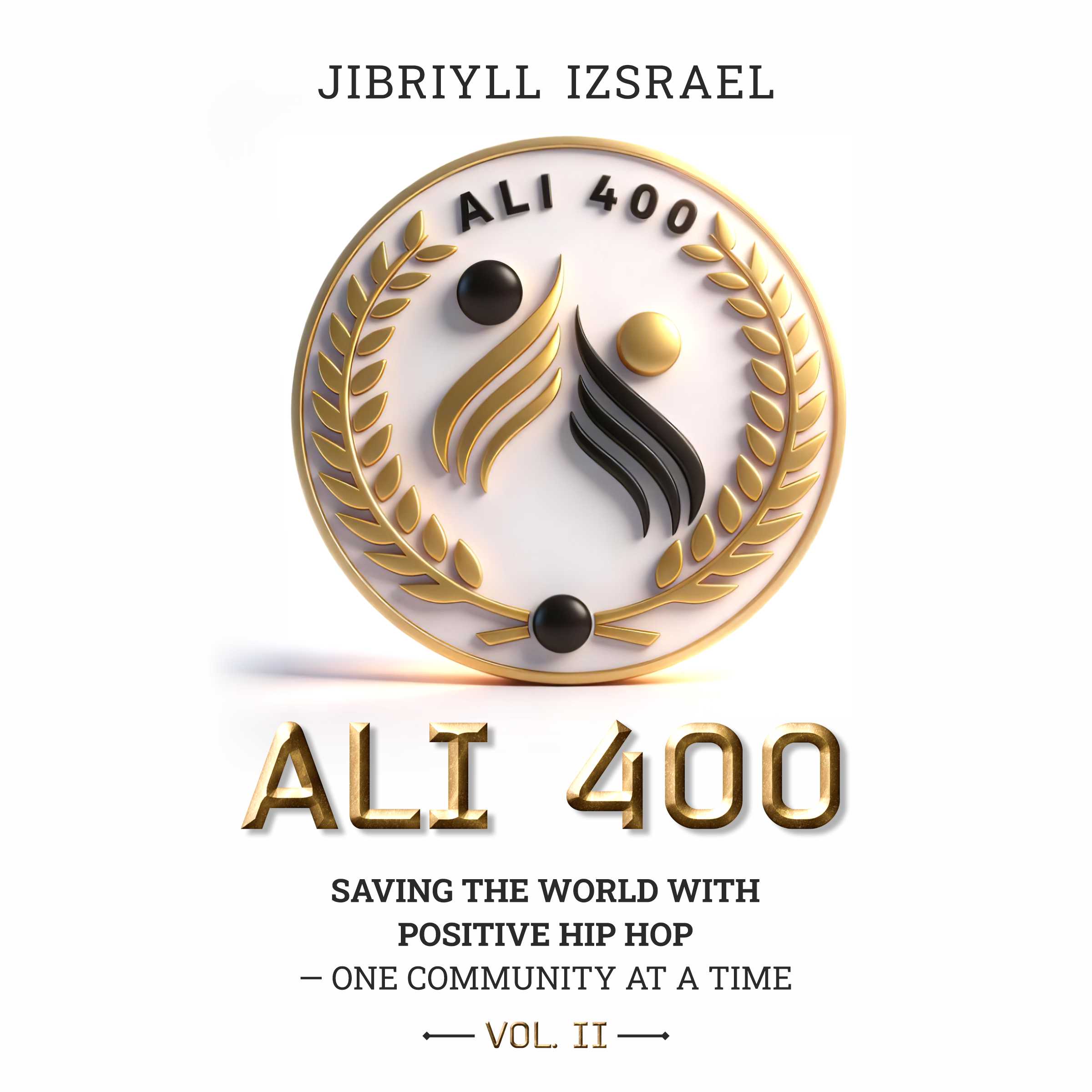
 By
By The Confederacy of Culture
ALI 400 — Chapter 10
ALI 400 is a global formation of four hundred and more positive cultural architects—
artists,
activists,
authors,
entrepreneurs,
educators,
motivators—
who walk in the legacy and likeness of Muhammad Ali:
disciplined,
fearless,
principled,
and unwilling to bow to injustice.
ALI 400 does not exist for applause.
It exists for consequence.
Each member functions as a catalyst for sociopolitical transformation—
not through slogans,
but through organized cultural power.
This is not a loose network of personalities.
It is a conglomerate of purpose:
many voices aligned under one vision,
many platforms coordinated toward one end.
Where conventional leadership fails,
culture governs.
Where systems speak down,
culture speaks with.
Where institutions move slowly,
culture moves at the speed of belief.
ALI 400 aims to become a conduit of preference—
a trusted channel through which youth and communities are drawn toward:
discipline,
literacy,
enterprise,
health,
and civic strength.
We do not compete with existing community efforts.
We connect them.
We do not replace local leadership.
We amplify it.
We do not drift from crisis to crisis.
We build structures that outlive moods.
This is the mission:
a confederacy of local cultural organizations forming a global architecture of art and activism.
The Hidden Unity Beneath Our Divisions
Few give serious thought to religion as a form of art—
or to religious organizations as activist institutions.
Yet once dogma is stripped away, the underlying structure becomes clear:
Collective rhythm.
Shared language.
Moral formation.
Community care.
Disciplined repetition.
All designed to shape the inner life of human beings.
Religion, at its best, is cultural infrastructure.
It teaches restraint.
It teaches responsibility.
It teaches continuity.
And in this era, something quietly significant is happening across the world:
People of differing traditions are finding common moral ground—
not by erasing difference,
but by recognizing shared ethical principles.
This matters not because it solves every conflict,
but because it proves a critical point:
Unity is possible without uniformity.
Yet the youth often remain outside this interfaith bridge—
not because they lack spiritual depth,
but because the language of many institutions does not meet them where they live.
A gap persists:
a communication barrier between inherited moral systems and the real-time culture shaping young minds.
This is where Hip-Hop becomes strategically relevant.
Hip-Hop as Cultural Conduit
Hip-Hop emerged from communities saturated with spiritual tradition, moral struggle, and survival discipline.
It carries that inheritance—
even when distorted,
even when commercialized—
because it is fundamentally a culture of testimony:
a people speaking from the ground,
recounting what life feels like,
searching for meaning under pressure.
Within Hip-Hop itself there exists a living current moving toward:
moral development,
community repair,
spiritual uplift.
Not as propaganda.
As practice.
Not as dogma.
As direction.
Hip-Hop Takes Advantage of Everything
One of Hip-Hop’s most revolutionary features is its origin story.
It was created by people without access, without permission, and without resources—
yet it produced a global language.
Hip-Hop is the art of turning limitation into leverage.
We grew up re-recording breakbeats on cassette tapes.
Building worlds from scraps.
We did not have studios.
We did not have budgets.
But we had imagination.
Hunger.
Rhythm.
Hip-Hop taught a generation a permanent principle:
If you do not have the tools—
you build them.
If you do not have the platform—
you create it.
If you do not have the system—
you become it.
Hip-Hop takes advantage of:
technology
the entrepreneurial instinct
culture and community
language and storytelling
difference and diversity
opportunity and improvisation
unity and coordination
spirituality and moral formation
dance and embodiment
prosperity and aspiration
fashion and identity
marketing and distribution
writing and literacy
This is not a list of hobbies.
These are instruments.
Hip-Hop is uniquely designed to translate life into communication that youth trust.
And learning cannot begin until communication becomes mutual.
Only when the teacher speaks a language the student can receive does transformation take root.
This is why Hip-Hop—when disciplined—has become a preferred conduit for redirecting life trajectories across the world.
It does not require permission.
It does not require perfect conditions.
It thrives in the very places institutions claim are too broken to reach.
From Expression to Construction
The world does not suffer from a shortage of opinions.
It suffers from a shortage of organized, coherent, sustained effort.
To change our cultural trajectory, we must become radically resourceful.
The human species must learn to reconcile ideological differences without erasing identity—
so that:
young and old,
rich and poor,
men and women,
liberal and conservative,
all spiritual traditions—
can coexist without domination.
Music cannot replace policy.
But it can mobilize the mind that makes policy possible.
Music cannot substitute institutions.
But it can generate the trust required to build them.
Positive Hip-Hop—aligned with literacy and organized activism—can reshape the world because it moves where bureaucracy cannot:
into the inner life,
into identity,
into desire,
into the stories that govern behavior long before law ever does.
Fuse cultural power with literary discipline.
Fuse art with coordinated civic action.
Fuse message with structure.
And there will be no place on Earth you cannot lead a people—
because you will not be leading them with force.
You will be leading them with clarity.
With language.
With meaning.
With a future they can finally see.
Support the Work
If this chapter resonated with you, consider supporting the African American Union.
Your support helps expand education, economic cooperation, and cultural development within our community.• Become a member
• Support the Union store
• Share this chapter
• Make a contribution
All net proceeds from the Sovereign Trilogy are dedicated to helping seed the African American Sovereign Wealth Fund, an initiative of the African American Union designed to strengthen economic cooperation and institution-building for future generations.
By supporting this work, readers help transform ideas into lasting infrastructure for our community.