
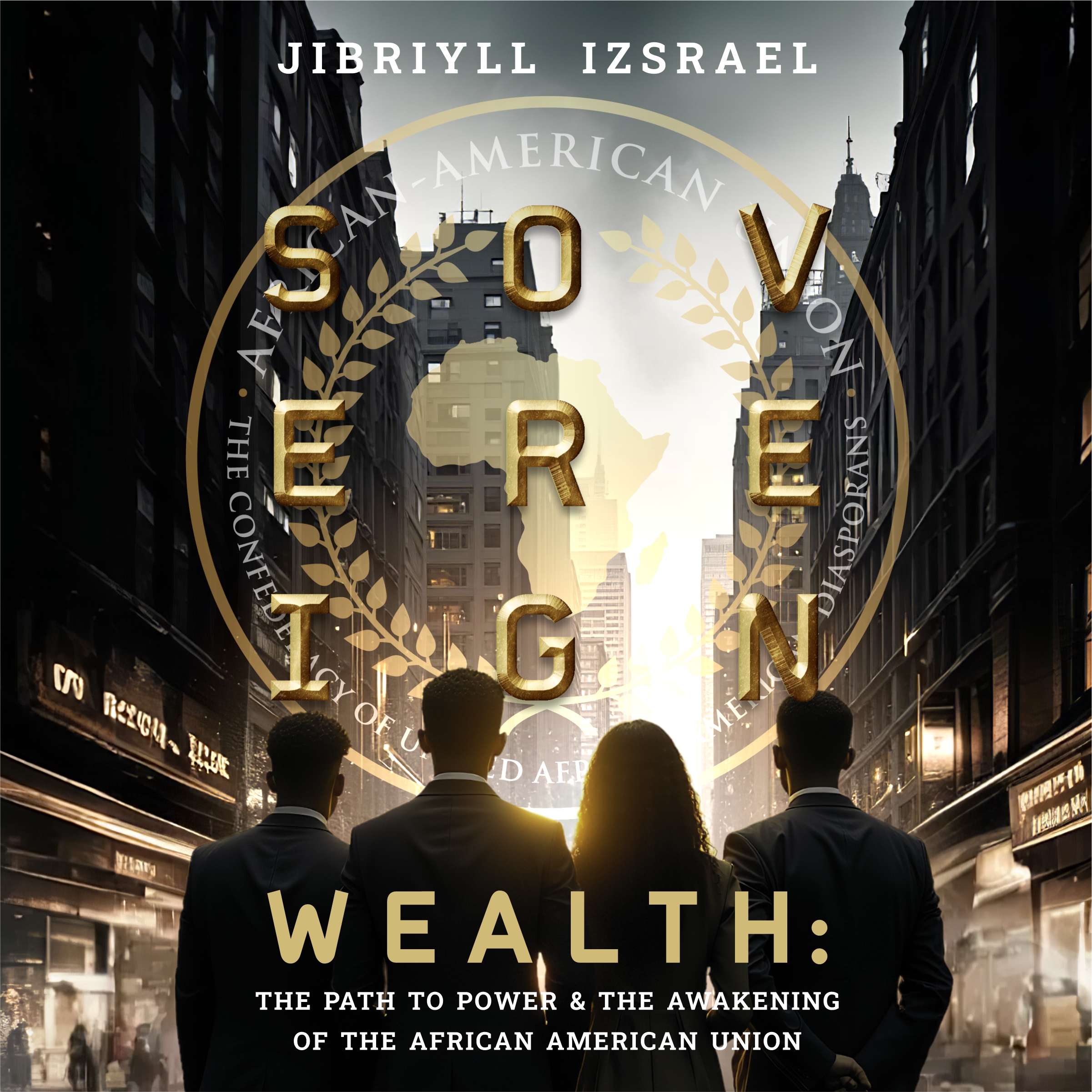
Sovereign Wealth: The Path to Power and the Awakening of the African American Union-Chapter 10
-
 By Jibiryll Izsrael
- 2026-03-22
Claim the Land—African American Economic Zones of Power
Soveroegin Wealth-Chapter 10
Chapter 10 explores the formation of African American Economic Empowerment Zones, illustrating how land stewardship, enterprise clustering, and capital federation convert geography into structured power.
Revolutions are not funded by slogans.
They are bankrolled by infrastructure—
by land,
by capital,
by ownership,
and by systems built to last.
Chanting for freedom means little if we cannot sustain it.
Marching for justice rings hollow if we must ask our oppressors to fund our progress.
We cannot demand freedom without financial firepower.
We cannot protect culture without economic control.
And we cannot build the African American Union on rented land and borrowed capital.
True liberation requires sovereignty at every level—and that includes economic sovereignty.
We must move beyond symbolic gestures and into strategic investment.
This calls for the development of African American Economic Empowerment Zones—self-sustaining, self-governed, economically fortified territories where our wealth becomes an instrument of liberation.
These zones must be more than business hubs.
They must become cultural sanctuaries.
They must serve as ecosystems of innovation.
They must become economic engines designed to inspire a robust entrepreneurial spirit within our people and a deep sense of pride in our future.
They must be zones where we circulate our dollars, educate our youth, protect our assets, and anchor our progress.
Zones where we no longer seek inclusion.
Zones where we no longer lobby for preference.
Zones where we are the priority.
For the African American Union, economic power is not a luxury.
It is a fundamental imperative.
It is the core of every lasting society.
And it is how we will ensure that the African American Union is not merely a dream, but a durable, generational reality.
What Is an African American Economic Empowerment Zone?
An African American Economic Empowerment Zone is not merely a neighborhood where most of the residents are African American.
It is not simply a business district with soul food spots, barbershops, and good music.
While culture matters, this is about infrastructure, ownership, power, and strategy.
An African American Economic Empowerment Zone is a deliberately designed territory where our economic interests are not only prioritized, but accelerated and directed by the community itself.
It is a place where African American dollars remain in African American hands—circulating multiple times before ever leaving the zone.
It is a place where African American-owned banks provide capital to fuel African American-owned businesses without the discriminatory barriers of mainstream institutions.
It is a place where real estate, industry, media, and agriculture are not merely operated by African American people, but owned by African American families, cooperatives, and institutions accountable to our community.
It is a zone where our children grow up witnessing African American economic excellence—not scarcity.
Where they see wealth creation as normal, entrepreneurship as expected, and self-reliance as non-negotiable.
They do not merely learn it in theory.
They live it.
African American Economic Empowerment Zones are 21st-century freedom forts—protected, productive, and rooted in the belief that liberation without economics is incomplete.
These zones are not about exclusion.
They are about insulation.
Insulation from exploitation.
Insulation from erasure.
Insulation from dependency.
This is how we secure the future—not through slogans, but through systems that economically empower our people as a Union.
Why We Need Them Now
The numbers speak for themselves, and the truth is sobering.
The typical African American dollar leaves our community in a matter of hours.
That means that by the time the sun sets, much of the money we have earned—our economic power—has already left our communities and is enriching someone else.
African American buying power is massive, yet African American ownership remains disproportionately small.
Most African American neighborhoods function as financial colonies.
We spend heavily, but own very little.
The profits flow out while the poverty remains.
Gentrification is not merely displacement.
It is economic warfare.
It strips us of land, community, and power—replacing cultural legacy with outside commercial gain.
Without zones of control, we will continue to generate wealth that builds empires for everyone but ourselves.
That is why we need African American Economic Empowerment Zones now—not later.
We must draw new lines.
Not merely physical borders, but economic boundaries with a purpose:
to protect,
to circulate,
and to multiply African American wealth on our own terms.
The Blueprint for African American Economic Empowerment Zones
1. Secure and Control the Land
Land is the launchpad.
Without it, there is no foundation, no sovereignty, and no lasting infrastructure.
We cannot build an empowerment zone on land we do not own.
We must launch land-acquisition cooperatives—pooling community resources to buy back blocks, buildings, lots, and landmarks.
Ownership must be shared, protected, and guided by collective vision.
We must target areas with historical significance or strategic value—places where African American legacy runs deep or where untapped opportunity exists.
This is not merely about where we live.
It is about where we lead.
To guard against displacement, we must develop community land trusts—legal structures that lock land into community control and help keep it affordable for generations to come.
This ensures that once we reclaim it, it stays ours.
We must also prioritize multi-use spaces.
Neighborhoods must not be merely residential.
They must be living ecosystems.
Housing, retail, education, agriculture, wellness, and culture must coexist in one place.
A zone is not just land.
It is life.
Own the ground, and you own the future.
2. Build a Backbone of African American Financial Institutions
You cannot control your economy without controlling your banks.
Ownership without capital flow is a hollow victory.
If we want true economic sovereignty, we must build the financial backbone that sustains it—institutions rooted in trust, built by us, and accountable to our communities.
We need to establish African American-owned:
-
credit unions
-
fintech platforms
-
investment funds
-
lending circles
-
and community capital vehicles
Sovereign Wealth mechanisms must be developed and deployed to finance long-term development projects, infrastructure, and innovation within our zones.
These funds can pool resources from across the African diaspora and redirect them into strategic initiatives that build real value—not mere consumption.
Every family should be encouraged to bank Black and invest locally.
This is not merely an act of solidarity.
It is a strategy for survival.
Redirecting our dollars into our own institutions is how we build leverage, resilience, and independence.
We must also revive and modernize rotating capital circles—traditional susus, tandas, and peer-to-peer lending systems rooted in trust, transparency, and community accountability.
These models have supported African-descended communities for generations.
It is time to scale them.
Finance must be internalized.
No more begging for loans.
No more waiting for approval.
We fund ourselves because we believe in ourselves—and because we possess the power to do so.
3. Create Dense Networks of African American Businesses
A zone is only as strong as the enterprises it supports.
Business is the lifeblood of any economy, and without a dense, interwoven network of African American-owned businesses, an empowerment zone becomes little more than a concept.
The goal is not merely to have businesses present.
The goal is to have them thriving, connected, and reinforcing one another.
We must build clusters of interdependent African American-owned businesses—not scattered or isolated, but intentionally linked.
Grocers sourcing from African American farmers.
Contractors building African American-owned developments.
African American media amplifying African American educators and healthcare providers.
When businesses work together, communities rise together.
To sustain them, we must provide tangible support:
-
tax incentives
-
rent relief or cooperative lease structures
-
grant programs
-
capital access
-
and cooperative ownership models
Access to capital must not remain a barrier.
Support systems must be built into the very structure of the zone.
We also need African American startup incubators and tech hubs inside these zones.
Innovation should emerge from within the community, solving real problems with real resources.
From fintech to food science, technology must serve the village.
To maximize impact, we must connect local supply chains.
From producer to consumer, from service to service, money must flow in circles—not in pipelines that lead outward.
The goal is repeated economic circulation before a dollar leaves the zone.
That is how wealth is retained.
That is how legacy is built.
A single business is good.
A connected business ecosystem is revolutionary.
4. Build Institutions, Not Just Businesses
Businesses come and go.
They open, they close, they pivot.
But institutions shape generations.
They preserve memory.
They instill identity.
They create infrastructure that outlives individuals.
If we want our economic zones to be more than short-term success stories, we must root them in long-term institutional power.
We begin by establishing:
-
charter schools
-
trade academies
-
Pan-African curriculum centers
-
financial literacy institutes
-
and leadership training programs
These institutions must teach more than job readiness.
They must teach sovereignty.
They must fuse academic excellence with cultural clarity—preparing students not merely to compete, but to innovate, lead, build, and remember.
We must also build media centers and production studios to produce our own news, films, documentaries, and digital content.
Whoever controls the narrative influences the culture.
And whoever controls the culture shapes behavior.
We must create think tanks, legal clinics, and security training centers that defend the zone intellectually, legally, and structurally.
These institutions serve as guardians of the zone’s autonomy.
And we must fund our own museums, historical archives, and cultural libraries to preserve our stories, our genius, and our truth.
These are not merely spaces for reflection.
They are sources of pride, research, memory, and resistance.
Economics plus culture equals nationhood.
It is not enough to make money.
We must also make meaning.
That is the power of institutions.
5. Embed Defense, Policy, and Governance
Every economic zone must be more than a marketplace.
It must be a protected, governed, and self-sustaining territory.
Prosperity without protection is vulnerability.
Ownership without policy is chaos.
To build lasting zones of freedom, we must anchor them in structure.
We begin by establishing community-accountable security and safety systems that are trained, disciplined, and answerable to the people—not exploitative outside forces.
Their role is to de-escalate conflict, defend the zone, and help maintain safety with integrity.
We must also train our youth in:
-
civic leadership
-
public policy
-
local governance
-
budgeting
-
negotiation
-
and lawmaking
A liberated economy must be matched by a pipeline of liberated leaders.
We should form economic development councils made up of residents—not outsiders or political appointees.
The people who live, work, and build in the zone should guide its policies, priorities, and partnerships.
And we must write community constitutions—living documents that outline the zone’s values, codes of conduct, dispute-resolution systems, and long-term plans.
Governance does not need to mirror the state.
It needs to reflect the people.
Freedom must be designed—not merely desired.
Examples of the Vision
These are not mere ideas.
They are prototypes for the future.
“Ujamaa Towns”
Small, self-sustaining towns built on cooperative economics and African principles.
Inspired by the vision of collective development, these towns would integrate housing, education, farming, healing, and governance—each rooted in unity, shared ownership, and cultural pride.
“Freedom Markets”
Weekly commerce zones where farmers, artists, healers, and merchants come together to sell, trade, and network.
These markets serve as both economic hubs and cultural centers—generating consistent revenue while strengthening trust, visibility, and collaboration.
“The New Black Wall Street District”
A designated multi-block district in every major U.S. city where everything—from schools and tech labs to bookstores and cafés—is African American-built, African American-funded, and African American-owned.
These zones would serve as living monuments to our capacity—not merely our history, but our present and future ability to build, lead, and thrive.
We do not need permission to begin.
We need precision.
We need planning.
We need power.
What Happens When the Zones Multiply
One zone becomes two.
Two become twenty.
Twenty become a continental grid of African American power centers—each one self-sustaining, strategically connected, and increasingly sovereign in function.
And suddenly, the game changes.
We set our own prices—rooted in value, not exploitation.
We fund our own media—shaping the narrative instead of reacting to it.
We feed our own people—through farms, grocers, and distribution networks built on trust.
We finance our own liberation—not through charity, but through cooperative wealth, shared investment, and intentional ownership.
These zones are more than economic projects.
They are launchpads for a new era.
An era where power is not begged for, but built.
Where influence is not borrowed, but owned.
Where African American identity is no longer framed only by struggle, but defined by sovereignty.
This is how the African American Union becomes real—not as a declaration alone, but as a lived reality of commerce, territory, and legacy.
Freedom looks like land.
Power looks like infrastructure.
Liberation looks like us—
multiplied, fortified, and unstoppable.
The Call to Action: Build or Be Bought
We can keep reacting, or we can start architecting a future that serves us.
The choice is clear.
And the time is now.
We must:
-
fund land purchases and establish autonomous development zones
-
move with urgency as a people who understand the stakes
-
teach our children that African American freedom is not a trending slogan, but an intergenerational economic responsibility
-
build systems of self-determination rather than renting our future from hostile structures
This is bigger than capitalism.
This is about sovereignty.
About self-determination.
About refusing to rent our future from systems that were never built for us.
Build the zones.
Control the commerce.
Ignite the Union.
Support the Work
If this chapter resonated with you, consider supporting the African American Union.
Your support helps expand education, economic cooperation, and cultural development within our community.• Become a member
• Support the Union store
• Share this chapter
• Make a contribution
All net proceeds from the Sovereign Trilogy are dedicated to helping seed the African American Sovereign Wealth Fund, an initiative of the African American Union designed to strengthen economic cooperation and institution-building for future generations.
By supporting this work, readers help transform ideas into lasting infrastructure for our community.