
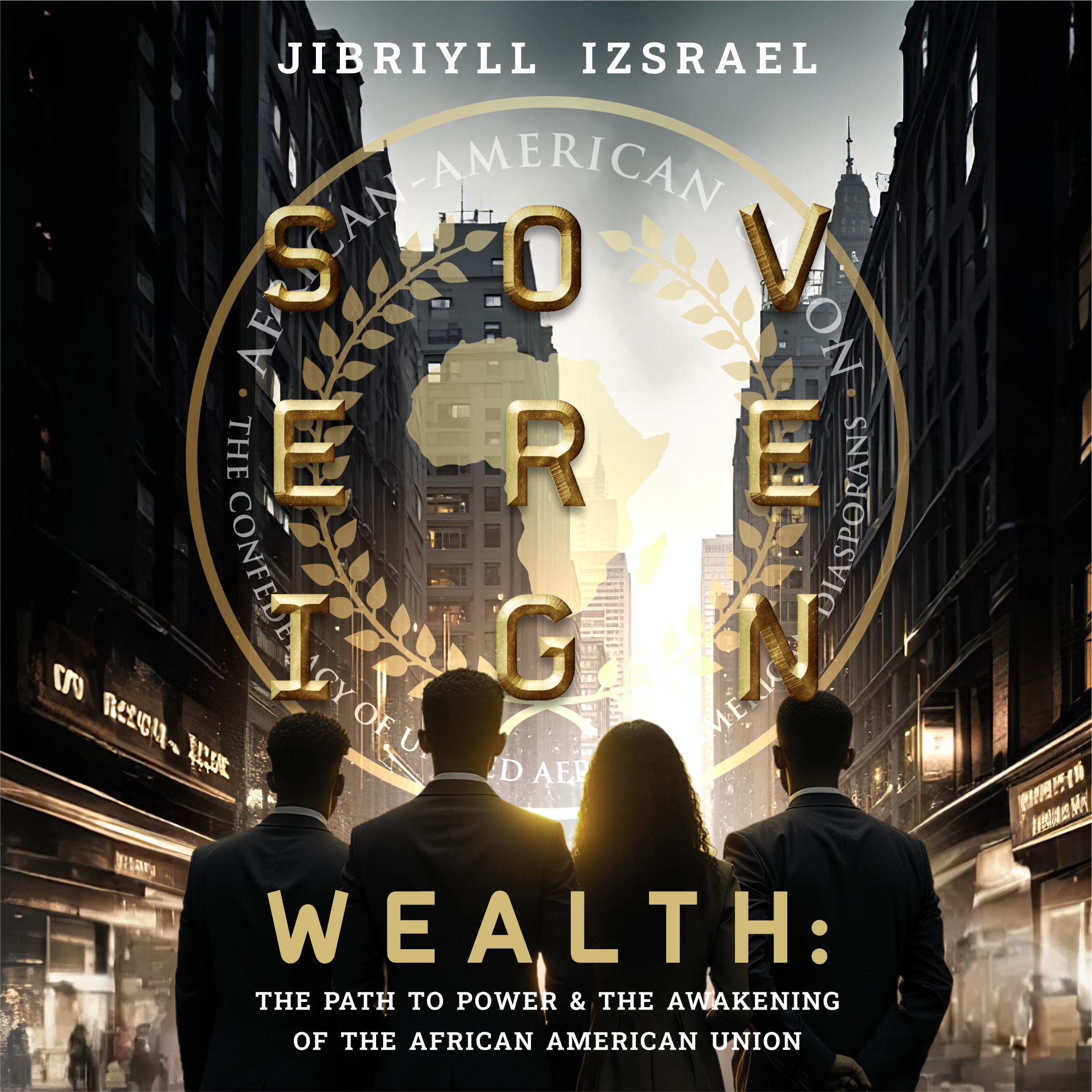
Sovereign Wealth: The Path to Power and the Awakening of the African American Union-Chapter 9
-
 By Jibriyll Izsrael
- 2026-03-21
Rebuild the House—The Rebirth of the African American Family
Sovereign Wealth-Chapter 9
Chapter 9 restores the centrality of the family as the primary institution of sovereignty, demonstrating how disciplined households, economic cooperation, and intergenerational continuity form the living structure upon which collective power is sustained.
Before the ships, we were whole.
Before the whips, we were kingdoms.
Before the chains, we were legacies in motion—passed through generations of mothers, fathers, elders, and children who understood the sacredness of the unit.
Family was not just structure.
It was spirit.
It was the foundation of society, identity, and survival.
But colonization did not just take bodies.
It stole bonds.
It split bloodlines.
It severed roots.
It turned lovers into laborers, parents into property, and families into fractured memory.
The violence was not only physical.
It was emotional, cultural, and spiritual—designed to unravel everything that made us human, connected, and whole.
And yet, still we rise.
Still breathing.
Still building.
Still remembering who we are.
But in order to rise as the African American Union, we must do more than survive.
We must reconstruct what was stolen.
We must rebuild the family.
We must restore the lineage.
We must reclaim the unity that held us together long before the world tried to tear us apart.
This is not only about reshaping the future.
It is about reviving the brilliance of what we once were—and becoming even more.
The Family Was Our First Institution
Before we had schools,
we had parents.
Before governments,
we had judges and elders.
Before organized religion,
we had ancestors in the town square, guiding us through story, ritual, and prayer.
Family was never merely biology.
It was the first classroom,
the first council,
the first place where spirit and structure met.
The family is where culture is passed down.
Where tradition is preserved.
Where identity is affirmed.
And where trauma is either healed—or passed on.
When you destroy the family, you do not merely break homes.
You destabilize a people.
You interrupt the transmission of wisdom, disrupt the development of self-worth, and weaken the bonds that hold communities together.
But when you restore the family—in all its forms, across generations, rooted in love and accountability—you do not merely heal individuals.
You heal the nation.
Because every movement begins at the dinner table, and every revolution starts within the home.
What Broke Us—And How We Heal
1. Slavery and Systemic Separation
The breaking did not begin with poverty or crime.
It began with slavery—a system built on separation, control, and psychological warfare.
Fathers were sold away, ripped from their children’s arms.
Mothers were brutalized, forced to nurture the children of their oppressors while mourning their own.
Children were raised by strangers under the constant threat of violence, denied the safety and love that should have shaped their earliest years.
This was not merely physical abuse.
It was deep, intentional psychological reprogramming—designed to unravel our sense of family, identity, and connection.
And it did not stop in 1865.
Welfare systems were structured in ways that punished two-parent African American households, making stability a financial risk.
Mass incarceration removed African American men from their communities by the millions, leaving generations of children to grow up without fathers.
Economic stress—driven by exclusion and exploitation—placed relentless pressure on our homes, forcing survival to take precedence over bonding.
This was not accidental.
It was engineered.
And yet we have been fighting to protect and rebuild our families ever since—through love, resilience, and unrelenting resistance.
Healing begins with truth.
And the truth is this:
Our families were attacked because they were powerful.
Which means that when we restore them, we restore our power.
2. Cultural Attack and Role Confusion
The attack on the African American family did not end with physical separation.
It evolved into a cultural war designed to confuse, distort, and divide.
African American masculinity was criminalized or erased.
African American boys were labeled threats before they could grow into men—their strength feared instead of nurtured. Fathers were cast as absent by default, even when fighting every day to remain present against impossible odds.
African American femininity was oversexualized and shamed.
African American women were either hypervisible and exploited, or invisible and denied softness, rest, and respect. They were told they had to be everything to everyone—or nothing at all.
African American children were pathologized before they could even read—labeled as problems, medicated into silence, and trapped in systems of so-called rehabilitation that often harmed more than they healed.
We have been fed lies for generations:
-
that our love is violent
-
that our fathers always disappear
-
that our women do not need men and are better off alone
Lies.
All of them.
The truth is that together, we are powerful beyond comprehension—when not distorted by design, when not filtered through stereotypes, colonial frameworks, or unhealed trauma.
Healing means reclaiming our image.
Rewriting our roles.
Remembering that unity is our natural state—not division.
Blueprint for the Rebirth of the African American Family
1. Restore African American Love as a Revolutionary Act of Liberation
African American love is not merely romance.
It is one of the most powerful forms of resistance available to us.
It is among the most radical things we can reclaim in a world that has tried to tear us apart at every level.
When two African American people come together in love, unity, and purpose, they defy centuries-old systems designed to divide and conquer them.
We must place African American love at the forefront of our lives—not as fantasy, but as foundation.
That means:
-
having honest conversations about healing inherited trauma
-
intentionally forming strong unions
-
and passing down generational wealth, stability, and vision
We must move beyond survival-based relationships and build purpose-driven family units.
We need cultural campaigns that uplift African American marriage, lifelong commitment, and co-parenting rooted in mutual respect.
Our media, schools, and institutions must show what healthy African American love looks like—because what we see, we begin to believe, and what we believe, we often recreate.
Therapy and counseling must become normal—not merely crisis responses, but investments in growth, longevity, and relational strength.
Love, like any powerful thing, requires maintenance, reflection, honesty, and accountability.
And most importantly, African American men and women must remember:
We are not enemies.
We are a lineage.
We are protectors of legacy.
When we align in love and vision, we become unshakeable.
Love is not weakness.
Love is not softness without strength.
Love is what fuels revolutions.
2. Empower Fathers, Honor Mothers
Fatherhood is power.
Motherhood is strategy.
Together, they are sacred.
Rebuilding the African American family means restoring the honor and support both roles deserve—not in theory, but in practice.
We must uplift and celebrate African American fathers publicly and consistently—not just one day a year, but year-round.
Too often, African American fatherhood is discussed only in terms of absence.
It is time to flood the narrative with the visibility of fathers who are present, nurturing, protecting, teaching, and leading.
Visibility affirms value.
Value confirms worth.
We also need mentorship programs that connect young African American boys with strong, principled African American male role models.
Boys do not just need discipline.
They need direction.
They need men who model integrity, emotional intelligence, and purpose.
These programs are not luxuries.
They are lifelines.
At the same time, we must support African American mothers with the infrastructure long denied to them:
-
reliable childcare networks
-
doula services
-
community-based care
-
maternal health support
-
and rest
Yes—rest.
A rested mother is a revolution in motion.
She must be protected and honored.
No longer should African American women be expected to do everything alone.
They deserve husbands, partners, families, and institutions that honor their labor and support their flourishing.
We must also fund and protect African American birth work:
-
midwifery
-
womb healing
-
reproductive justice
-
and maternal care led by and for African American women
African American birth is sacred.
And it must be treated as such.
Because the children born into our communities are not just babies.
They are the next chapters in our fight for freedom.
3. Family Wealth and Legacy Building
Freedom begins at the dinner table—in the conversations we have, the lessons we share, and the values we pass down.
But it must also extend to the bank account.
True sovereignty includes economic power.
And economic power begins at home.
Every African American household should be equipped with the tools of financial continuity:
-
estate planning
-
life insurance
-
wills
-
trusts
-
and long-term saving and investment habits
These are not merely documents.
They are declarations of intention.
They ensure that what we build does not die with us, but continues to strengthen the next generation.
We must also launch family investment clubs.
Pooling money to invest in stocks, land, businesses, and community assets is not merely strategic.
It is necessary.
We need to pass down more than heirlooms.
We must pass down:
-
businesses
-
land deeds
-
rental properties
-
financial literacy
-
and institutional vision
Pass down the blueprint—not just the burden.
This requires planning, structure, and consistent conversations about money, purpose, and legacy.
“Generational wealth” must become more than a slogan.
It must become a mandate.
This is not about individual riches.
It is about collective continuity.
We are not starting from scratch.
We are picking up where our grandparents left off—and building forward with clarity, unity, and purpose.
4. Cultural Family Traditions and Rites of Passage
Give our youth roots—not just rules.
In a world that constantly pulls them in every direction, we must anchor them with a clear sense of identity, purpose, and belonging.
Culture is not mere celebration.
It is structure.
It is guidance.
It is protection.
We must restore rites of passage that guide young people into adulthood with clarity about who they are, what they value, and why they matter.
These rites should speak to:
-
manhood and womanhood
-
emotional maturity
-
spiritual awareness
-
and communal responsibility
We should celebrate family milestones with honor and sacredness.
Naming ceremonies, elder honors, birthdays, cultural holidays, and family gatherings can all become opportunities to reinforce identity and purpose.
We must also create and preserve family trees with seriousness and devotion.
They should be documented, digitized, and passed down.
No child should grow up disconnected from lineage.
Knowing where you come from is one of the strongest protections against identity loss and generational amnesia.
As the proverb teaches:
A people who do not know from whence they came can never truly know where they are going.
And in our homes, we must make space for reverence—spaces where we honor the Creator, pray, remember, reflect, and protect the sanctity of the household.
This is not superstition.
It is remembrance.
It is structure.
It is nationhood at the cellular level—the kind that begins with family and multiplies into legacy.
5. Rebuild the African Village
In Africa, we were taught that it takes a village to raise a child.
The family is not merely mother, father, and child.
It is the wider web of care, wisdom, and accountability that holds generations together.
The village was never a metaphor.
It was real.
It was functional.
It was necessary.
“It takes a village” is not a slogan.
It is a survival strategy.
It is how our ancestors raised children, protected the vulnerable, and passed on cultural wisdom.
When the immediate family is stretched thin, the village steps in.
When the system fails, the village closes the gap.
Rebuilding the village means constructing multigenerational homes where elders are no longer isolated, but honored as sources of knowledge, grounding, and continuity.
It means developing cooperative child-rearing networks where no parent struggles alone.
It means elder care circles—safe, loving systems that preserve the dignity of those who paved the way for our greatness.
We must teach and live by communal responsibility:
Your child is my child.
Your elder is our elder.
Your burden concerns me.
Your future concerns us all.
This mindset builds accountability, safety, and belonging—the very foundation of nationhood.
And we must invest in physical spaces that reflect these values:
-
family-centered libraries
-
gardens that nourish body and spirit
-
health centers grounded in African American wellness
-
cultural schools rooted in heritage
-
and gathering spaces that strengthen communal life
The African American Union is more than a vision.
It is a mega-village—interconnected, intergenerational, and intentionally built for longevity.
For the Union to truly rise, the village must rise again.
Family Is the First Freedom School
The family is where the revolution begins—not in speeches or protests, but in the way we raise our children, love one another, and pass down truth across generations.
Before any school, any movement, or any house of worship, the home is the first classroom.
Raise children who know who they are.
Who understand their lineage, their purpose, and their worth.
Raise children who see their parents’ love paving the way before them—with tenderness, loyalty, and intention.
Raise children who are taught the value of wealth, the honor of discipline, and the pursuit of wisdom—not as distant ideals, but as daily practices.
Raise children who walk into the world already whole—not searching for identity, but walking in it.
When the family is fortified, the movement becomes harder to break.
When love and structure exist side by side at home, communities become stronger.
And once this becomes reality, the African American Union will have secured its most important institution—not merely in theory, but in households, in habits, and in truth.
Because for African Americans, one of the greatest revolutions possible is the raising of a generation of families whose minds can never again be stolen.
Support the Work
If this chapter resonated with you, consider supporting the African American Union.
Your support helps expand education, economic cooperation, and cultural development within our community.• Become a member
• Support the Union store
• Share this chapter
• Make a contribution
All net proceeds from the Sovereign Trilogy are dedicated to helping seed the African American Sovereign Wealth Fund, an initiative of the African American Union designed to strengthen economic cooperation and institution-building for future generations.
By supporting this work, readers help transform ideas into lasting infrastructure for our community.