
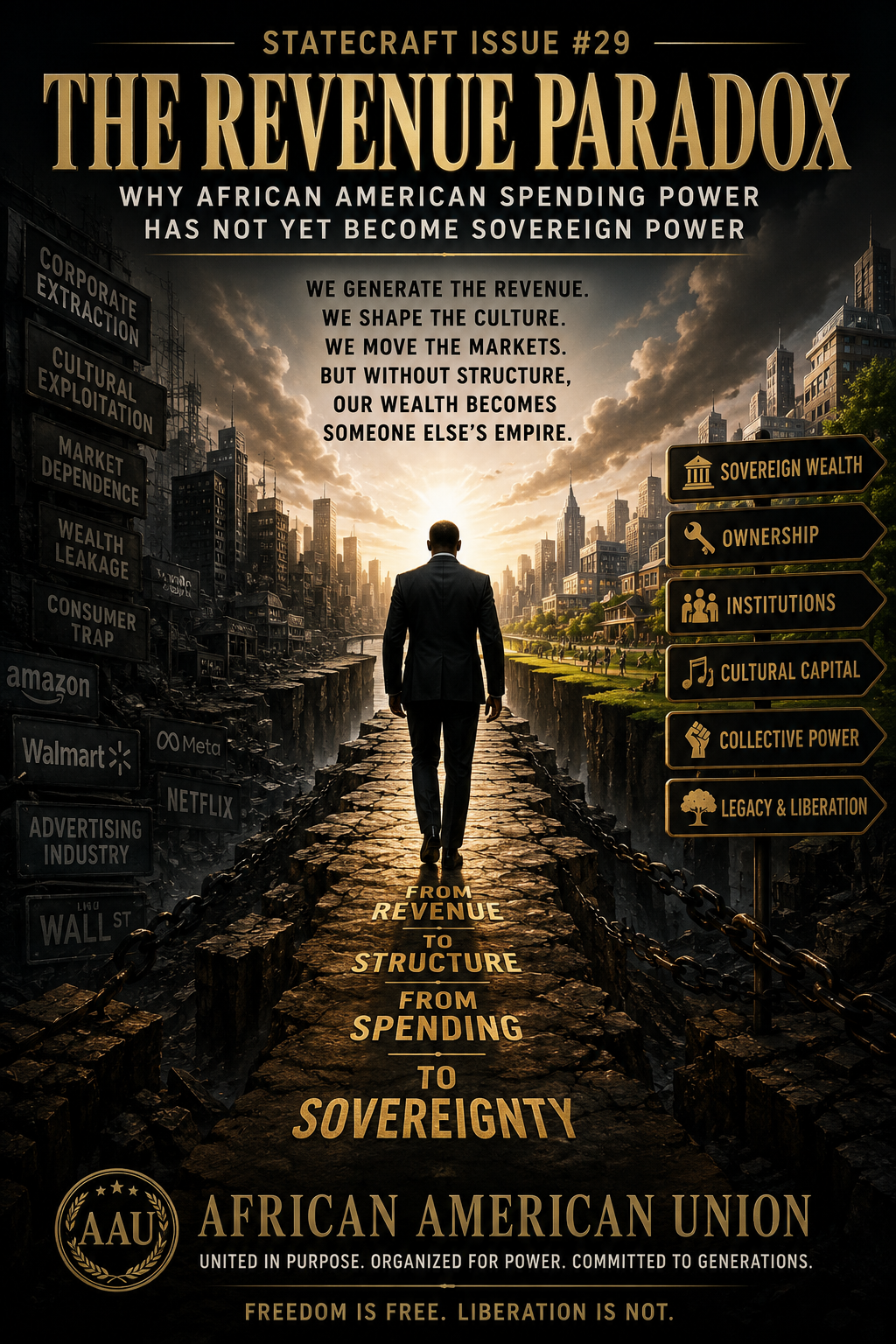
Statecraft: The Strategic Journal of the African American Union Issue No. 29—The Revenue Paradox
-
 By Jibriyll Izsrael
- 2026-05-12
THE REVENUE PARADOX
Why African American Spending Power Has Not Yet Become Sovereign Power
We generate the revenue.
We shape the culture.
We move the markets.
But without structure, our wealth becomes someone else’s empire.
Statecraft: The Strategic Journal of the African American Union
Freedom is free. Liberation is not.
OPENING DECLARATION
African Americans are not poor because we lack value.
We are not powerless because we lack genius.
We are not underdeveloped because we lack talent, creativity, labor, intelligence, faith, discipline, sacrifice, or cultural force.
The evidence is everywhere.
We build industries.
We define music.
We shape fashion.
We drive entertainment.
We influence politics.
We move consumer markets.
We produce athletes, artists, scholars, entrepreneurs, ministers, organizers, designers, inventors, educators, and cultural architects.
We generate attention.
We generate labor.
We generate revenue.
We generate meaning.
And yet the central contradiction remains:
We generate enormous economic power, but too little of it becomes organized institutional power.
This is the Revenue Paradox.
A people can spend billions and still lack capital.
A people can shape markets and still lack ownership.
A people can create culture and still lack infrastructure.
A people can build wealth for others and still remain undercapitalized themselves.
A people can be economically valuable to the world and still be institutionally vulnerable inside it.
That is the paradox.
And until we solve it, representation will remain incomplete.
Celebrity will remain insufficient.
Visibility will remain fragile.
And culture will remain exposed to extraction.
This is why Sovereign Wealth had to be written.
This is why the African American Union must be built.
I. THE PARADOX DEFINED
A paradox is not a simple contradiction.
It is a condition where two realities appear to exist at the same time, but one of them exposes the failure of the system underneath.
Here is ours:
African Americans are one of the most culturally influential and economically active populations in the world.
Yet our communities often remain institutionally undercapitalized.
We buy.
We spend.
We create.
We work.
We vote.
We entertain.
We inspire.
We produce.
We consume.
But the systems that convert all of that activity into durable power are rarely owned, governed, or coordinated by us.
That is the paradox.
The issue is not that no Black people succeed.
Many do.
The issue is that individual success does not automatically become collective infrastructure.
A millionaire does not equal a treasury.
A celebrity does not equal a media institution.
A business owner does not equal an economic system.
A voter bloc does not equal sovereign governance.
A viral moment does not equal organized capacity.
A talented people do not become powerful simply because the world profits from their talent.
Power requires structure.
II. THE DIFFERENCE BETWEEN MONEY AND POWER
Money and power are related.
But they are not the same.
Money can be spent.
Power can command.
Money can purchase.
Power can negotiate.
Money can decorate.
Power can build.
Money can impress.
Power can protect.
Money can move through a community and leave no institution behind.
Power remains when the transaction ends.
This is why the Revenue Paradox is so dangerous.
A people can have visible money and still lack strategic power.
A people can have luxury consumption and still lack land.
A people can have expensive fashion and still lack manufacturing.
A people can have streaming influence and still lack media ownership.
A people can have political enthusiasm and still lack legal infrastructure.
A people can have churches, brands, nonprofits, podcasts, shops, artists, and influencers, yet still lack one coordinated system capable of converting all that activity into collective leverage.
This is the difference between economic motion and economic architecture.
Motion means activity.
Architecture means design.
Motion creates movement.
Architecture creates power.
III. THE LEAKAGE PROBLEM
The first layer of the Revenue Paradox is leakage.
Wealth enters the community, but does not remain long enough to become institutional.
It passes through us.
It moves from paycheck to bills.
From bills to corporations.
From corporations to shareholders.
From culture to platforms.
From attention to advertisers.
From labor to employers.
From consumption to external ownership.
From pain to entertainment.
From identity to branding.
From loyalty to someone else’s market share.
This is leakage.
Not because African Americans are irresponsible by nature.
That is a shallow insult.
The deeper truth is that most people spend inside systems already built for them by others.
If the grocery chains, banks, platforms, factories, insurers, media companies, payment processors, schools, publishers, streaming services, logistics networks, and investment vehicles are externally owned, then even disciplined spending will often exit the community.
The problem is not only behavior.
The problem is architecture.
A people cannot retain wealth through motivation alone.
They need channels.
They need institutions.
They need ownership.
They need coordinated economic pathways.
They need places where their money can go and still remain connected to collective development.
Without that, revenue becomes movement without memory.
It comes.
It goes.
And nothing permanent is built.
IV. CULTURE WITHOUT CAPTURE
African American culture is among the most powerful economic engines on earth.
Our language travels.
Our music travels.
Our style travels.
Our rhythm travels.
Our struggle travels.
Our humor travels.
Our pain travels.
Our spirituality travels.
Our rebellion travels.
Our beauty travels.
Our creativity travels.
Our identity travels.
But the question is not whether our culture travels.
The question is:
Who captures the value once it moves?
This is the second layer of the Revenue Paradox.
We create cultural value at world-historical scale, but often lack the institutional machinery to capture that value for collective development.
The sound is ours.
The catalog may not be.
The trend is ours.
The manufacturing may not be.
The audience is ours.
The platform may not be.
The image is ours.
The licensing may not be.
The loyalty is ours.
The marketplace may not be.
The story is ours.
The publishing may not be.
The data is ours.
The monetization may not be.
This is not merely exploitation.
It is misalignment.
Culture flows outward.
Capital does not return inward.
That is the wound.
That is the paradox.
And that is why culture alone cannot save us.
Culture must be converted into capital.
Capital must be converted into institutions.
Institutions must be converted into sovereignty.
V. THE ISOLATED TITAN PROBLEM
The third layer of the Revenue Paradox is the Isolated Titan Problem.
Every generation produces extraordinary individuals.
The brilliant artist.
The wealthy athlete.
The visionary entrepreneur.
The influential pastor.
The powerful organizer.
The genius scholar.
The high-earning professional.
The charismatic speaker.
The celebrity founder.
The local builder.
The problem is not that these titans exist.
The problem is that they often remain isolated.
Each titan builds a personal platform.
Each titan fights a private war.
Each titan carries a piece of the burden.
Each titan develops a brand, an audience, a company, a nonprofit, a ministry, or a following.
But without a shared institutional container, their power rarely consolidates.
The result is fragmentation.
One person has capital.
Another has audience.
Another has land.
Another has doctrine.
Another has media skill.
Another has legal expertise.
Another has political access.
Another has business experience.
Another has educational capacity.
Another has cultural influence.
But no unified structure gathers these capacities into one strategic body.
This is why individual excellence does not automatically become collective power.
The titan rises.
The people applaud.
The institution remains unbuilt.
That is the paradox.
VI. THE MARKET WITHOUT A TREASURY
African Americans are often described as a market.
A consumer segment.
A demographic.
A voting bloc.
An audience.
A cultural force.
A trend engine.
But a market is not the same as a treasury.
A market is something others sell to.
A treasury is something a people governs.
A market can be targeted.
A treasury can invest.
A market can be studied.
A treasury can build.
A market can be advertised to.
A treasury can finance.
A market can be harvested.
A treasury can defend.
This is one of the central failures of the old model.
We became visible as a market before we became organized as a treasury.
Corporations learned our tastes.
Political campaigns learned our fears.
Platforms learned our attention patterns.
Advertisers learned our language.
Fashion houses learned our style.
Music companies learned our sound.
Data systems learned our behavior.
But we did not build a unified treasury capable of transforming our market power into institutional power.
That is why Sovereign Wealth matters.
Because Sovereign Wealth asks:
What if the market became a treasury?
What if the audience became a membership?
What if the consumer became a founder?
What if the culture became a funding engine?
What if spending became strategy?
What if revenue became construction?
What if the people who generate the value also organized the structure that captures it?
That is the turn.
VII. THE DIFFERENCE BETWEEN CONSUMPTION AND CONSTRUCTION
Consumption is not evil.
People must eat.
People must dress.
People must travel.
People must celebrate.
People must enjoy beauty.
People must buy tools, services, homes, books, music, technology, and experiences.
The issue is not consumption itself.
The issue is consumption without construction.
Consumption without construction means money leaves and nothing is built.
Construction means spending is connected to institution.
Construction means purchases circulate into businesses aligned with collective development.
Construction means cultural products fund infrastructure.
Construction means membership dues support media, legal work, education, organizing, and economic strategy.
Construction means events are not merely entertainment, but recruitment channels.
Construction means books are not merely read, but used as manuals.
Construction means apparel is not merely fashion, but identity infrastructure.
Construction means music is not merely streamed, but used to train, gather, and activate.
Construction means every dollar asks:
What does this build?
This is the economic discipline Sovereign Wealth demands.
Not shame.
Not guilt.
Not anti-joy.
Discipline.
A people serious about freedom must learn to distinguish spending from building.
VIII. THE SOVEREIGN WEALTH SOLUTION
Sovereign Wealth is the answer to the Revenue Paradox.
Not because it magically creates wealth out of nothing.
But because it gives wealth a structure.
It creates a disciplined logic for organizing resources.
It asks the people to stop measuring power only by individual income and start measuring power by collective capacity.
Can we fund our own media?
Can we train our own youth?
Can we document our own people?
Can we defend our own claims?
Can we support our own businesses?
Can we build our own technology?
Can we finance our own institutions?
Can we create our own development funds?
Can we direct our own purchasing power?
Can we convert cultural influence into economic infrastructure?
This is the purpose of Sovereign Wealth.
It turns scattered revenue into organized capital.
It turns organized capital into institutions.
It turns institutions into leverage.
It turns leverage into negotiation.
It turns negotiation into sovereignty.
This is not merely economics.
This is statecraft.
IX. THE AFRICAN AMERICAN UNION AS ECONOMIC CONTAINER
A people cannot build Sovereign Wealth without a container.
Revenue needs direction.
Membership needs administration.
Capital needs trust.
Culture needs doctrine.
Media needs a platform.
Registry needs governance.
Legal claims need structure.
Founders need a body.
Chapters need standards.
Businesses need alignment.
The people need a place to gather their force.
That is the role of the African American Union.
The AAU is not merely an organization.
It is the container through which scattered strength becomes coordinated capacity.
The Union gives form to the fund.
Form to the registry.
Form to the media.
Form to the membership.
Form to the founders.
Form to the chapters.
Form to the economic engine.
Form to the doctrine.
Form to the construction.
Without a container, revenue remains scattered.
With a container, revenue can become architecture.
That is the difference.
X. THE FOUNDERS’ ECONOMY
Every great institution begins with a founding class.
Not consumers.
Founders.
Consumers ask:
What do I get?
Founders ask:
What must be built?
Consumers wait for finished products.
Founders help create the foundation.
Consumers measure convenience.
Founders measure destiny.
Consumers spend and leave.
Founders contribute and construct.
The African American Union must therefore call forth a Founders’ Economy.
A class of people who understand that membership is not merely access.
It is responsibility.
A class of people who understand that contribution is not charity.
It is capitalization.
A class of people who understand that building an institution requires sacrifice, discipline, trust, patience, and recurring support.
A Founders’ Economy begins when people stop asking only what the Union will do for them and start asking what the Union must be empowered to do for generations.
This is how revenue becomes covenant.
This is how membership becomes power.
This is how ordinary contributions become extraordinary infrastructure.
XI. THE REVENUE PARADOX AND THE TRILOGY
The Sovereign Trilogy arrives at the exact moment this question must be answered.
Sovereign Wealth
Sovereign Wealth names the economic contradiction and gives the blueprint for turning revenue into power.
The Diaspora Archetype
The Diaspora Archetype gives the people a civilizational identity capable of carrying responsibility beyond consumer identity.
ALI 400
ALI 400 gives the activation layer, showing how culture, music, media, education, and youth development can become disciplined construction.
Together, the Trilogy answers the crisis beneath the paradox.
We are not broke in spirit.
We are not broke in genius.
We are not broke in culture.
We are not broke in historical legitimacy.
We are not broke in creative power.
We are not even broke in economic activity.
We are under-organized.
That is the diagnosis.
And if under-organization is the wound, then institution-building is the remedy.
This is why the Trilogy is not merely literature.
It is infrastructure in written form.
XII. THE QUESTION BEFORE MAY 15
May 15, 2026 is not simply a release date.
It is a question.
Will we remain a people whose wealth is measured by what others extract from us?
Or will we become a people whose wealth is measured by what we build for ourselves?
Will we continue to be studied as a consumer market?
Or will we organize ourselves as a sovereign development body?
Will our culture continue to finance other empires?
Or will our culture begin financing our own institutions?
Will our brightest individuals continue rising alone?
Or will their brilliance be connected to a structure capable of uplifting the people?
Will our spending remain scattered?
Or will our revenue become organized?
Will we remain visible?
Or will we become powerful?
This is the question before May 15.
And the answer must be construction.
XIII. WHAT MUST BE BUILT
The Revenue Paradox cannot be solved with slogans.
It must be solved with systems.
Build the fund.
So the people have a financial base.
Build the institutions.
So vision has a structure.
Build the registry.
So the people can be documented, represented, and organized.
Build the media.
So the narrative is defended and doctrine is distributed.
Build the economic engine.
So culture, commerce, production, and ownership begin moving together.
Build the chapters.
So the Union has local bodies capable of action.
Build the curriculum.
So the next generation is trained.
Build the marketplace.
So spending can become circulation.
Build the membership.
So the people are not merely observers, but participants.
Build the African American Union.
So scattered revenue becomes sovereign capacity.
XIV. THE NEW ECONOMIC QUESTION
The old economic question was:
How do I succeed?
The new economic question is:
How does my success build the people?
The old economic question was:
How do I get paid?
The new economic question is:
What does my revenue construct?
The old economic question was:
How do I enter the market?
The new economic question is:
How do we govern the market we already create?
The old economic question was:
How do we gain representation?
The new economic question is:
How do we build ownership?
The old economic question was:
How do we survive inside the system?
The new economic question is:
How do we build institutions capable of negotiating with systems?
This is the maturity Sovereign Wealth demands.
This is the discipline the age requires.
XV. CLOSING DECLARATION
The Revenue Paradox must end.
A people cannot continue generating value without organizing power.
A people cannot continue shaping culture without owning infrastructure.
A people cannot continue moving markets without building a treasury.
A people cannot continue producing stars without building systems.
A people cannot continue spending billions while remaining institutionally undercapitalized.
The age of scattered revenue must end.
The age of organized capital must begin.
The age of consumption without construction must end.
The age of Sovereign Wealth must begin.
We do not lack value.
We lack alignment.
We do not lack brilliance.
We lack structure.
We do not lack culture.
We lack institutional capture.
We do not lack motion.
We lack architecture.
So now we build.
Build the fund.
Build the institutions.
Build the registry.
Build the media.
Build the economic engine.
Build the African American Union.
Because money without structure disappears.
Culture without capital is extracted.
Revenue without institution becomes someone else’s empire.
But revenue organized through a sovereign framework becomes power.
And that is why Sovereign Wealth had to be written.
That is why The Sovereign Trilogy had to emerge.
That is why the African American Union must now be placed before the people.
Not as an idea.
As an economic command.
Not as a dream.
As a structure.
Not as a slogan.
As a system.
MAY 15, 2026
The Sovereign Trilogy arrives.
The framework opens.
The construction begins.
FINAL CALL TO ACTION
Read. Join. Build.
The African American Union is not asking the people to admire economic power from a distance.
It is calling the people to organize the revenue we already generate.
Visit AfricanAmericanUnion.com.
Read The Sovereign Trilogy.
Become a Founding Member.
Help build the institution our future requires.
Freedom is free. Liberation is not.
Support the Work
If this issue resonated with you, consider supporting the African American Union.
Your support helps expand education, economic cooperation, and cultural development within our community.• Become a member
• Support the Union store
• Share this issue
• Make a contribution
All net proceeds raised from the Statecraft newsletter are dedicated to helping seed the African American Sovereign Wealth Fund, an initiative of the African American Union designed to strengthen economic cooperation and institution-building for future generations.
By supporting this work, readers help transform ideas into lasting infrastructure for our community.