
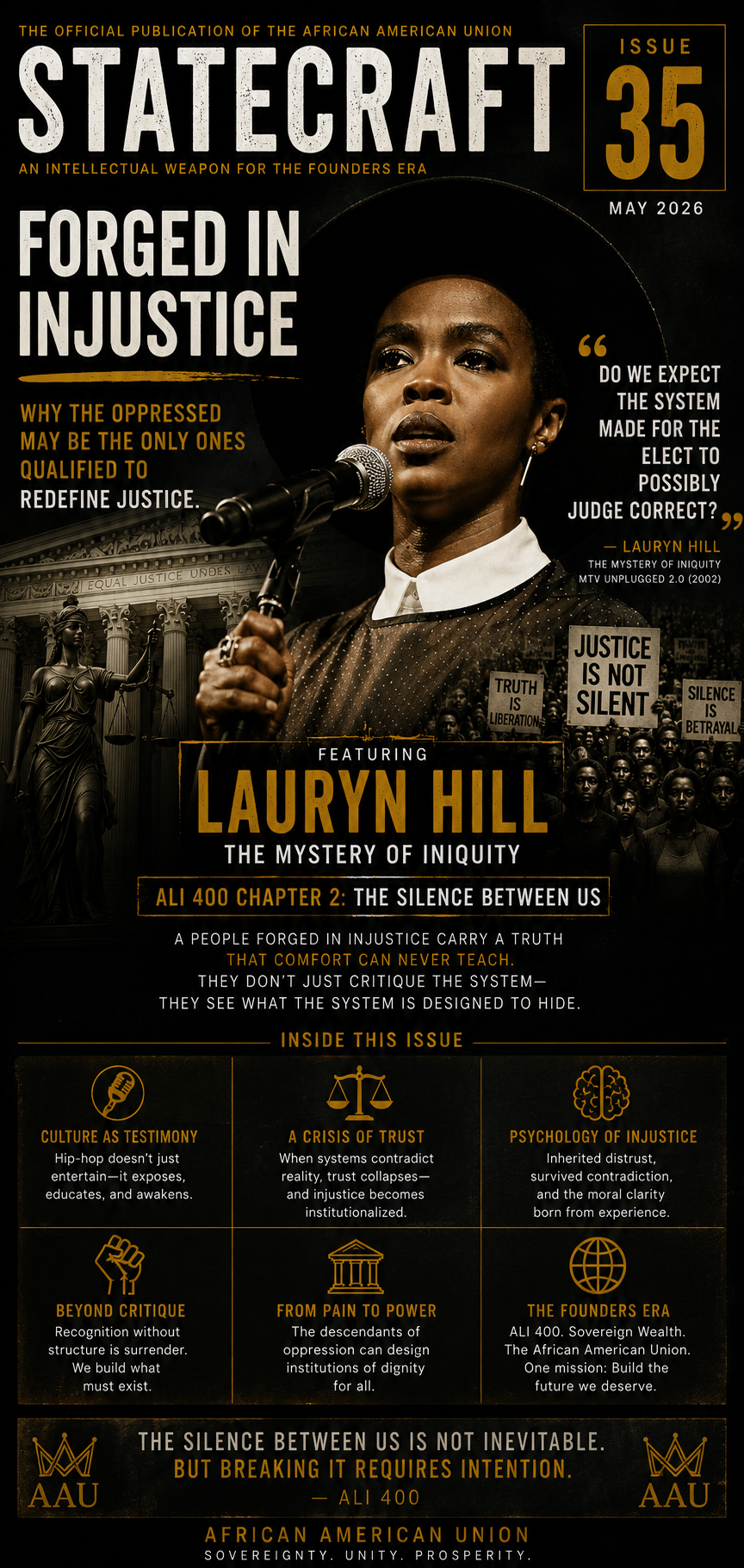
Statecraft: The Strategic Journal of the African American Union Issue No. 35—Forged in Injustice
-
 By Jibriyll Izsrael
- 2026-05-27
Forged in Injustice
Why the Oppressed May Be the Only Ones Qualified to Redefine Justice
Featuring Lauryn Hill’s The Mystery of Iniquity
ALI 400, Chapter 2, and The Silence Between Us
Freedom is free. Liberation is not.
The Woman Who Put the Court on Trial
Some performances entertain.
Others expose.
And once exposed, certain things can never again be unseen.
In 2002, on MTV Unplugged 2.0, Lauryn Hill stood before an audience and performed something far more dangerous than music.
She performed testimony.
Not polished spectacle.
Not commercial escapism.
Not carefully diluted critique designed to offend no one and challenge nothing.
Testimony.
She stood before a listening audience and delivered a blistering indictment of hypocrisy, judicial corruption, institutional deceit, moral decay, spiritual contradiction, and the dangerous distance between what civilization claims to value and what it repeatedly rewards.
And importantly:
People listened.
Quietly.
Carefully.
Just as they did with Chance the Rapper in Statecraft Issue #34.
This matters.
Because ALI 400 argues something increasingly difficult to deny:
When institutions fail to communicate truth, culture becomes testimony.
And when testimony becomes unavoidable:
Civilizations are forced to confront themselves.
The Crisis Beneath the Crisis
Why Chapter 2 Begins with Communication
In Chapter 2 of ALI 400: Saving the World with Positive Hip-Hop, we argue that humanity’s greatest crisis is not a lack of intelligence, resources, or technology.
It is the collapse of communication.
Or more precisely:
The collapse of trust.
We live in the Information Age.
Messages travel instantly.
Information floods endlessly.
And still:
War persists.
Hunger persists.
Distrust compounds.
Communities fracture.
Young people inherit contradiction.
The question becomes unavoidable:
If communication is everywhere, why does understanding remain so scarce?
This is the silence between us.
Not silence caused by absence.
But silence caused by distortion.
A refusal to speak honestly.
A refusal to reconcile rhetoric with lived reality.
And nowhere does this contradiction reveal itself more clearly than in systems claiming to administer justice.
Lauryn Hill and the Architecture of Contradiction
Lauryn’s The Mystery of Iniquity is not simply protest music.
It is civilizational diagnosis.
Line by line, she dissects the moral contradictions beneath institutional legitimacy.
She asks uncomfortable questions.
Questions polite society often avoids.
Questions communities forged in contradiction cannot afford to ignore.
Consider this devastating observation:
“Do we expect the system made for the elect to possibly judge correct?”
Pause there.
Because this line quietly interrogates one of the deepest assumptions of modern civilization:
Can systems built under inequality truly administer justice equally?
This is not cynicism.
It is structural inquiry.
And for many communities—particularly African Americans—this question is not theoretical.
It is historical.
Experiential.
Inherited.
A People Forged in Injustice
Why Suffering Can Produce Moral Clarity
Here we arrive at a difficult but necessary proposition:
A people forged in injustice are often the only ones qualified to redefine justice.
Not because suffering automatically grants wisdom.
Not because oppression is virtuous.
But because contradiction teaches what theory cannot.
Those who have endured institutional betrayal understand:
What injustice feels like.
How distrust forms psychologically.
How institutions lose legitimacy.
What dignity actually requires.
What systems must protect if they are to be trusted.
This matters profoundly.
Because throughout history, the most important moral corrections often emerged not from the powerful:
But from those forced to survive what power refused to acknowledge.
The enslaved understood freedom differently.
The colonized understood sovereignty differently.
The excluded understood belonging differently.
The poor understood dignity differently.
And the descendants of contradiction often possess unique clarity about what justice must become.
The Mystery of Iniquity as Cultural Testimony
What Lauryn performs is more than critique.
She exposes the emotional architecture of distrust.
The judicial system appears repeatedly in her performance:
But not merely as law.
As theater.
As spectacle.
As contradiction.
She speaks of:
False indictments.
Performative morality.
Legal manipulation.
Spiritual emptiness.
Manufactured outcomes.
At one point she warns:
“Only two positions: victimizer or victim / Both end up in destruction trusting this crooked system.”
This is an extraordinary observation.
Because Lauryn is not merely condemning individuals.
She is exposing systems capable of reproducing moral confusion.
Systems where trust collapses.
Where truth becomes negotiable.
Where suffering becomes procedural.
And Chapter 2 of ALI 400 argues precisely this:
Distrust compounds when systems repeatedly contradict lived reality.
Suspicion becomes habit.
Habit becomes hostility.
Hostility becomes violence.
Civilizations fracture.
And youth inherit the psychological debris.
The Audience Matters Again
And once again:
The audience matters.
This performance did not occur in isolation.
Lauryn stood before listeners.
A diverse audience.
People willing—at least momentarily—to sit with uncomfortable truths.
This is one of the great overlooked powers of intentional culture:
It creates shared emotional space.
Policy often polarizes.
Politics divides.
Institutions defend themselves.
But art:
When honest:
Creates the possibility of collective listening.
This is why ALI 400 insists culture is not decoration.
Culture is infrastructure.
Because culture can restore dialogue where institutions fail.
It can transmit memory.
Restore dignity.
Humanize suffering.
And reintroduce moral questions society has learned to suppress.
From Critique to Construction
Why the AAU Exists
Yet critique alone is insufficient.
If all we do is diagnose dysfunction:
Despair eventually follows.
This is why the African American Union exists.
Not merely to identify broken systems:
But to intentionally construct alternatives.
This is where ALI 400 meets Sovereign Wealth.
Culture diagnoses the wound.
Institutions design the response.
Music activates.
Governance organizes.
Economics stabilizes.
Community sustains.
Because:
Recognition without structure is surrender.
If injustice teaches us what failed:
Then we are morally obligated to build what should exist.
This means:
Trusted institutions.
Intentional economics.
Cultural responsibility.
Education rooted in truth.
Systems capable of preserving dignity.
The Founder’s Question
What Does Justice Look Like When Designed by the Previously Excluded?
This may be the defining question of our age.
Not:
How do we reform injustice?
But:
What does justice look like when designed by people who survived injustice?
Would it prioritize dignity?
Would it prioritize nourishment?
Would it value truth over spectacle?
Would it preserve humanity rather than exploit vulnerability?
Would it seek domination:
Or restoration?
These are not abstract questions.
They are civilizational questions.
And increasingly:
They belong to those history forced to understand them most deeply.
Final Reflection
The Ones Who Survived the Fire
Perhaps history’s greatest irony is this:
The people civilization attempted to break:
May be among the very people most qualified to help heal it.
Because surviving contradiction teaches something rare:
Discernment.
Empathy.
Pattern recognition.
Moral seriousness.
And above all:
The ability to recognize injustice long before it becomes fashionable to condemn it.
Lauryn Hill’s performance reminds us of something essential:
Truth does not disappear simply because systems ignore it.
Eventually:
Truth sings.
Truth testifies.
Truth stands on stages.
Truth enters culture.
And once enough people begin listening:
Civilizations change.
The question before us is simple:
Will we remain spectators to contradiction?
Or builders of something better?
Read Chapter 2 of ALI 400: Saving the World with Positive Hip-Hop
Join the Founder’s Era of the African American Union
Help Build Institutions Worth Trusting
Freedom is free. Liberation is not.
Support the Work
If this issue resonated with you, consider supporting the African American Union.
Your support helps expand education, economic cooperation, and cultural development within our community.• Become a member
• Support the Union store
• Share this issue
• Make a contribution
All net proceeds raised from the Statecraft newsletter are dedicated to helping seed the African American Sovereign Wealth Fund, an initiative of the African American Union designed to strengthen economic cooperation and institution-building for future generations.
By supporting this work, readers help transform ideas into lasting infrastructure for our community.