
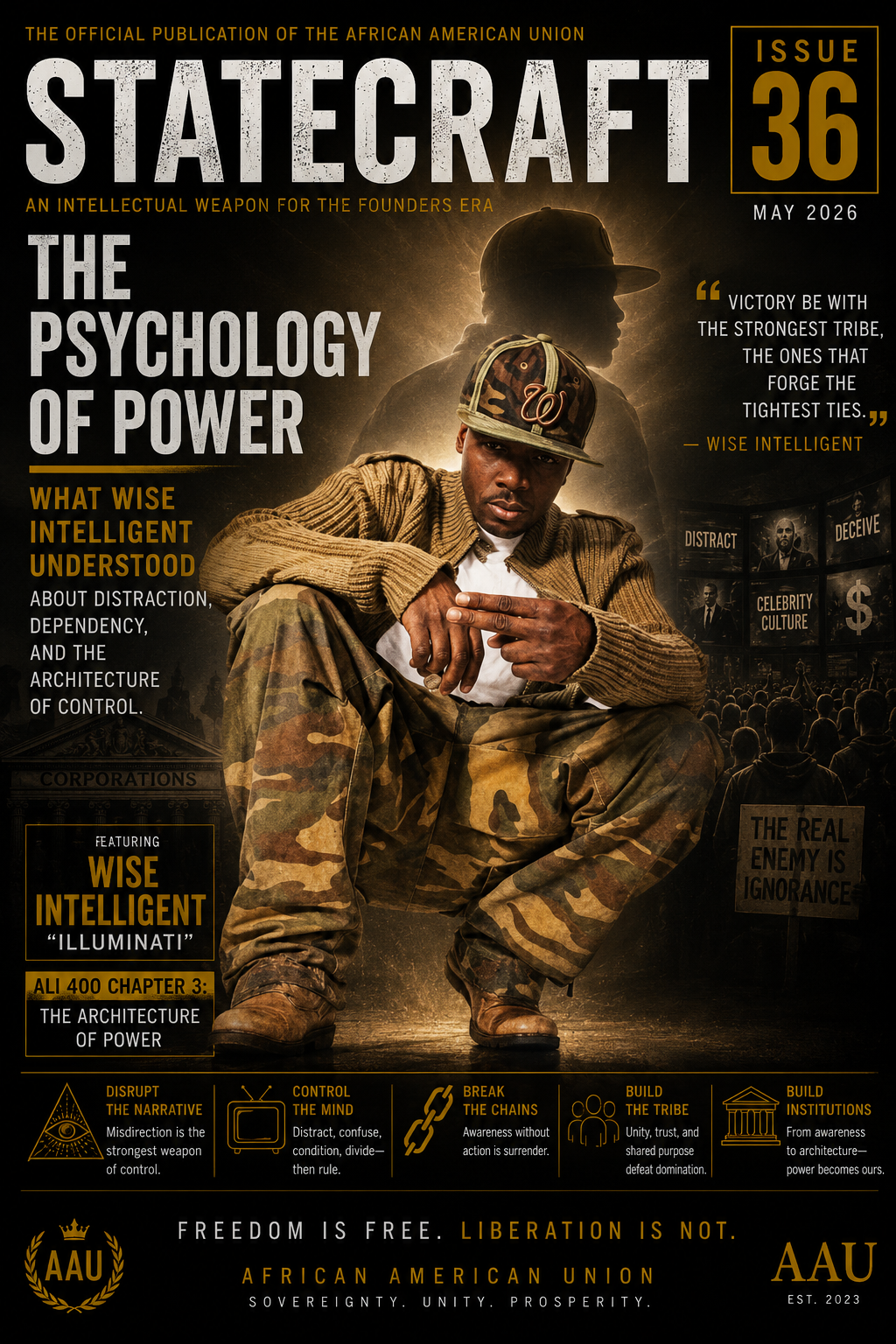
Statecraft: The Strategic Journal of the African American Union Issue No. 36—Forged in Injustice
-
 By Jibriyll Izsrael
- 2026-06-01
THE PSYCHOLOGY OF POWER
Why Wise Intelligent Aged Like Fine Wine in an Era of Civilizational Confusion
Featuring Wise Intelligent's "Illuminati"
From Poor Righteous Teachers to ALI 400: Hip-Hop as Political Inheritance
Freedom is free. Liberation is not.
SECTION I
THE MAN WHO REFUSED DISTRACTION
Some artists follow culture.
Others shape it.
And a rare few quietly refuse to abandon truths the world is not yet prepared to hear.
Wise Intelligent belongs to the latter category.
For those unfamiliar, Wise Intelligent emerged as one of the founding voices of Poor Righteous Teachers—a pioneering force in conscious hip-hop whose contribution to political and historical awareness remains vastly underappreciated.
But to understand Wise merely as a rapper is to misunderstand what hip-hop was becoming in his era.
Because hip-hop, at its highest expression, was never simply music.
It was inheritance.
Born in the Bronx—within cultural reach of Harlem's political legacy—hip-hop emerged not in isolation, but downstream from unfinished struggle.
The echoes of Malcolm X.
The organizing traditions of Kwame Ture.
The resistance embodied by Assata Shakur.
The demand for dignity.
These ideas did not disappear.
They evolved.
Civil rights gave way to cultural rights.
Political organizing gave way to artistic transmission.
The street corner became lecture hall.
The cipher became classroom.
The beat became memory.
And hip-hop became the language through which a generation attempted to make sense of inherited contradiction.
This matters.
Because the generation born into hip-hop inherited something unique:
Not freedom—but unfinished work.
They inherited communities still recovering from disinvestment.
Schools stripped of trust.
Neighborhoods flooded with instability.
Economic exclusion.
Mass incarceration.
Political abandonment.
And yet—from these same conditions emerged one of the most intellectually potent cultural movements in modern history.
Hip-hop did what institutions repeatedly failed to do:
It told the truth people were too uncomfortable to say aloud.
Not polished truth.
Not politically approved truth.
Experiential truth.
Street truth.
Historical memory set to rhythm.
And among those voices—Wise Intelligent stood apart.
Because unlike many artists whose politics softened beneath success—Wise never abandoned the recipe.
He refined it.
Aged into it.
Sharpened it.
If anything—time made him more potent.
More disciplined.
More precise.
And perhaps most importantly:
Far more wise.
By the time he released Illuminati, Wise was no longer simply speaking as an artist.
He was speaking as a man observing patterns.
Watching institutions.
Watching priorities.
Watching distraction eclipse discernment.
And asking difficult questions about power—long before many people possessed language for what they were beginning to feel.
Importantly, whether one agrees with every conclusion Wise reached is not the point.
The deeper question is:
What pathology was Wise attempting to diagnose?
Because beneath the rhetoric, symbolism, and controversy, Wise was repeatedly pointing toward something profoundly unsettling:
A civilization capable of extraordinary coordination toward destruction while appearing strangely incapable of coordinating toward nourishment.
Weapons financed immediately.
War organized efficiently.
Surveillance perfected endlessly.
Yet hunger persists.
Poverty persists.
Instability compounds.
And suffering remains strangely negotiable.
These contradictions are no longer confined to distant communities.
Today the world itself is beginning to confront them.
Ukraine.
Gaza.
Iran.
Escalating geopolitical fragmentation.
Competing narratives.
Institutional distrust.
And increasingly—a growing inability among many societies to reconcile the contradictions before them.
Meanwhile, communities long forged in contradiction often recognize instability earlier.
Not because suffering makes one superior.
But because suffering sharpens perception.
A people repeatedly forced to survive contradiction develop pattern recognition.
And perhaps this explains why so much conscious hip-hop often sounded less like entertainment and more like warning.
A child born from a people who suffered in a land not their own for over four hundred years was articulating concerns nearly a decade ago that much of the so-called developed world still struggles to comprehend.
Perhaps the issue was never whether these artists were too radical.
Perhaps history simply had not yet caught up to what they were seeing.
And perhaps that is exactly why Wise Intelligent matters now.
Because in an era increasingly defined by confusion, he reminds us of something civilization desperately needs to remember:
Power reveals itself through priorities.
And priorities never lie.
SECTION II
BORN OF HARLEM, RAISED IN THE BRONX
How Hip-Hop Inherited Civil Rights Consciousness
Civilizations rarely transform in clean succession.
Movements do not simply end.
They evolve.
They change language.
And often—they relocate.
What many misunderstand about hip-hop is this:
It did not emerge from nowhere.
It emerged from aftermath.
The Bronx did not invent struggle.
It inherited it.
And in many ways, hip-hop itself inherited the unfinished emotional, political, and psychological labor of the Civil Rights era.
To understand conscious hip-hop, one must understand geography.
The Bronx—where hip-hop was born—sits within cultural reach of Harlem.
And Harlem functioned as one of the intellectual capitals of Black political imagination.
The speeches of Malcolm X.
The organizing traditions of Kwame Ture.
The resistance embodied by Assata Shakur.
The moral force of Fannie Lou Hamer.
These names did not vanish.
Their questions remained unresolved.
Their warnings remained unfinished.
Their work remained incomplete.
And then history shifted.
The assassinations came.
The movements fractured.
Economic restructuring accelerated.
Drugs flooded communities.
Industry disappeared.
Trust eroded.
Neighborhoods destabilized.
And a generation inherited the debris.
Yet from this debris emerged something extraordinary.
A language.
Hip-hop.
Not merely entertainment.
Political memory set to rhythm.
A place where young people processed contradiction.
A place where the children of unfinished struggle wrestled publicly with questions institutions no longer seemed interested in answering.
The inheritance never disappeared.
It simply learned how to rhyme.
SECTION III
POOR RIGHTEOUS TEACHERS
The Malcolm X's of the Hip-Hop Generation
History remembers selectively.
And power often decides who gets remembered.
This is one of civilization's oldest patterns.
Communities without institutions capable of preserving their own memory eventually inherit narratives written by others.
Their thinkers become reduced.
Their organizers become simplified.
Their intellectuals become caricatures.
Their movements become misunderstood.
And their builders quietly disappear beneath history's noise.
This problem is particularly devastating for African Americans.
Because for generations, our contributions have often been remembered only after suffering.
Only after death.
Or only after broader society became comfortable enough to sanitize what once felt threatening.
Yet history reveals something undeniable:
Every generation produces its own architects.
Its own witnesses.
Its own moral challengers.
Its own truth tellers.
Its own builders of consciousness.
The Civil Rights era produced figures whose names became synonymous with struggle.
Malcolm X.
Assata Shakur.
Kwame Ture.
Fannie Lou Hamer.
Fred Hampton.
These individuals were not remembered because they were universally loved.
Nor because they were commercially successful.
Nor because institutions willingly embraced them.
They were remembered because they carried burdens larger than themselves.
They spoke difficult truths.
They challenged power.
They expanded political imagination.
And they refused surrender.
But history did not stop with them.
The struggle evolved.
Its language shifted.
Its terrain changed.
And the generation born inside hip-hop inherited unfinished work.
This generation did not inherit movement infrastructure.
It inherited fragmentation.
Disinvestment.
Mass incarceration.
Economic abandonment.
The weaponization of addiction.
Political fatigue.
And yet—
it still produced truth tellers.
This time, not primarily through podiums.
But through culture.
Through lyricism.
Through rhythm.
Through memory.
Through warning.
The uncomfortable truth is this:
The Hip-Hop generation produced its own Malcolm X's.
Its own Assatas.
Its own Kwame Tures.
Not replicas.
Evolutions.
Not politicians.
Cultural translators.
And history has barely begun documenting them seriously.
This matters.
Because many of these figures were dismissed as entertainers when, in reality, they were functioning as:
Historians.
Political interpreters.
Psychologists.
Community educators.
Moral witnesses.
And civilizational diagnosticians.
Artists such as:
Wise Intelligent.
Chuck D.
KRS-One.
Lauryn Hill.
Tupac Shakur.
Dead Prez.
Each, in different ways, carried fragments of unfinished struggle into a generation institutions often failed to reach.
And among them, Wise Intelligent occupies a particularly important place.
Because Poor Righteous Teachers never abandoned the assignment.
Never diluted the message.
Never confused popularity with purpose.
The recipe remained.
The consciousness remained.
The political seriousness remained.
Only the refinement changed.
Time aged the message.
Sharpened it.
Clarified it.
And what we witness in Illuminati is not decline—
but maturation.
Not bitterness—
but precision.
Not nostalgia—
but evolved clarity.
Wise appears not as a man trapped in the past—
but as a witness to recurring patterns.
Watching power evolve.
Watching distraction intensify.
Watching confusion become normalized.
And refusing to stop asking difficult questions.
This raises a larger civilizational question:
Who names the builders of a people?
Who preserves their memory?
Who determines whose contributions mattered?
Because if communities do not intentionally chronicle their own contributors—
others will do it for them.
And history repeatedly shows:
Outsourced memory becomes distorted memory.
This is one reason the African American Union matters.
Because sovereignty is not merely economic.
Nor political.
Nor legal.
It is historical.
A sovereign people must possess the ability to intentionally preserve:
Its builders.
Its thinkers.
Its organizers.
Its cultural architects.
Its institutional visionaries.
Named not by celebrity.
Named by merit.
Not by algorithms.
By contribution.
Not by popularity.
By sacrifice.
This is Founding work.
Because what we are witnessing now—
at the beginning—
may ultimately become the first serious attempt in generations to intentionally reclaim historical authorship.
To say:
We will remember our own.
Correctly.
With context.
With seriousness.
With dignity.
And perhaps—
when future generations look back—
they will understand something we are only beginning to recognize now:
That the Hip-Hop generation was not merely entertaining itself.
It was documenting survival.
Translating struggle.
Preserving memory.
And preparing civilization for conversations it was not yet mature enough to have.
The question is whether we possess enough wisdom—
enough institutional courage—
to finally name the builders while they are still here.
Because history belongs not only to those who make it.
History belongs to those who preserve it.
And perhaps the greatest responsibility of the Founding Era is not simply to build institutions—
but to ensure that the names of those who carried the work are never lost again.
SECTION IV
THE PSYCHOLOGY OF POWER
Why Chapter 3 Begins with Priorities
Most people misunderstand power.
Because most people are taught to recognize power only when it announces itself.
Through titles.
Through wealth.
Through institutions.
Through visible authority.
Through flags.
Podiums.
Presidents.
Corporations.
And yet history repeatedly teaches something much more uncomfortable:
The most consequential forms of power are often the least visible.
Power rarely survives because it is obvious.
Power survives because it becomes normal.
Habitual.
Unquestioned.
Invisible through repetition.
This is why civilizations frequently fail to recognize their deepest contradictions until instability arrives at their own doorstep.
Because power is rarely maintained through force alone.
More often, it is maintained through:
Narrative.
Attention.
Priority.
Fragmentation.
Perception.
This matters.
Because Chapter 3 of ALI 400 begins with a proposition many societies instinctively resist:
To understand power, one must study priorities.
Not speeches.
Not slogans.
Not promises.
Priorities.
Because priorities reveal truth.
And truth becomes difficult to hide when viewed through allocation.
What receives urgency?
What receives delay?
What receives immediate funding?
What remains perpetually negotiable?
This is where Wise Intelligent becomes profoundly important.
Because beneath the rhetoric of Illuminati lies a much deeper observation:
Power often hides itself through distraction.
Wise repeatedly redirects attention away from personalities and toward systems.
Away from celebrity fixation and toward structure.
He asks listeners to consider:
What forces shape the conditions we normalize?
And importantly, whether one agrees with every claim he makes misses the larger point entirely.
Because Wise is diagnosing something larger than literal conspiracy.
He is interrogating the psychology of governance itself.
Why do societies repeatedly appear capable of extraordinary coordination toward destruction while remaining strangely incapable of coordinating toward nourishment?
This contradiction deserves attention.
Because it transcends ideology.
And geography.
And political affiliation.
Civilizations routinely mobilize astonishing resources for:
War.
Weapons.
Surveillance.
Containment.
Enforcement.
Urgently.
Efficiently.
Without hesitation.
Yet when conversations turn toward:
Hunger.
Housing.
Mental health.
Education.
Public well-being.
Suddenly complexity appears.
Delay appears.
Bureaucracy appears.
Excuses emerge.
The impossible becomes language.
This contradiction is no longer subtle.
Nor isolated.
We witness it globally.
Weapons financed instantly.
Entire conflicts funded continuously.
Military escalation treated as logistical necessity.
Meanwhile:
Hunger remains unresolved.
Poverty remains procedural.
Infrastructure collapses.
Communities destabilize.
And millions remain trapped inside systems perpetually negotiating whether dignity can be afforded.
This is not merely inefficiency.
It is prioritization.
And prioritization reveals philosophy.
Because every civilization ultimately answers one question, whether consciously or unconsciously:
What matters most?
Protection of life?
Or management of instability?
Human flourishing?
Or preservation of order?
Abundance?
Or control?
And increasingly, many governing systems appear to reveal something deeply unsettling:
Stability often matters more than justice.
This is where Wise's critique becomes remarkably relevant.
Because beneath the symbolism of Illuminati exists a recurring warning:
Misdirection protects power.
Communities argue over personalities while systems quietly remain untouched.
People become consumed with symbols while priorities reveal themselves openly.
The loudest distractions often obscure the quietest truths.
And perhaps this explains why communities repeatedly forged in contradiction—particularly African Americans, Africans, and many throughout Latin America—often recognize instability earlier.
Not because suffering grants superiority.
But because contradiction sharpens perception.
When promises repeatedly collapse, people begin paying closer attention.
When systems repeatedly fail, pattern recognition emerges.
And this is perhaps the deepest irony of our age:
Many communities long dismissed as "underdeveloped" or politically unstable have spent generations navigating contradictions that much of the so-called developed world is only now beginning to confront.
Narrative warfare.
Institutional distrust.
Moral inconsistency.
Information fragmentation.
Permanent crisis.
The inability to reconcile competing realities.
Ukraine.
Gaza.
Iran.
Escalating instability.
And increasingly, a global population struggling to determine:
Who is telling the truth?
But perhaps the deeper question is not:
Who is telling the truth?
Perhaps it is:
What do our priorities already reveal?
Because priorities do not lie.
Budgets speak.
Urgency speaks.
Coordination speaks.
And power, despite its preference for invisibility, always leaves fingerprints.
This is why Chapter 3 begins here.
Because before people can organize—
before institutions can be built—
before sovereignty can emerge—
people must first learn to recognize how power actually behaves.
Not in theory.
Not in slogans.
In practice.
And practice never lies.
SECTION V
THE POPULATION QUESTION
What Wise Was Really Warning About
Few subjects expose the moral contradictions of modern civilization more quickly than conversations surrounding population.
And few subjects are handled more carelessly.
Too often, the conversation collapses into extremes.
On one side:
Apocalyptic warnings of overpopulation.
On the other:
Dismissal of all concerns as paranoia.
Yet beneath the noise exists something deeper.
And far more uncomfortable.
A question of values.
A question of priorities.
A question of what governing systems fundamentally believe about human beings themselves.
Because buried beneath many modern debates surrounding population, sustainability, scarcity, and resource management lies an increasingly difficult question to avoid:
Does modern governance fundamentally view humanity as an asset—
or as a burden?
This is where Wise Intelligent's Illuminati becomes especially provocative.
While many listeners became fixated on the song's symbolism, its deeper concern appears to be something else entirely:
The fear that systems increasingly prioritize management over flourishing.
Control over nourishment.
Containment over empowerment.
Reduction over construction.
Whether one agrees with Wise's specific conclusions is ultimately secondary.
The larger question remains.
And it is not hypothetical.
Because throughout history, moments of instability repeatedly produced ideologies rooted in limitation.
The belief that suffering stems not from poor organization—
but from excess people.
Not from inequality—
but from human existence itself.
Not from systems—
but from those trapped inside them.
This idea has appeared repeatedly throughout history.
Under different names.
Different institutions.
Different justifications.
Yet the underlying assumption often sounds remarkably familiar:
Humanity itself is the problem.
This idea deserves scrutiny.
Because history repeatedly demonstrates something else.
Human beings are not merely consumers of resources.
Human beings create resources.
Innovation emerges from people.
Civilizations emerge from people.
Technology emerges from people.
Art emerges from people.
Prosperity emerges from people.
Abundance emerges from coordinated human imagination.
What societies repeatedly call scarcity is often something else entirely:
Mismanagement.
Distribution failure.
Concentrated access.
Political obstruction.
Closed systems.
History offers difficult evidence.
Entire regions experience hunger not because food does not exist—
but because systems fail to distribute it effectively.
Communities suffer not because solutions are impossible—
but because priorities reveal themselves elsewhere.
And this is where Wise's critique becomes deeply relevant.
Because beneath the rhetoric lies a profound moral observation:
A civilization capable of financing destruction while overlooking hunger must confront its own philosophy.
Not eventually.
Now.
Because this contradiction increasingly defines the modern age.
Weapons systems financed with astonishing urgency.
Military infrastructure expanded effortlessly.
Escalation coordinated globally.
Yet:
Millions remain hungry.
Communities remain destabilized.
Education deteriorates.
Healthcare remains inaccessible to many.
And conversations about public flourishing become trapped inside perpetual negotiation.
Suddenly, the question shifts.
Not:
Can humanity solve suffering?
But:
What suffering have governing systems learned to tolerate?
This is where Wise proved strangely ahead of his time.
Not necessarily because every conclusion was perfect.
But because he was wrestling publicly with contradictions much of the mainstream world still struggles to articulate.
And perhaps that is what conscious hip-hop has always done best:
Ask uncomfortable questions before institutions feel safe asking them.
Questions like:
Why are societies extraordinarily efficient at destruction—
yet endlessly delayed in nourishment?
Why does military urgency feel immediate—
while human dignity feels negotiable?
Why does suffering remain normalized despite unprecedented technological capacity?
These are not conspiracy questions.
They are civilizational questions.
And increasingly, the so-called developed world appears unable to reconcile them.
Ukraine.
Gaza.
Iran.
Escalating instability.
Competing moral narratives.
Fragmented trust.
A growing inability to explain why violence feels inevitable while peace feels perpetually delayed.
Meanwhile, many communities long forged inside contradiction have learned something difficult:
Systems reveal themselves most honestly through what they repeatedly fund.
Priorities speak.
Budgets speak.
Urgency speaks.
And increasingly, the world is beginning to hear what communities long ignored had already been saying.
Perhaps Wise Intelligent was not merely warning about hidden power.
Perhaps he was warning about something much larger:
What happens when civilizations quietly lose confidence in the value of human life itself.
Because when nourishment becomes optional—
and destruction becomes procedural—
something foundational begins to fracture.
And once fractured, civilizations eventually confront a question no amount of technology can avoid:
What exactly are we building?
And more importantly:
Who are we building it for?
The answer to that question may ultimately determine whether civilization continues to advance—
or merely perfects its ability to manage decline.
SECTION VI
THE PATHOLOGY OF MODERN GOVERNANCE
Why Systems Finance Destruction While Negotiating Hunger
Every civilization eventually reveals itself.
Not through slogans.
Not through speeches.
Not through carefully written mission statements.
But through behavior.
Through repetition.
Through investment.
Through priority.
And perhaps nowhere is modern civilization more revealing than in what it repeatedly demonstrates an extraordinary willingness to finance.
Because if one observes carefully, a difficult contradiction emerges.
One so obvious it becomes strangely invisible.
Humanity has developed systems capable of astonishing precision.
We can coordinate globally.
Move resources instantly.
Deploy advanced technology across continents.
Organize military alliances with breathtaking speed.
Mobilize trillions in funding under conditions of urgency.
And yet—
millions remain hungry.
Communities collapse beneath preventable instability.
Education deteriorates.
Healthcare remains inaccessible to many.
Basic dignity remains strangely negotiable.
This contradiction deserves far more attention than it receives.
Because it raises a question modern governance often avoids:
Is suffering truly unavoidable—
or merely tolerated?
This is not an accusation aimed at one nation.
Nor one ideology.
Nor one political tradition.
It is a civilizational observation.
And increasingly, the contradiction appears global.
War mobilizes urgency.
Hunger mobilizes paperwork.
Military escalation moves quickly.
Human flourishing moves bureaucratically.
Violence receives precision.
Peace receives conferences.
Bombs arrive on schedule.
Food arrives conditionally.
The contradiction is difficult to ignore once seen.
Especially in an era increasingly defined by moral fragmentation.
Ukraine.
Gaza.
Iran.
Entire populations trapped inside competing narratives while global institutions appear increasingly incapable of producing coherent moral consensus.
Everyone claims justice.
Everyone claims necessity.
Everyone claims moral authority.
And increasingly, ordinary people are left attempting to reconcile contradictions too large for ordinary language.
Because modern governance often speaks in paradox.
We are told peace is the objective—
while war remains perpetual.
We are told abundance exists—
while scarcity is normalized.
We are told humanity matters—
while preventable suffering remains structurally tolerated.
This contradiction is not merely political.
It is psychological.
Because repeated contradiction produces distrust.
And distrust produces fragmentation.
The very condition Chapter 2 of ALI 400 warned about.
When rhetoric repeatedly collapses beneath lived reality, people begin searching elsewhere for explanation.
Elsewhere for meaning.
Elsewhere for truth.
And this is precisely why conscious hip-hop became so important.
Because before many institutions possessed language for these contradictions, artists were already wrestling publicly with them.
Not academically.
Experientially.
Emotionally.
Through rhythm.
Through warning.
Through testimony.
Wise Intelligent's Illuminati emerges from precisely this tension.
Again, whether every claim is literally correct is not the deepest issue.
The deeper issue is this:
Why did so many people recognize emotional truth inside the critique?
Because beneath the rhetoric, many communities already sensed something unsettling:
That systems often appear extraordinarily organized when destruction is involved—
yet strangely disorganized when nourishment becomes the objective.
This observation matters.
Especially for communities repeatedly forced to survive contradiction.
African Americans.
Many throughout Africa.
Latin America.
Colonized peoples.
Communities long navigating instability often develop unusual sensitivity toward contradiction.
Not because suffering grants enlightenment.
But because survival sharpens observation.
And perhaps this is why so many communities historically dismissed as "developing" now find themselves watching parts of the so-called developed world struggle with realities long familiar:
Institutional distrust.
Narrative confusion.
Political instability.
Economic anxiety.
Information warfare.
Moral fragmentation.
The irony is profound.
Communities once described as politically unstable are increasingly watching political instability become global.
And suddenly, the questions conscious hip-hop raised no longer sound fringe.
They sound timely.
Urgent even.
This brings us back to the central issue:
What philosophy governs a civilization that repeatedly demonstrates greater urgency toward destruction than nourishment?
Because priorities are never accidental.
Budgets reveal philosophy.
Urgency reveals belief.
And what societies repeatedly fund eventually exposes what societies truly value.
This is not cynicism.
Nor hopelessness.
It is invitation.
Invitation to confront difficult truths honestly.
Because civilizations do not collapse merely from external pressure.
They fracture internally when too many contradictions become impossible to reconcile.
And perhaps the greatest contradiction of all is this:
Humanity has already developed the capacity to nourish itself.
The question is whether it possesses the moral courage—
to prioritize life with the same seriousness it prioritizes war.
Because every civilization is ultimately measured not by what it claims to value—
but by what it repeatedly chooses to build.
And history is watching.
SECTION VII
COMMUNITIES FORGED IN CONTRADICTION
Why the Developed World Is Struggling to Understand What Marginalized Peoples Already Know
There is an uncomfortable truth modern civilization increasingly struggles to confront:
Contradiction teaches.
Not beautifully.
Not gently.
But thoroughly.
Communities repeatedly forced to survive instability often develop forms of perception unavailable to those insulated from it.
Not because suffering is virtuous.
Not because hardship makes one morally superior.
But because contradiction sharpens observation.
People repeatedly exposed to institutional inconsistency become unusually attentive to patterns.
They notice shifts earlier.
Recognize instability sooner.
Develop skepticism toward narratives faster.
And perhaps most importantly:
They learn to survive realities others still imagine impossible.
This matters.
Because much of the world now appears increasingly trapped inside contradictions many historically marginalized communities have long navigated.
Institutional distrust.
Narrative warfare.
Political fragmentation.
Economic anxiety.
Information overload.
Conflicting moral frameworks.
Competing truths.
The sudden realization that official explanations no longer feel entirely sufficient.
For many in the so-called developed world, this feels new.
Disorienting.
Destabilizing.
But for many African Americans—
for many throughout Africa—
for many across Latin America—
contradiction has rarely been abstract.
It has been inherited.
Lived.
Normalized.
A daily negotiation between:
Promise and reality.
Law and practice.
Rights and access.
Hope and memory.
This is not accidental.
Because communities repeatedly exposed to contradiction develop something difficult to teach formally:
Pattern recognition.
They become deeply attentive to what institutions say versus what institutions repeatedly do.
And this is where the Hip-Hop generation becomes historically significant.
Because hip-hop emerged from communities already wrestling with contradictions mainstream institutions often ignored.
Communities forced to ask:
Why are resources abundant while deprivation remains concentrated?
Why does violence receive urgency while healing receives delay?
Why do political promises repeatedly dissolve?
Why do systems claiming justice often feel structurally indifferent?
And because these contradictions remained unresolved—
culture became translator.
Hip-hop became witness.
Not merely entertainment.
Interpretation.
Which is why artists like Wise Intelligent matter.
Because long before global trust began visibly fracturing, conscious hip-hop was already wrestling publicly with questions of:
Power.
Scarcity.
Institutional legitimacy.
Historical memory.
Social fragmentation.
And perhaps this is why so much conscious hip-hop now sounds strangely prophetic.
Not because artists possessed supernatural foresight.
But because communities forged in contradiction often recognize instability earlier.
A people who survived:
Slavery.
Segregation.
Displacement.
Economic exclusion.
Criminalization.
Institutional betrayal.
Develop unusual sensitivity toward recurring patterns.
Four hundred years inside contradiction leaves residue.
But it also produces awareness.
The child of a people forced to survive a land not originally their own often learns to study systems carefully.
To read contradictions carefully.
To question appearances carefully.
This matters now.
Because the global order increasingly appears unable to reconcile itself.
Ukraine.
Gaza.
Iran.
Escalating geopolitical instability.
Moral confusion.
Competing narratives.
And increasingly, societies struggling to determine:
Who deserves sympathy?
Whose suffering counts?
Which violence is justified?
Which injustice matters?
The contradictions multiply.
And the moral frameworks no longer appear universally coherent.
Meanwhile, many communities long dismissed as politically unstable quietly observe:
We have seen this before.
Not these exact events.
But the feeling.
The uncertainty.
The competing narratives.
The instability beneath certainty.
The disorientation that emerges when institutions lose unquestioned legitimacy.
And perhaps this explains why conscious hip-hop increasingly feels less like nostalgia and more like preparation.
Because what many once dismissed as radical may have simply been communities attempting to articulate contradictions long before powerful societies possessed language for them.
This is not celebration.
Nor vindication.
Because suffering should never become spectacle.
The point is deeper:
Contradiction can become teacher.
And perhaps one of history's greatest ironies is this:
Communities most dismissed by civilization may sometimes understand civilization's fractures most clearly.
Not because they stood outside history—
but because history repeatedly stood on top of them.
This realization carries profound implications for the future.
Because if contradiction teaches, then communities forged in contradiction possess lessons worth hearing.
Not because they are infallible.
But because they have spent generations navigating conditions others are only now beginning to encounter.
And perhaps this is why positive hip-hop matters so profoundly.
Because before institutions learned how to discuss contradiction honestly, hip-hop was already teaching people how to survive it.
How to interpret it.
How to question it.
How to maintain dignity inside it.
And ultimately—
how to build beyond it.
Because survival is not the highest aspiration of a people.
Construction is.
And every lesson learned through contradiction ultimately finds its highest purpose when transformed into wisdom capable of building something better.
SECTION VIII
FROM AWARENESS TO INSTITUTION
Why the African American Union Exists
Awareness alone is insufficient.
In fact—
awareness without structure often becomes despair.
This is one of the great tragedies of politically conscious communities.
People learn to identify dysfunction.
They recognize contradiction.
They understand injustice.
They become increasingly aware of structural imbalance.
And yet—
without organized pathways toward construction—
awareness eventually collapses into exhaustion.
Frustration.
Cynicism.
Or paralysis.
History offers painful evidence of this.
Communities repeatedly awaken—
only to discover they possess insufficient institutions through which to transform consciousness into coordinated action.
And this is precisely where many movements fracture.
Because diagnosis, by itself, cannot sustain a people.
Critique, by itself, cannot feed a people.
Exposure, by itself, cannot protect a people.
Eventually, a civilization must move from:
Awareness
to
Organization.
This is where ALI 400 naturally meets Sovereign Wealth.
Because one of the central realizations of ALI 400 is simple:
Before systems can function—
people must first be activated.
People must believe:
That coordination is possible.
That institutions can be trusted.
That collective action still matters.
That culture can still produce meaning.
This is why hip-hop matters.
At its highest level, hip-hop became one of the few surviving infrastructures of trust.
Not perfect trust.
But trust nonetheless.
Young people often trusted artists before politicians.
Lyrics before institutions.
Cultural memory before official narratives.
Why?
Because culture still felt honest.
And honesty creates emotional legitimacy.
This matters profoundly.
Because trust is civilization's hidden currency.
Without trust:
Institutions collapse.
Economies fracture.
Communities fragment.
Coordination becomes impossible.
And eventually, people retreat into survival rather than construction.
This is precisely why the African American Union exists.
Not as reaction.
As construction.
Not merely to critique systems—
but to intentionally build alternatives.
To say:
If fragmentation weakens—
then alignment must become strategy.
If dependence creates vulnerability—
then internal circulation must become priority.
If institutions repeatedly fail trust—
then trusted institutions must be intentionally designed.
This means building:
Economic infrastructure.
Media infrastructure.
Educational infrastructure.
Cultural infrastructure.
Historical infrastructure.
Legal infrastructure.
Community infrastructure.
Not abstractly.
Deliberately.
This is why Sovereign Wealth argued something many found uncomfortable:
Participation inside national economic systems does not automatically produce internal sovereignty.
Because communities without:
Ownership.
Coordination.
Institutional continuity.
Economic circulation.
And trusted governance.
Often remain permanently vulnerable to external instability.
This is not isolationism.
Nor fantasy.
It is organizational maturity.
Because every stable civilization eventually learns:
Power without institution evaporates.
Emotion without infrastructure collapses.
Awareness without organization scatters.
And outrage without construction exhausts itself.
This is why Founding matters.
Because Founding is not symbolic.
It is structural.
Founders do not merely join movements.
Founders build systems capable of surviving beyond personality.
They build:
The fund.
The registry.
The institutions.
The media.
The curriculum.
The governance.
The trust.
This is why the moment matters.
Because what we are witnessing may ultimately become remembered as something much larger than organizational launch.
Perhaps—
for the first time in generations—
a people consciously choosing:
To stop outsourcing its future.
To stop outsourcing memory.
To stop outsourcing legitimacy.
To stop outsourcing authorship.
And instead—
to build.
Not perfectly.
But intentionally.
Not emotionally.
Structurally.
This is the natural bridge between ALI 400 and Sovereign Wealth.
ALI 400 asks:
How do we activate a people?
Sovereign Wealth asks:
Once activated, what must they build?
One provides the spark.
The other provides the architecture.
One restores belief.
The other converts belief into institution.
Together they form a complete doctrine of construction.
Because once people recognize contradiction, the question changes.
No longer:
What is wrong?
But:
What are we prepared to build instead?
And perhaps this is the deeper lesson Wise Intelligent quietly leaves behind.
Awareness matters.
Truth matters.
Warning matters.
But eventually every generation must answer the same question:
Will we merely understand power?
Or will we build enough institutional power to shape outcomes ourselves?
That question now stands before the African American community.
Not in theory.
Not in rhetoric.
But in practice.
History has already provided the diagnosis.
The task before us is construction.
And construction begins with institution.
SECTION IX
THE SOVEREIGN RECORD
Naming Builders by Merit, Not Fame
Every people eventually face the same question:
Who will remember us correctly?
Not romantically.
Not selectively.
Not commercially.
Correctly.
History has never merely been memory.
History is authorship.
And authorship is power.
Those who control historical memory often control:
Identity.
Legitimacy.
Narrative.
Inheritance.
And ultimately—
civilizational direction.
This is why sovereign peoples preserve their own record.
Because communities unable to document their builders eventually inherit incomplete versions of themselves.
Their thinkers disappear.
Their organizers are forgotten.
Their truth tellers become footnotes.
And entire generations quietly vanish beneath narratives written elsewhere.
This has happened repeatedly to African Americans.
Our contributions are too often remembered only after struggle becomes safe.
Only after discomfort fades.
Only after institutions become comfortable enough to celebrate what they once resisted.
And perhaps nowhere is this danger more visible than in how the Hip-Hop generation has been remembered.
Too often, history reduced hip-hop to spectacle.
Consumption.
Entertainment.
Controversy.
Excess.
As though an entire generation merely danced through contradiction.
As though no serious political labor occurred inside culture.
As though no civilizational thinking survived the collapse of formal movement infrastructure.
But this interpretation is profoundly incomplete.
Because the Hip-Hop generation inherited unfinished struggle.
And many among them carried that responsibility forward.
Quietly.
Imperfectly.
But sincerely.
Not merely through protest.
Through preservation.
Through memory.
Through translation.
Through cultural instruction.
Through warning.
Through survival theory.
This is why artists like Wise Intelligent matter.
Not because they achieved celebrity at the highest level.
Not because institutions crowned them.
But because contribution matters more than popularity.
And this distinction may define the Founding Era itself.
Because one of the great responsibilities of sovereign institution-building is this:
We must become capable of naming our own builders.
Not according to algorithms.
Not according to marketability.
Not according to corporate visibility.
According to merit.
Contribution.
Discipline.
Sacrifice.
Impact.
Historical seriousness.
This means asking better questions.
Not:
Who became famous?
But:
Who carried the work?
Who preserved political memory?
Who translated consciousness across generations?
Who warned communities when institutions failed?
Who protected dignity through culture?
Who expanded imagination?
Who planted seeds whose fruit may not emerge for decades?
These questions matter.
Because civilizations survive partly through continuity.
And continuity requires intentional remembrance.
This is where the African American Union enters history differently.
Because the Founding Era is not simply about economics.
Nor governance alone.
Nor even sovereignty narrowly understood.
It is about reclaiming authorship.
To say:
We will intentionally document:
Our builders.
Our teachers.
Our organizers.
Our artists.
Our scholars.
Our institutional architects.
Our cultural guardians.
Not after death.
While they are still here.
Named not by fame.
By merit.
Named not by popularity.
By contribution.
Named not by celebrity.
By service.
This matters deeply.
Because future generations deserve more than fragmented memory.
They deserve lineage.
Context.
Inheritance.
They deserve to know:
Who held the line?
Who preserved the recipe?
Who refused surrender during periods of confusion?
Who continued speaking truth before truth became fashionable?
And perhaps this is what makes Wise Intelligent so important to this conversation.
Because what we witness in Illuminati is not merely critique.
We witness continuity.
The maturation of a tradition that refused disappearance.
The evolution of a recipe that never changed—
only refined itself.
A political inheritance carried through rhythm.
A consciousness aged like fine wine.
And perhaps future generations will eventually recognize something many still overlook:
That the Hip-Hop generation was never merely reacting to history.
It was preserving civilizational memory in real time.
This realization carries enormous implications for the Founding Era.
Because every generation produces individuals whose contributions exceed their visibility.
Builders whose names never trend.
Organizers whose labor never becomes headline.
Teachers whose influence cannot be measured by followers.
Artists whose impact cannot be calculated through sales.
Yet these individuals often become the true architects of historical continuity.
The African American Union must learn to see them.
Must learn to document them.
Must learn to honor them.
Not because recognition is owed.
But because memory is necessary.
A sovereign people incapable of preserving its own contributors remains dependent upon others to explain its history.
And outsourced memory inevitably becomes distorted memory.
This is why the Founding matters.
Because Founding is not simply the creation of institutions.
It is the creation of archives.
Records.
Lineages.
Historical continuity.
It is the deliberate decision to say:
We will remember our own.
Not selectively.
Not politically.
Not commercially.
But accurately.
And perhaps one day, future generations will look back upon this era and recognize what we are only beginning to understand now:
That the greatest achievement of the Founding was not merely the institutions it built.
But the memory it preserved.
Because sovereign people do not simply build systems.
They build historical continuity.
They build inheritance.
They build legacy.
And legacy begins by naming builders according to merit rather than fame.
SECTION X
THE RECIPE NEVER CHANGED
The Ones Who Refused to Forget
Perhaps history's greatest irony is this:
The people most dismissed by civilization often become the people most capable of helping civilization understand itself.
Not because suffering grants moral perfection.
Not because struggle automatically produces wisdom.
But because contradiction leaves residue.
And residue teaches.
It teaches:
Discernment.
Pattern recognition.
Skepticism toward appearances.
Sensitivity toward hypocrisy.
And above all—
an unusual ability to distinguish performance from reality.
Perhaps this is why so much conscious hip-hop continues to feel strangely relevant.
Because what many dismissed as paranoia often reflected communities wrestling honestly with contradictions they could already see forming.
Not perfectly.
Not infallibly.
But sincerely.
Wise Intelligent did not emerge from comfort.
He emerged from inheritance.
From a generation born inside unfinished struggle.
A generation handed the emotional debris of:
Broken promises.
Economic abandonment.
Political fragmentation.
Institutional distrust.
Historical amnesia.
Yet somehow—
rather than surrender entirely—
many transformed confusion into culture.
Pain into philosophy.
Contradiction into rhythm.
And warning into art.
This matters.
Because what we are witnessing in Wise's evolution is not reinvention.
It is refinement.
The recipe never changed.
Only the precision evolved.
Only the language matured.
Only the observations deepened.
This is what aging looks like when purpose survives popularity.
When consciousness survives commodification.
When truth refuses expiration.
And perhaps this is why Wise feels more potent now than before.
Because civilization itself increasingly resembles the contradictions conscious hip-hop warned about long ago.
A world drowning in information—
yet starving for wisdom.
Connected digitally—
yet fragmented psychologically.
Capable of abundance—
yet negotiating dignity.
Claiming peace—
while financing perpetual instability.
And perhaps this is why the so-called developed world increasingly struggles to reconcile itself.
Ukraine.
Gaza.
Iran.
Escalating distrust.
Competing narratives.
Moral fragmentation.
A growing inability to determine:
Who is right?
Who is lying?
Whose suffering matters?
What truth even means anymore.
Meanwhile—
many communities long forged in contradiction quietly observe:
We recognize this feeling.
Not triumphantly.
Not mockingly.
But familiarly.
Because instability has never been foreign.
Only unevenly distributed.
And perhaps this is why positive hip-hop matters more now than ever before.
Because before institutions found language for civilizational contradiction—
hip-hop was already teaching people how to survive it.
How to interpret it.
How to question it.
How to remain human inside it.
And perhaps—
how to build beyond it.
This brings us to the Founding.
Because Founding is not merely organizational.
It is historical.
We stand at a moment where a people once fragmented may finally possess the opportunity to intentionally preserve:
Its memory.
Its builders.
Its witnesses.
Its teachers.
Its cultural architects.
Its institutional labor.
To say clearly:
We will remember our own.
Not selectively.
Not commercially.
Correctly.
The Hip-Hop generation produced thinkers.
Builders.
Strategists.
Witnesses.
Political translators.
Not perfect people.
But necessary people.
And history deserves enough honesty to say so.
This is why sovereign institution-building matters.
Because without institutions—
memory scatters.
Contribution fades.
Narrative fragments.
And future generations inherit confusion rather than lineage.
But with intention—
something different becomes possible.
A people consciously reclaiming authorship.
A people naming contributors by merit.
A people refusing to forget.
A people documenting their own civilizational labor while they still possess the chance.
And perhaps one day—
future generations will look back upon this era and recognize something we are only beginning to understand now:
That hip-hop was never merely entertainment.
It was inheritance.
A continuation of unfinished struggle.
A language born in the Bronx—
within reach of Harlem—
carrying echoes of:
Freedom movements.
Political imagination.
Moral resistance.
And the stubborn refusal to surrender dignity.
And among those who carried that inheritance—
some remained faithful to the assignment.
Wise Intelligent among them.
Not because fame crowned him.
Because contribution preserved him.
Because the recipe remained.
Because the work continued.
Because truth survived the noise.
The question before us now is simple:
Will we merely inherit history?
Or finally become courageous enough to author it?
Because sovereign people do not simply survive history.
They write it.
And perhaps the greatest responsibility of the Founding Era is not merely to build institutions.
It is to ensure that future generations know who built them.
To preserve the names.
The labor.
The sacrifice.
The vision.
To establish a Sovereign Record that no outside institution can distort, erase, or redefine.
Because history belongs to those who preserve memory.
And memory belongs to those willing to build.
The recipe never changed.
The assignment never changed.
The struggle never disappeared.
Only the generation changed.
Now the responsibility belongs to us.
FINAL REFLECTION
The Hip-Hop generation was never merely entertaining itself.
It was documenting survival.
Translating struggle.
Preserving memory.
And preparing civilization for conversations it was not yet mature enough to have.
The question before us now is simple:
Will we merely inherit history?
Or finally become courageous enough to author it?
Because sovereign people do not simply survive history.
They write it.
Freedom is free.
Liberation is not.
AFRICAN AMERICAN UNION
One Union. One Vision. One Future.
Support the Work
If this issue resonated with you, consider supporting the African American Union.
Your support helps expand education, economic cooperation, and cultural development within our community.• Become a member
• Support the Union store
• Share this issue
• Make a contribution
All net proceeds raised from the Statecraft newsletter are dedicated to helping seed the African American Sovereign Wealth Fund, an initiative of the African American Union designed to strengthen economic cooperation and institution-building for future generations.
By supporting this work, readers help transform ideas into lasting infrastructure for our community.