
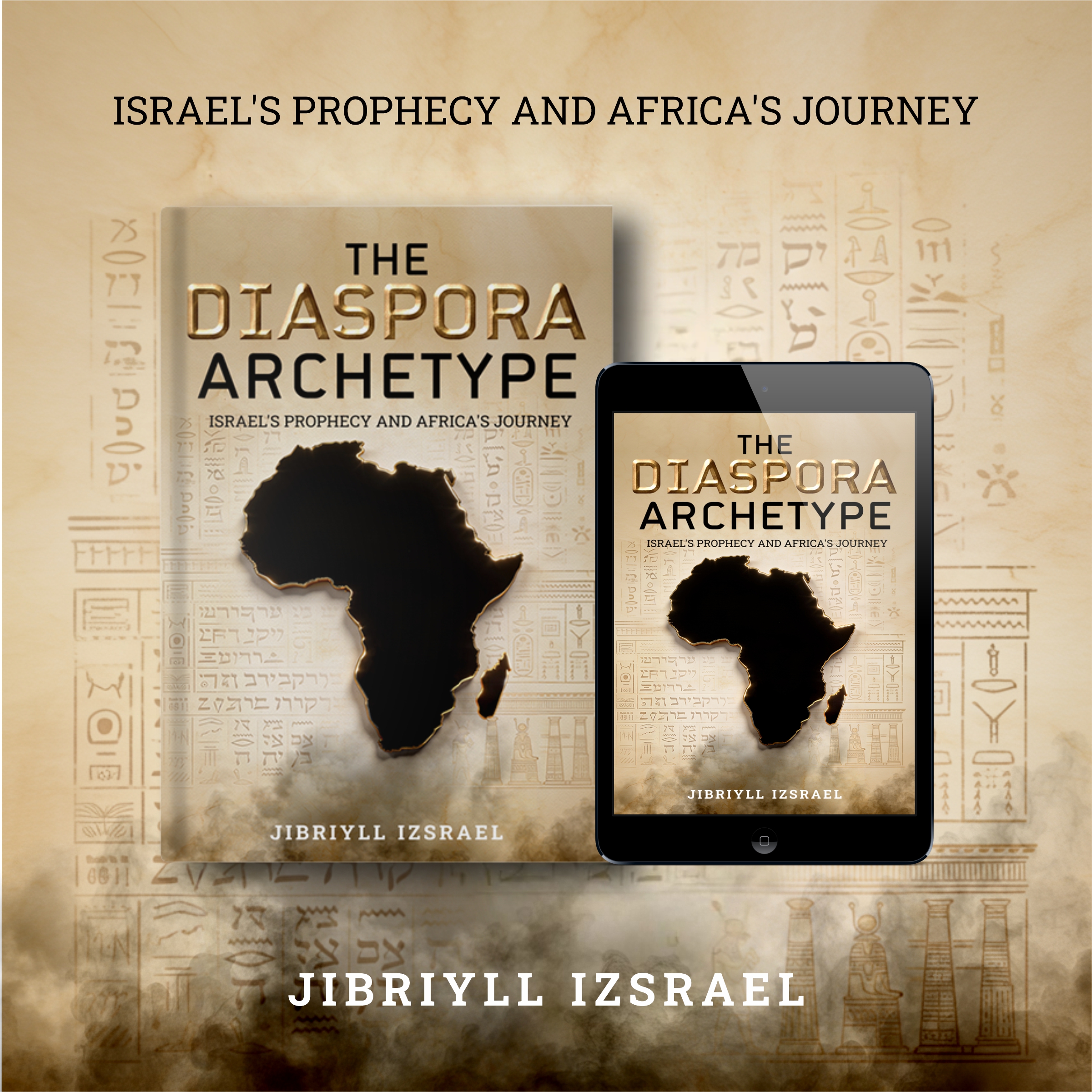
The Diaspora Archetype: Israel's Prophesy and Africa's Journey-Chapter 12
-
 By Jibriyll Izsrael
- 2026-03-19
The Africa–Caribbean Corridor — From Extraction to Circulation
The Diaspora Archetyp-Chapter 12
The Middle Passage Reopens
Previously in Chapter Four: Migrations of Memory, the Atlantic was named not merely as a body of water,
but as a moving archive of rupture, violence, erasure, and forced disassembly.
It was the ocean across which African peoples were transformed into cargo,
kinship into commodity,
and memory into silence.
Migrations of Memory established a foundational truth:
Diaspora is not dispersion alone.
It is structured separation enforced by maritime power.
The reindustrialization of the Diaspora, outlined in the preceding chapter, builds upon that insight by asserting an equally foundational countertruth:
Sovereignty is not an abstraction—
but an infrastructure—
forged in factories, logistics networks, energy systems, and disciplined human creativity.
Yet even industrial capacity cannot heal a wound that was maritime in origin.
A people scattered by ships cannot be reunited by factories alone.
Industrial power grants autonomy.
But corridors—
especially maritime corridors—
restore destiny.
In Chapter Two: The Architecture of the Diaspora Archetype, production flowed out of Africa while value was captured elsewhere.
The ocean functioned as a one-way valve of extraction.
Here, the Middle Passage is reintroduced—
not as an abyss of loss,
but as a contested space capable of reprogramming.
What once severed,
must now synchronize.
What once erased,
must now circulate.
Thus, the next phase of diasporic reconstruction emerges with historical inevitability:
The Atlantic itself must be reclaimed as infrastructure.
The Jet That Announced a New Era
In Migrations of Memory, the Middle Passage was framed as a moving graveyard—
an ocean whose routes were mapped by whips, chains, insurance ledgers, and imperial navies.
Those same routes structured Black dispossession for centuries.
Against that history, the chartered jet traveling from Accra to the Caribbean marked something unprecedented:
The reversal of exile without coercion.
When the aircraft touched down,
it interrupted a logic that had endured for four hundred years.
A route once defined by forced removal
now carried intentional return—
organized, capitalized, and sovereign.
Sponsored by Milvest, the strategic investment arm of Miller Holding,
the flight anchored the GUBA Trade and Investment Conference and Awards 2025.
There, public officials, corporate leaders, financiers, and diasporic entrepreneurs gathered
to outline a projected $3 trillion Africa–Caribbean economic space.
In Chapter Two, the Middle Passage was memory that moved without consent.
Here, it becomes a generational corridor of retrieval—
designed with purpose.
The presence of His Royal Majesty Otumfuo Osei Tutu II,
the Asantehene of Ghana,
completed the symbolic inversion.
Where enslaved Africans once crossed the seas stripped of lineage,
the Asantehene crossed it bearing intact authority,
continuity,
and ancestral legitimacy.
His words—
“History matters, but investment is what will close the distance”—
echoed the central warning of Chapter Two:
Memory preserves identity,
but structure determines destiny.
The Asantehene and the Restoration of African-Atlantic Legitimacy
Authority Older Than the European Order
Chapter Two emphasized that transatlantic slavery ruptured not only families,
but legitimacy systems—
disconnecting African peoples from political authority older than Europe itself.
The Asantehene embodies the restoration of that interrupted continuity.
His Majesty’s authority predates all modern Western economies.
It is not derivative of colonial law or postcolonial recognition.
By stepping onto Caribbean soil,
he literally returned pre-colonial sovereignty to the Diaspora.
Cultural Sovereignty as Maritime Diplomacy
Where Chapter Two documented maritime power as imperial enforcement,
the Asantehene’s presence transforms the Middle Passage into a cultural-diplomatic space.
This affirms the argument advanced earlier in the text:
That cultural institutions can operate as geopolitical actors,
opening corridors where states alone cannot.
Moral Gravity After Maritime Trauma
The Atlantic was once the geography of moral collapse.
As established in earlier chapters,
reconnection without ethical grounding risks reproducing the logic of domination that created exile.
The Asantehene’s role restores moral gravity to transoceanic engagement—
ensuring that reconnection is covenantal,
not extractive.
From Extraction to Circulation
Chapter Two traced the transoceanic slave system as a closed circuit:
African labor moved outward.
Wealth accumulated elsewhere.
The Africa–Caribbean corridor represents a structural inversion of that design:
Trade integration rewires supply chains once bypassing Black ownership.
Financial interoperability disrupts currency dependency.
Industrial and energy collaboration reverses plantation logic.
Cultural economies convert memory into retained value.
The Middle Passage shifts from extraction corridor—
to value-retention loop.
Geopolitics After the Erosion of Monopoly
In Chapter Two, control of sea lanes meant control of history.
That monopoly is now fracturing.
BRICS expansion, currency diversification, and South–South cooperation reopen the Atlantic
as a plural space rather than an imperial one.
Africa and the Caribbean now meet—
not as supplier and dependency—
but as co-architects of a shared maritime future.
This fulfills the trajectory outlined in the opening chapters:
The Diaspora emerging as a multi-nodal global polity.
Corporate Vessels After Imperial Ships
Where Chapter Two chronicled domination by slave ships and imperial fleets,
this chapter introduces a new maritime actor:
African corporate diplomacy.
Institutions like Milvest demonstrate how capital, logistics, and trust
can move through African-controlled systems—
rather than foreign intermediaries.
The corridor thus becomes a space of negotiated exchange—
rather than enforced inequality.
This is maritime sovereignty—
expressed through enterprise.
Memory Reclaimed as Maritime Capital
Throughout the African diasporic journey,
memory has survived in fragments.
Here, diasporic memory re-enters history—
as strategic capital.
Memory becomes collateral.
Identity becomes infrastructure.
Investment becomes instrument.
AAU, Sovereign Wealth, and the Post-Atlantic Order
The Africa–Caribbean corridor operationalizes the AAU’s central thesis:
Sovereignty emerges where markets, memory, and institutions converge.
The path that led to exile now leads to reassembly.
The corridor thus becomes the logistical spine of the New Jerusalem vision—
supporting supply chains, capital flows, and cultural legitimacy.
Structural Forces — Why the Atlantic Cannot Close Again
Exile was engineered.
Reassembly is now structural.
Demography.
Technology.
Economics.
Culture.
Imperial decline—
all converge to prevent a return to strategic isolation.
The Atlantic cannot be resealed,
because the architecture of separation has already collapsed.
History has shifted phases.
Conclusion — The Atlantic Healed
Chapter Two named the sea as the wound.
This chapter names it as healing.
History remains our identity.
Investment becomes our instrument.
Unity forms our architecture.
The ocean that once carried chains—
now carries strategy.
The routes of dispersal—
become the doors of return.
The Diaspora Archetype no longer floats in theory.
It docks in reality.
Support the Work
If this chapter resonated with you, consider supporting the African American Union.
Your support helps expand education, economic cooperation, and cultural development within our community.• Become a member
• Support the Union store
• Share this chapter
• Make a contribution
All net proceeds from the Sovereign Trilogy are dedicated to helping seed the African American Sovereign Wealth Fund, an initiative of the African American Union designed to strengthen economic cooperation and institution-building for future generations.
By supporting this work, readers help transform ideas into lasting infrastructure for our community.