
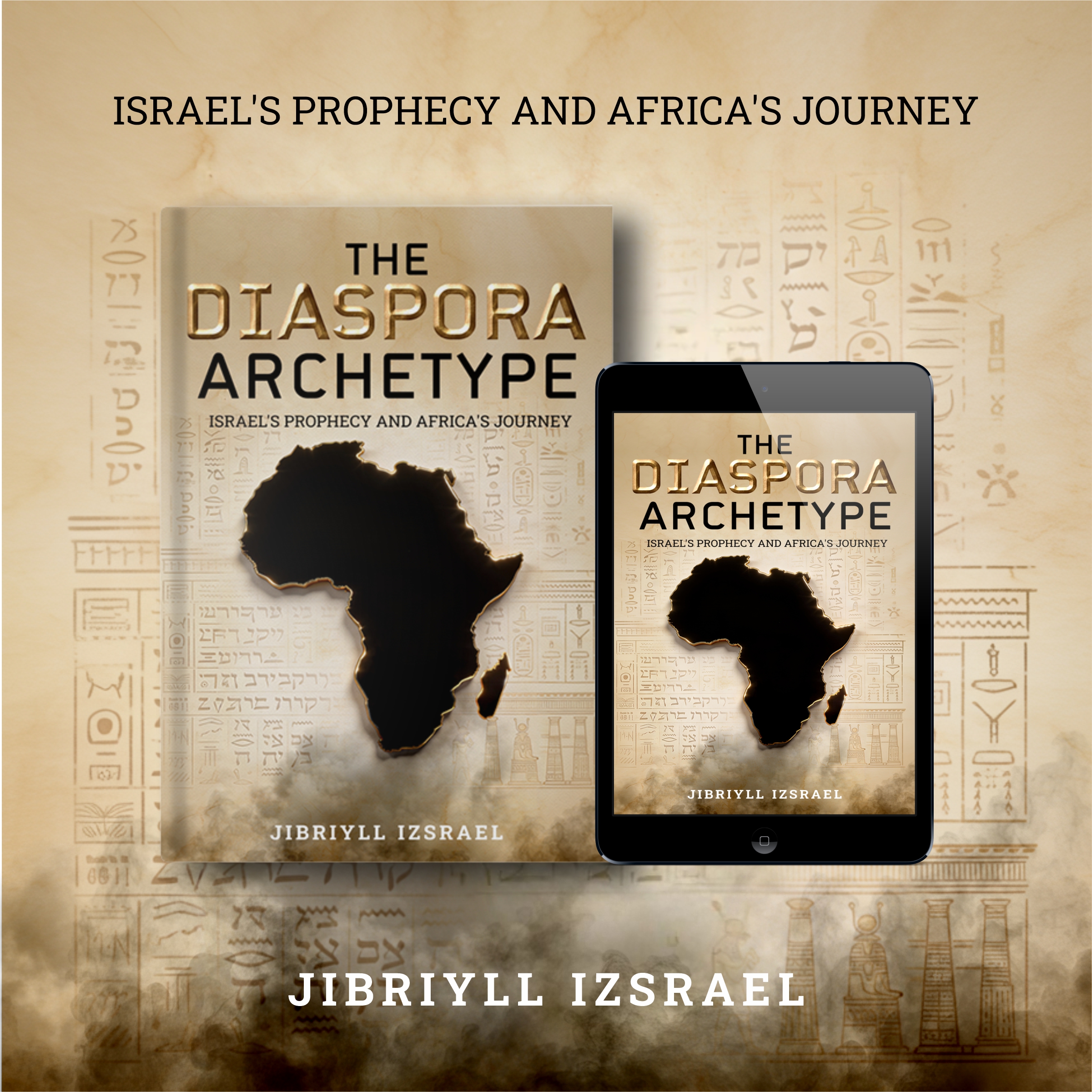
The Diaspora Archetype: Israel's Prophesy and Africa's Journey-Chapter 14
-
 By Jjibriyll Izsrael
- 2026-03-19
The Architecture of Disenfranchisement — Conquest Beyond Territory
The Diaspora Archetype-Chapter 14
Conquest Beyond Territory
Conquest, as it has operated across African history,
cannot be reduced to the seizure of land
or the defeat of armies.
Such a framing misunderstands
its most enduring
and consequential dimension.
True conquest is not merely territorial—
it is civilizational.
It is the systematic reordering of the structures
through which meaning,
legitimacy,
and humanity itself
are defined.
As established in Chapter Two,
the Atlantic world-system did not simply move bodies across water;
it transferred authorship—
over labor, law, memory, and value—
away from African peoples
and into foreign hands.
What followed across the continent and the Diaspora
was not uniform erasure,
but something more precise—
and more devastating:
the capture of the mechanisms
by which a people recognizes itself as sovereign.
When domination succeeds,
it does not stop at borders.
It reorders language—
determining which tongues grant access to power
and which are confined to ritual, folklore, or private memory.
It reconfigures law—
displacing indigenous jurisprudence with alien legal regimes
that redefine property, personhood, and obligation.
It recenters religion—
elevating imported sacred narratives
while demoting ancestral cosmologies
to superstition or heresy.
It restructures land tenure—
transforming communal inheritance into extractable commodity.
It captures trade routes—
redirecting wealth outward rather than circulating it locally.
And most critically,
it redraws the boundary of the human—
deciding who may rule, testify, inherit,
and shape the future.
This is conquest at its most complete.
Conquest as Structural Reclassification
Over time,
such total reordering produces outcomes
that appear as demographic disappearance.
Peoples seem to have been “pushed out,”
replaced,
or extinguished.
Yet in many cases,
the deeper mechanism is not annihilation—
but a triad far more insidious:
Assimilation
Dispossession
Selective displacement
These mechanisms allow conquest to persist
long after flags are lowered
and armies withdraw.
Assimilation — Survival as Conditional Identity
Assimilation functions
not as cultural surrender,
but as rational survival.
When access to safety, education, trade, or dignity
is conditioned upon adopting the conqueror’s language,
religion,
or norms—
adaptation becomes necessity
rather than choice.
In Egypt,
the Arab-Islamic conquests of the seventh century
did not eliminate the indigenous population.
Instead, across generations:
Arabic displaced Coptic as the language of administration and prestige.
Islam became dominant in public life.
Egyptian identity was not erased.
It was reclassified.
The people remained—
but civilizational authorship
was gradually reassigned.
A parallel process unfolded across the Maghreb.
Indigenous Amazigh populations were not exterminated;
they were absorbed into a new hierarchy of legitimacy.
Arabization reshaped linguistic authority.
Islamic jurisprudence reordered law.
Land relations were transformed.
Over time,
the conqueror’s identity became synonymous with civilization—
while indigenous identity was permitted cultural expression
without political authority.
Assimilation, in this sense,
is not disappearance.
It is presence without authorship.
Dispossession — Sovereignty Neutralized Without Erasure
Dispossession operates more quietly.
It does not require cultural replacement—
it requires institutional capture.
Among the Akan and Ashanti,
sovereignty was not dismantled
through immediate cultural suppression,
but through colonial administrative control.
British rule redirected:
Taxation
Courts
Trade
Diplomacy
into imperial hands—
rendering indigenous governance ceremonial
rather than sovereign.
The Golden Stool became more than a cultural symbol—
it became a contested site of legitimacy.
Its authority exceeded colonial categories—
and therefore threatened them.
The struggle was never about the stool itself,
but about who possessed the power
to define political reality.
This pattern recurs across the continent:
Rulers remain.
Rituals persist.
But decision-making power migrates elsewhere.
Selective Displacement — Removing the Keepers of Continuity
Selective displacement completes
the architecture of disenfranchisement.
Rather than uprooting entire populations,
conquest targets those most capable of sustaining
institutional continuity:
Political elites
Spiritual authorities
Warrior classes
Legal custodians
Communities such as the Lemba and Beta Israel
demonstrate how sovereignty can survive underground
when public legitimacy is denied.
Through kinship law, ritual observance, and oral transmission,
identity persists—
even as recognition vanishes.
In Ethiopia,
the designation Falasha—
often translated as “landless” or “exile”—
was not merely descriptive.
It was juridical.
It removed a people from the legal definition of belonging
while leaving them physically present.
They remained in place—
yet outside the architecture of power.
The Paradox of Presence Without Power
The cumulative effect of:
Assimilation
Dispossession
Selective displacement
produces a recurring paradox
across African and Diasporic history:
A people remains in place,
yet experiences its own antiquity as foreign.
Ancient civilizations are admired—
but treated as artifacts.
Indigenous systems are remembered culturally—
but denied political authority.
History becomes something that happened to a people—
not something they are permitted to extend.
As argued throughout The Diaspora Archetype,
conquest succeeds not when a people disappears—
but when it loses authorship:
Over institutions
Over memory
Over the definition of the human
Presence without power
is mistaken for survival.
Continuity without control
is normalized as peace.
From Memory to Institution — The Axis of Restoration
History does not end in suspension.
What has been fractured
can be reconsolidated.
As demonstrated in Chapters Nine through Eleven,
restoration does not begin with nostalgia—
nor with symbolic recovery alone.
It begins when:
Memory becomes institution
When language regains legal force
When ancestral ethics inform contemporary law
When land is governed as inheritance rather than commodity
When trade routes circulate wealth within communities
When finance serves continuity rather than extraction
When a people defines itself as fully human within its own political order
This is the logic animating:
The African American Union
The Sovereign Wealth doctrine
The Africa–Caribbean corridor
The coming global rebalancing
These are not isolated projects.
They are institutional responses
to a civilizational wound.
Completion, Not Reversal
The reconsolidation of African sovereignty—
across the Nile corridor,
the Maghreb,
Akan and Ashanti lands,
communities such as the Lemba and Beta Israel,
and the global African Diaspora—
is not a reversal of history.
It is its completion.
For centuries,
global stability has been purchased through imbalance.
Extraction has been normalized as order.
Dispossession has been mislabeled as development.
Yet no system built on denied humanity
can endure indefinitely.
As argued in the preceding chapter,
when African peoples reclaim institutional authorship—
financial, legal, cultural, and geopolitical—
the consequences reverberate globally:
Extraction yields to reciprocity.
Proxy wars lose their economic rationale.
Forced migration declines as dignity and opportunity rise at home.
The myth that peace requires domination dissolves.
Restoration as Global Repair
This is why the project articulated in The Diaspora Archetype
is neither separatist
nor antagonistic.
It is restorative.
It seeks balance
where imbalance was engineered.
It insists that a world made whole
requires all its civilizational pillars
to stand upright.
When Africa stands—
not as resource,
not as symbol,
but as sovereign author—
the world will not collapse.
It will finally exhale.
Support the Work
If this chapter resonated with you, consider supporting the African American Union.
Your support helps expand education, economic cooperation, and cultural development within our community.• Become a member
• Support the Union store
• Share this chapter
• Make a contribution
All net proceeds from the Sovereign Trilogy are dedicated to helping seed the African American Sovereign Wealth Fund, an initiative of the African American Union designed to strengthen economic cooperation and institution-building for future generations.
By supporting this work, readers help transform ideas into lasting infrastructure for our community.