
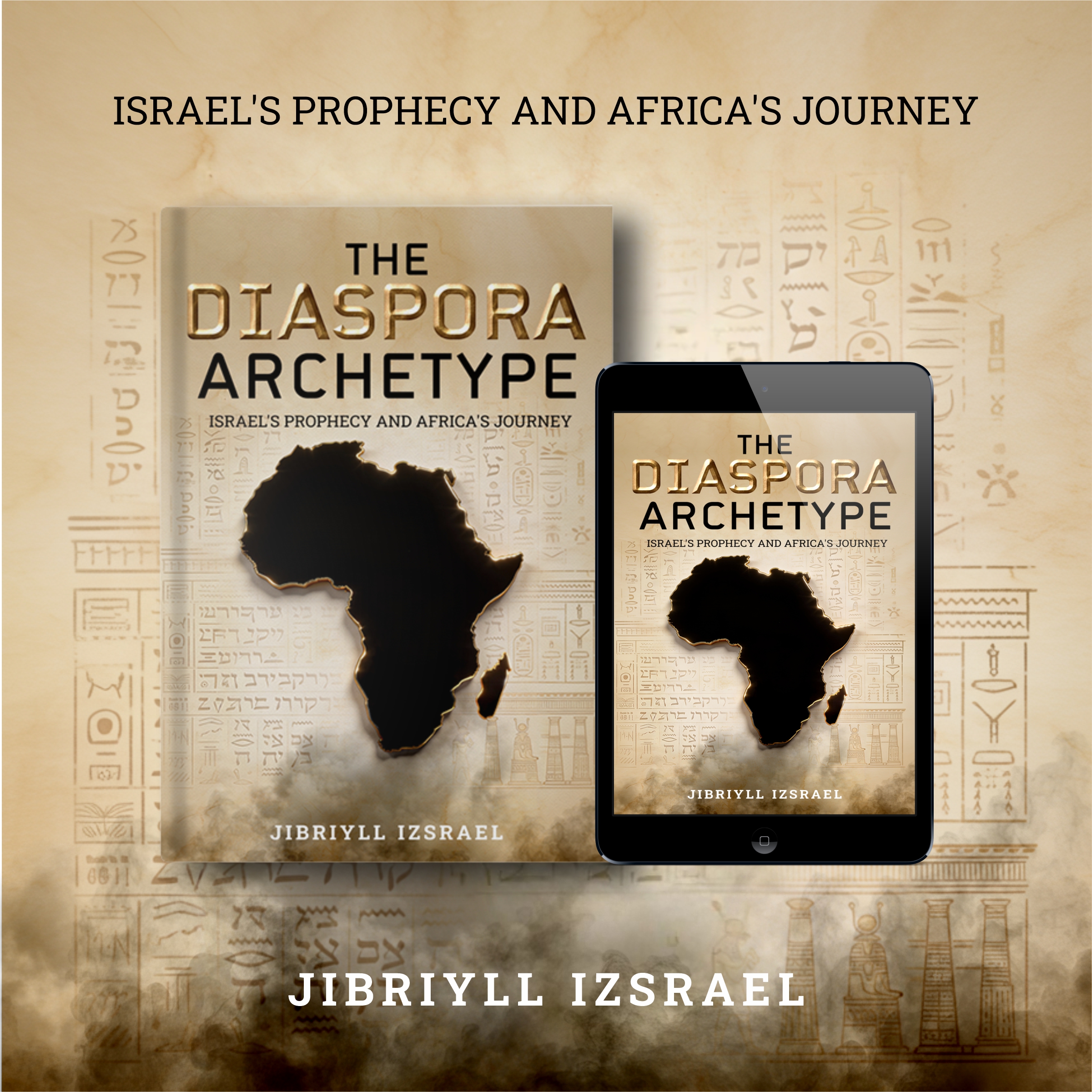
The Diaspora Archetype: Israel's Prophesy and Africa's Journey-Chapter 15
-
 By Jibriyll Izsrael
- 2026-03-19
“They Left Here Black and Came Back White” — Nasser, Racial Memory, and the Politics of Identity Reconstruction
The Diaspora Archetype-Chapter 15
Introduction — A Line That Fractured the Archive
Few statements in the twentieth century condense the collision of:
Race
Memory
Empire
Return
as starkly as Gamal Abdel Nasser’s 1958 remark:
“They left here Black and came back White.”
With this line,
the Egyptian president was not commenting on skin tone alone.
He was naming a civilizational rupture—
a transformation in how the ancient Near East was remembered,
racialized,
and inherited.
He was pointing to a discontinuity:
Between antiquity and modern return
Between origin and representation
Within the framework of The Diaspora Archetype,
Nasser’s remark functions as a diagnostic key.
It exposes how identity is:
Reshaped in exile
Weaponized by empire
Contested in movements of return
It forces a question that echoes across the African world:
Who controls historical memory—
and who is permitted to inherit its authority?
Ancient Israel in the Afro-Asiatic World
Long before modern racial categories hardened into ideology,
the ancient Near East existed as an Afro-Asiatic ecumene—
a continuous civilizational belt linking:
Egypt and Nubia
Cush and Ethiopia
The Arabian Peninsula
The Levant
Scholars such as:
Cheikh Anta Diop
Théophile Obenga
J. A. Rogers
W. E. B. Du Bois
argued that this world was neither European nor “white” in any modern sense.
It was:
African in origin
African-influenced
African-participatory
The early Hebrews emerged from this milieu.
They were Semitic shepherds shaped by:
Northeast Africa
Arabia
—not by Europe.
Genesis repeatedly situates their story in:
Egypt
Cush
signaling proximity not only geographic—
but cultural and historical.
To say that the Israelites “left here Black”
was not exaggeration.
It reflected a pre-modern historical consensus later obscured:
Israel emerged from an Afro-Asiatic world
whose memory would be overwritten by empire.
Whitening Antiquity — Empire’s Reassignment of Sacred Authority
As Europe ascended to global dominance,
it did not conquer territory alone.
It conquered time.
A systematic project of racial reassignment unfolded across antiquity:
Jesus rendered as a pale European
Moses, Solomon, and the prophets visually Westernized
Egypt reclassified as “Mediterranean Caucasoid”
African Church Fathers minimized or erased
Afro-Asiatic sacred history recoded as European inheritance
This was not coincidence.
It was theological strategy.
By transferring sacred authority to European identity,
empire legitimized colonial domination
as destiny rather than theft.
Sacred history became political capital.
Whiteness became divine proximity.
Nasser’s statement thus rebuked not only modern geopolitics—
but a deeper maneuver:
the whitening of antiquity to authorize empire.
Zionism and the Question of Return
When the modern State of Israel was established in 1948,
Nasser did not interpret it
as a seamless return of ancient Afro-Asiatic Hebrews.
He perceived a phenomenon consistent with the patterns traced throughout this work:
A European nationalist project transplanted into the Near East
A demographic transformation facilitated by British imperial power
A political culture formed primarily within Europe rather than the Levant
When he said:
“…and came back White,”
Nasser was not rejecting Judaism.
He was interrogating transformation through exile.
Those who returned appeared:
European politically
European culturally
European linguistically
Often European phenotypically
—bearing the imprint of centuries under European systems.
The question he raised was not solely religious authenticity—
but civilizational continuity as a whole:
Had exile altered identity so profoundly
that return itself became rupture?
Diaspora as Ontological Restructuring
Here, Nasser’s insight converges directly with The Diaspora Archetype.
Diaspora is not merely geographic displacement.
It is ontological restructuring—
the remaking of a people
by the systems that govern them in exile.
This pattern recurs across history:
Roman refashioning of early Christianity
Europeanization of Jewish identity
Whitening of biblical iconography
Racialization of Africans in the Americas
Absorption of Irish, Italian, and German identities into “whiteness”
Empire does not merely rule bodies.
It reformats identity.
Nasser’s statement thus operates as both warning and mirror:
Exile distorts memory.
Empire redefines identity.
Liberation requires recovery.
The Battle for Memory and Sacred Inheritance
Why does this question remain so charged?
Because ancient identity confers legitimacy—
over land,
theology,
and destiny.
If ancient Israel was Afro-Asiatic,
then Africa and the African Diaspora are not marginal to biblical history.
They are central.
This reorients sacred memory
and disrupts centuries of European theological monopoly.
As shown in earlier chapters,
narrative authority precedes institutional power.
To reclaim memory
is to reclaim authorship.
For African peoples rising toward sovereignty,
this realization is catalytic:
Our inheritance is not derivative.
It is foundational.
The African American Parallel — The Archetype Clarified
At this point,
the parallel becomes unavoidable.
African Americans experienced a comparable process:
Forced removal from Africa
Reclassification under European racial hierarchies
Suppression of indigenous spiritual systems
Imposition of foreign names, laws, and identities
Theological whitening alongside social degradation
Like ancient Israelites in exile,
African Americans were transformed by empire—
then denied the legitimacy of their origins.
Nasser’s critique becomes both metaphor and mirror:
A people cannot fulfill its destiny
while living inside an identity
authored by its oppressor.
The Diaspora Archetype teaches:
Return is not only geographic or economic.
It is historical and spiritual.
Conclusion — The Return of the Real
Nasser’s line was not insult.
It was diagnosis.
It named:
The mutation of identity in exile
The weaponization of race in theology
The politics of return
The struggle for memory against empire
Within The Diaspora Archetype,
the statement becomes a rallying truth:
The true return is not movement alone.
It is the restoration of authorship.
Just as Nasser challenged the whitening of ancient Israel,
the African Diaspora must challenge
the distortion of its own civilizational centrality.
To return is to remember.
To remember is to resist.
To resist is to rise.
Support the Work
If this chapter resonated with you, consider supporting the African American Union.
Your support helps expand education, economic cooperation, and cultural development within our community.• Become a member
• Support the Union store
• Share this chapter
• Make a contribution
All net proceeds from the Sovereign Trilogy are dedicated to helping seed the African American Sovereign Wealth Fund, an initiative of the African American Union designed to strengthen economic cooperation and institution-building for future generations.
By supporting this work, readers help transform ideas into lasting infrastructure for our community.