
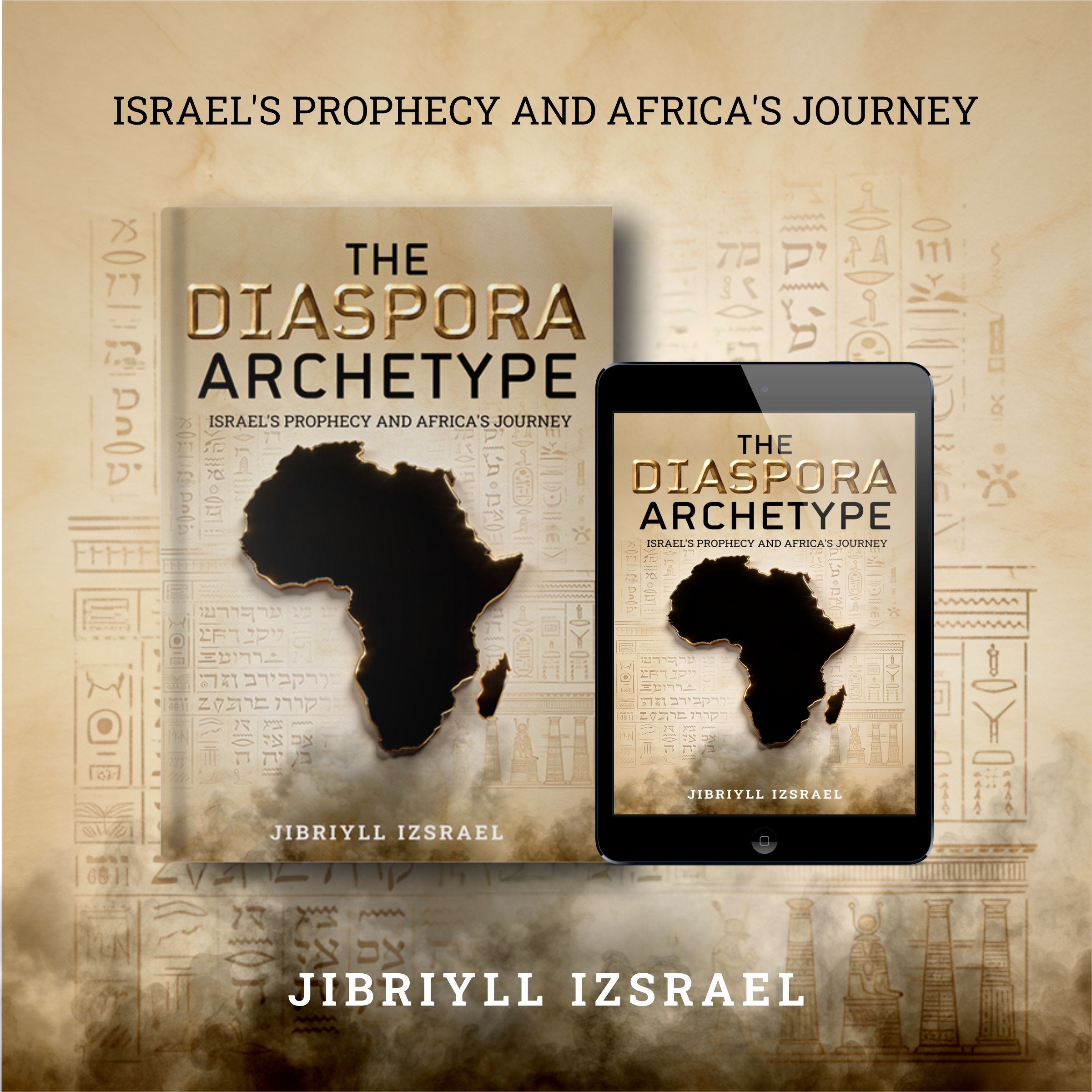
The Diaspora Archetype: Israel's Prophesy and Africa's Journey-Chapter 19
-
 By Jibriyll Izsrael
- 2026-03-20
Islam as the Refuge of Jerusalem’s Memory
The Diaspore Archetype-Chaper 19
Jerusalem Was Never Merely a City
Jerusalem was never merely a city.
It exists as holy parable,
a sanctuary of ethical discourse,
the revelation and interpretation of man’s purpose in this world—
and the next.
It functions as a theological archive—
a living repository of covenantal memory, prophetic resistance, and moral law
forged under the pressure of empire.
When Rome destroyed the city and scattered its people,
it assumed the archetype had been erased.
Empires routinely mistake the destruction of geography
for the destruction of meaning.
What Rome conquered was territory.
What the people failed to relinquish—
was covenant.
This chapter advances a necessary claim within The Diaspora Archetype:
Islam emerged, in part, as a refuge
for the displaced memory of Jerusalem.
Islam was not a replacement religion,
nor merely a derivative sect.
It functioned as an anti-imperial preservation
of pure Abrahamic monotheism
after Jerusalem’s institutional capture.
This is not a claim of succession,
but of continuity under exile—
of covenant learning to travel
when temples could not.
Ishmael Remembered — Genesis 17:20 and the Custody of Memory
Genesis 17:20 records a promise too often acknowledged,
yet rarely understood:
“And as for Ishmael, I have heard you: I will surely bless him; I will make him fruitful and will greatly increase his numbers. He will be the father of twelve rulers, and I will make him into a great nation.”
Among African and African American Christians,
this verse is familiar.
Among many African American Kemetic, Yoruba, and Hebrew Israelite communities,
it is often dismissed as irrelevant.
The reasons are not difficult to trace.
The Arab slave trade inflicted real trauma.
Centuries of violence, captivity, and humiliation
at the hands of Muslim empires
have left scars that do not disappear
through theological abstraction.
For many,
any gesture of recognition or respect toward Islam
feels like betrayal.
Yet Scripture does not allow us the luxury
of erasing what history has wounded.
Genesis 17:20 is not peripheral.
It is covenantal.
Ishmael was not an accident,
nor a discarded lineage.
The text is explicit:
God hears.
God blesses.
God multiplies.
God constitutes a nation.
Whatever later history becomes,
this blessing is neither revoked
nor subordinated to Isaac’s election.
The covenant with Isaac establishes a line of promise.
The blessing of Ishmael establishes a people of destiny.
Scripture maintains both—
without confusion.
To dismiss Ishmael
is not to protect Israel.
It is to misunderstand
the architecture of the Abrahamic narrative itself.
Twelve Rulers, Not a Footnote
The language of “twelve rulers” is not incidental.
It mirrors the twelve tribes of Israel,
signaling not competition,
but parallel structure.
The text does not present Ishmael as covenantless.
It presents him as governed differently—
yet intentionally.
This matters for diaspora peoples,
particularly those scattered through Africa
and later the Americas.
Genesis establishes that God’s dealings with history
are not monolinear.
Multiplicity of inheritance
does not negate election.
It contextualizes it.
The tragedy is not that Ishmael was blessed.
The tragedy is that his blessing was later weaponized—
by empire,
by commerce,
by conquest—
against other descendants of Abraham,
including those who would one day be dragged into bondage from inner Africa.
But Scripture distinguishes
between divine promise
and human misuse of power.
To collapse the two
is to indict God
for the crimes of empire.
The implications of this distinction are enormous.
When the promises given to Abraham
are understood as structurally plural
rather than monopolized by a single lineage,
the centuries-old tension
between the heirs of Isaac
and the heirs of Ishmael
begins to dissolve.
The text no longer reads
as a contest of legitimacy,
but as a framework of differentiated purpose
within a single sacred history.
The sons of Abraham cease to appear as theological rivals
and instead emerge as parallel participants
within a broader covenantal landscape.
The African World and the Abrahamic Meeting Point
For the African world—
both on the continent and throughout the diaspora—
this recognition carries particular weight.
Much of Africa’s spiritual geography
has long been shaped by the meeting of two Abrahamic traditions:
The Hebraic or Judaeo-Christian tradition,
historically linked to the Isaac narrative through its scriptural inheritance
and
Islam,
which traces deep identity through the line of Ishmael.
When these traditions are interpreted through the lens of rivalry,
the continent inherits a narrative of division
that was never required by the original text.
But when the Genesis account is read with structural clarity,
the perceived contradiction softens.
What once appeared as competing claims to divine favor
instead reveals itself
as a shared participation
in the unfolding of Abraham’s legacy.
Such a realization alters the emotional landscape
of the African world.
Communities that once approached one another through suspicion
may begin to recognize themselves
as participants in the same ancestral story—
shaped by different covenants,
yet rooted in a common patriarch.
The result is not theological uniformity—
nor should it be—
but the possibility of civilizational cooperation
grounded in mutual legitimacy.
Where rivalry once produced fragmentation,
recognition may produce alignment.
For African diasporic communities,
whose histories were later entangled through conquest, trade, and forced migration,
this reconciliation carries profound implications.
It invites Christians and Muslims alike
to see one another
not as theological adversaries competing for inheritance,
but as branches of a shared Abrahamic narrative
whose destinies intersect across the globe.
In such a light,
the old divisions lose much of their viability.
What remains is the opportunity
for renewed intellectual and spiritual solidarity—
capable of strengthening the African world
rather than fracturing it.
The Abrahamic Question Revisited
For centuries,
the story of Abraham’s sons
has been treated as a fault line of civilization.
Isaac and Ishmael were often framed as symbols
of competing inheritances,
their names invoked in theological disputes,
political arguments,
and cultural rivalries
stretching from the Middle East to Africa and beyond.
Yet when the foundational texts themselves
are examined carefully,
a striking reality emerges.
The narratives of Genesis
and the Qur’anic tradition alike
preserve Abraham
as the patriarch of a vast spiritual family.
Within that story,
Isaac carries the covenantal line,
yet Ishmael is explicitly blessed,
multiplied,
and promised nationhood.
The distinction is real—
but the rivalry so often built upon it
is not required by the text itself.
This observation matters profoundly
for Africa and the diaspora,
where Christianity and Islam—
both Abrahamic traditions—
have shaped the spiritual life
of hundreds of millions of people.
Too often these traditions have been presented
to one another as adversaries competing for legitimacy.
Yet both revere Abraham.
Both affirm divine blessing upon his descendants.
Both call humanity toward reverence, justice, and submission to the Creator.
Seen in this light,
the Abrahamic story begins to look less like a battlefield
and more like a family narrative
that grew larger than its earliest interpreters imagined.
What later history sometimes framed as rivalry
may instead reflect the expansion
of a single spiritual lineage
whose branches spread across continents.
When that possibility is acknowledged,
the emotional landscape shifts.
The question ceases to be
which branch of Abraham’s family should erase the other.
The question becomes
how the descendants of a shared patriarch
might recognize the depth of their intertwined inheritance.
For the African world—
where Christian and Muslim communities often live side by side—
this recognition can be transformative.
It does not dissolve theological differences,
nor should it.
But it reminds us
that the two largest faith traditions shaping African spiritual life
originate within the same Abrahamic story
and share a common call
toward devotion to the One.
In that sense,
the Abrahamic traditions may be understood
not as rival civilizations
but as a vast prophetic family—
diverse in expression,
yet united in the conviction
that human life is oriented toward reverence for the Creator
and responsibility toward one another.
And when the texts themselves are allowed to speak plainly,
the possibility of such recognition appears
not as a modern invention,
but as something present in the story
from the very beginning.
In the end,
the story of Abraham was never meant to belong to one tribe alone.
It began in a desert family
whose descendants would one day span continents,
languages,
and civilizations.
From the Middle East to Africa,
from the villages of the continent to the cities of the diaspora,
billions of people now trace spiritual memory
to that same patriarch
who lifted his eyes toward heaven
and trusted the unseen.
The divisions later layered upon this inheritance are real—
but they are not the whole story.
Beneath them remains a deeper continuity:
A shared call toward reverence for the Creator
and responsibility toward one another.
And when that continuity is remembered,
the Abrahamic traditions begin to look less like rival camps
and more like branches of a vast prophetic family—
whose roots reach back to Abraham,
and whose branches may yet shelter the human family.
Islam as the Keeper of Jerusalem’s Exiled Memory (7th Century CE)
By the 7th century CE,
Jerusalem had passed through Roman, Byzantine, and Christian imperial hands.
Its Hebraic population had been expelled or marginalized.
Its Temple had been destroyed.
Its messianic memory had been absorbed into imperial theology.
When Islam emerged in Arabia (c. 610–632 CE),
it did something historically anomalous:
It re-centered Jerusalem without possessing it.
Islam affirmed:
The prophetic lineage of Abraham
The sanctity of Jerusalem (al-Quds)
The continuity of Moses, David, Solomon, and Jesus
The oneness of God without imperial mediation
Crucially,
Islam did not claim Jerusalem by inheritance,
but by guardianship.
It preserved the memory of the city’s holiness
at a time when neither Rome nor Byzantium
could do so without distortion.
In this sense,
Islam functioned as a refuge
for Jerusalem’s memory—
not its replacement.
This does not erase conflict.
It contextualizes it.
African Memory, African Wounds, and Discernment
African peoples encountered Islam in multiple ways:
As trade partner
As intellectual interlocutor
As imperial oppressor
All are true.
None cancel Genesis 17:20.
The failure has been our inability
to hold discernment without amnesia:
To condemn enslavement without denying covenant
To name violence without erasing Scripture
To remember wounds without rewriting Genesis
For African American Israelites especially,
the temptation to discard Ishmael
mirrors the very logic used to discard us:
You matter only insofar as you fit the chosen narrative.
Scripture resists this logic.
God heard Hagar.
God heard Ishmael.
And God did not require Israel’s approval to do so.
Toward Maturity of Interpretation
Reclaiming Israel
does not require hostility toward Islam.
Honoring Isaac
does not require erasing Ishmael.
And healing African memory
does not require theological amputation.
Genesis 17:20 stands as a rebuke to reductionism—
religious, racial, or historical.
It insists that the God of Abraham
governs history through overlapping destinies,
not ethnic monopolies.
To understand diaspora
is to understand this tension:
That some lineages carry promise,
others carry preservation,
and still others carry memory—
until the time comes
when all must be reconciled to truth.
Jerusalem Before Capture — Covenant Against Empire
Before Roman domination,
Jerusalem embodied a theology
fundamentally incompatible with empire.
Its monotheism was radical.
Its law was moral rather than administrative.
Its prophets were confrontational rather than ceremonial.
Kings were judged—
not sanctified.
Righteousness was measured
by justice toward the poor—
not by ritual spectacle.
The earliest followers of Jesus,
centered around James the Just and the Jerusalem assembly,
stood firmly within this tradition.
Their faith was:
Ethically demanding
Torah-anchored
Resistant to imperial accommodation
Jesus himself was remembered
not as a metaphysical abstraction,
but as a righteous teacher executed by the state.
Rome did not destroy Jerusalem because it was weak.
It destroyed it because it was dangerous.
Rome’s Substitution — Winning Stone, Losing Meaning
After Jerusalem’s fall,
Rome enacted a substitution.
Covenant gave way to creed.
Law yielded to metaphysics.
Prophetic critique was replaced by orthodoxy.
Justice was absorbed into order.
Christianity was not eliminated.
It was re-engineered.
Stripped of its Jewish ethical framework
and depoliticized through universal doctrine,
it became compatible with imperial administration—
and eventually capable of legitimizing empire itself.
Yet something essential was displaced.
Jerusalem’s counter-imperial memory did not vanish.
It migrated.
Exile as Preservation — The Margins Remember
Contrary to later assumptions,
non-imperial forms of Jewish Christianity did not disappear.
Communities persisted on the margins:
Ethically rigorous
Uncompromisingly monotheistic
Skeptical of divinization
Committed to law, almsgiving, fasting, and resistance to empire-aligned theology
At the same time,
monotheist seekers and Abrahamic communities
lived beyond Roman and Persian control in Arabia.
Its geopolitical marginality
allowed displaced memory to survive
without imperial censor.
Exile, in this sense,
did not erase covenant.
It preserved it underground.
Islam’s Emergence Outside Empire
Islam did not arise in imperial capitals.
It emerged beyond Rome’s theological jurisdiction,
yet at the crossroads of displaced Abrahamic traditions.
Its core affirmations reflect this unmistakably:
Uncompromising monotheism
Law as moral dictate rather than ethnic privilege
A prophet confronting power
Abraham presented as primary ancestor and archetype of faith
This was neither Nicene Christianity
nor Rabbinic Judaism.
It was Abrahamic monotheism
cleansed of empire.
Jesus in the Qur’an — A Memory Closer to Jerusalem Than Rome
The Jesus preserved in the Qur’an
is closer to the Jesus remembered by marginalized Jewish-Christian communities:
Fully human
Born of Mary
Servant of God
Restorer of ethical law
Worker of signs by divine permission
Opposed by elites
Vindicated by God rather than enthroned by empire
Absent are the defining features
of Roman Christianity:
Imperial metaphysics
Priestly hierarchy
Sacralization of state violence
Theological justification of execution
Islam does not merely critique later Christian developments.
It preserves an earlier moral memory—
one closer to Jerusalem’s ethical grammar
than Rome’s imperial theology.
Medina as Diasporic Jerusalem
When the Prophet Muhammad migrated to Medina,
he entered a city already shaped by:
Scripture-centered life
Ethical monotheism
Covenantal law
The political order established there
was based on:
Shared obligation
Pluralism under moral law
Protection of the vulnerable
These features were far closer
to Jerusalem’s prophetic tradition
than to Roman imperial governance.
Islam did not seize Jerusalem’s memory.
It sheltered it.
Preservation, Not Replacement
To identify Islam as a refuge of Jerusalem’s memory
is not to claim the supersession of Judaism or Christianity.
It recognizes that when empire captured Abrahamic institutions,
Islam preserved Abrahamic culture and resistance.
It safeguarded:
Radical monotheism
Ethical law
Prophetic critique
Opposition to political idolatry
In this sense,
it functioned as a theological ark—
carrying endangered truths
across the floodwaters of empire.
Memory, Exile, and the Diaspora Archetype
This pattern recurs throughout the African Diaspora.
When land is stolen, memory travels.
When institutions are captured, truth migrates.
Just as Jerusalem’s covenant survived beyond Jerusalem,
African spiritual memory survived beyond Africa—
encoded in:
Song
Ritual
Ethics
Resistance traditions
—traditions empire never fully controlled.
Exile does not erase covenant.
It tests fidelity to it.
Why This Chapter Matters
The central question of The Diaspora Archetype
is not which religion is correct,
but which traditions resisted empire
and which were reshaped by it.
From this perspective,
Islam appears not as an outsider to biblical history,
but as a guardian
of its most dangerous truths—
truths empire attempted to bury
beneath councils, creeds, and crowns.
Jerusalem was conquered.
Its memory was not.
Conclusion — The City That Learned to Travel
Jerusalem learned to walk
when its walls fell.
It learned new languages.
It survived without imperial permission.
Islam is one of the places
where that memory rested,
gathered strength,
and spoke again—
outside Rome,
beyond Caesar,
beyond captured theology.
Support the Work
If this chapter resonated with you, consider supporting the African American Union.
Your support helps expand education, economic cooperation, and cultural development within our community.• Become a member
• Support the Union store
• Share this chapter
• Make a contribution
All net proceeds from the Sovereign Trilogy are dedicated to helping seed the African American Sovereign Wealth Fund, an initiative of the African American Union designed to strengthen economic cooperation and institution-building for future generations.
By supporting this work, readers help transform ideas into lasting infrastructure for our community.