
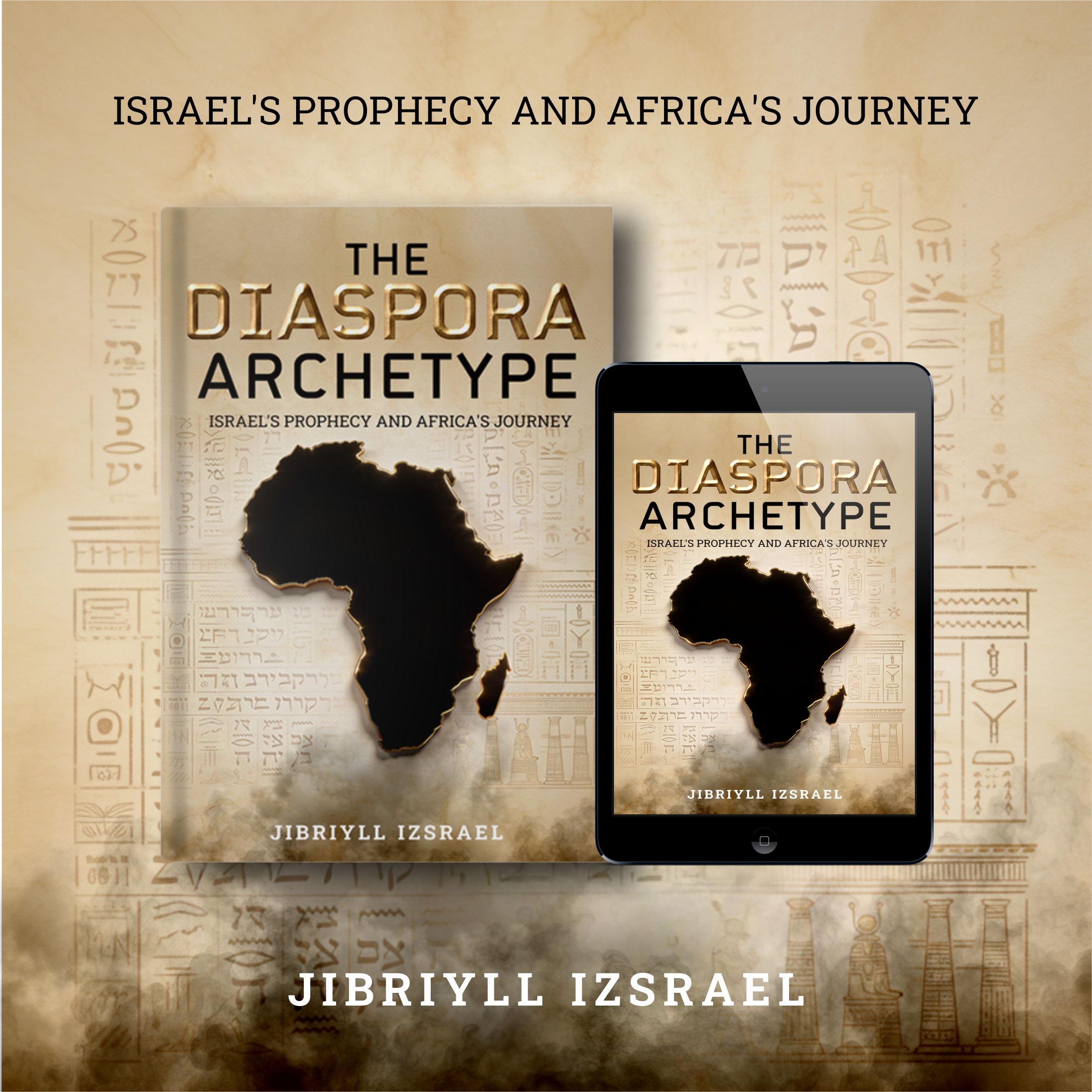
The Diaspora Archetype: Israel's Prophesy and Africa's Journey-Chapter 2
-
 By Jibriyll Izsrael
- 2026-03-17
The Architecture of the Diaspora Archetype
The Diaspora Archetype: Chapter 2
The Crucible
This book is governed by a single recognition:
History does not scatter peoples at random.
Nor does exile merely wound.
What was revealed in the darkness of covenant must now be examined in the light of structure.
Time and time again, across civilizations and centuries, displacement becomes the crucible through which conscience is refined and future order is born.
This recurring pattern—visible wherever a people is driven from land yet refuses erasure, stripped of power yet unwilling to forget—I name The Diaspora Archetype.
The Diaspora Archetype does not argue genetics per se, or that one people becomes another. Rather, it identifies a structural sequence—a grammar of historical experience—through which conscience is refined and civilization is renewed.
The archetype unfolds through four interrelated movements:
Scattering
Violent displacement from land, institutions, and political sovereignty.
This may occur through conquest, enslavement, extraction, or administrative reclassification.
Scattering fractures continuity, but it does not erase identity.
Instead, it externalizes culture, forcing it to travel.
Endurance
Survival through memory, adaptation, and communal discipline.
In exile, identity can no longer rely on territory or state power. It must be preserved through ritual, narrative, ethics, and transmission.
Endurance is not passive survival; it is the labor of coherence under pressure.
Remembrance
The reconstruction of a moral charter capable of explaining loss and assigning purpose.
Memory becomes constitutional.
Trauma is translated into meaning.
At this stage, a people no longer asks only what happened to us, but what are we now responsible to build?
Reconstruction
The creation of institutions that translate memory into law, economy, education, culture, and governance.
Endurance matures into organization.
Ethics demand embodiment.
A people becomes architect rather than witness.
This sequence does not unfold uniformly or predictably. It matures across generations, often unevenly, and frequently under renewed resistance.
Yet wherever it completes its cycle, a people emerges not merely restored, but refined—capable of articulating moral insight forged in exile and applying it to the design of social systems.
Ancient Israel provides the earliest sustained expression of this archetype within recorded history. Through covenantal literature, prophetic interpretation, and post-exilic reconstruction, Israel articulated exile not as abandonment, but as instruction—return not as nostalgia, but as ethical realignment.
The African world—particularly the African diaspora formed through the Atlantic system—represents the modern echo of this same pattern.
Torn from land and polity yet not stripped of memory, diasporic Africans were forced to improvise identity under conditions designed to prevent coherence.
Survival itself became a political act.
Cultural retention occurred without institutional reinforcement.
Meaning was preserved while mechanisms were denied.
This book traces how what was purified in the darkness of exile has produced the very light which all humanity now desperately seeks.
To remember without building is to remain suspended between reverence and powerlessness.
To awaken consciousness without constructing institutions is to invite exhaustion.
The Diaspora Archetype therefore does not culminate in awareness, but in responsibility.
Moral Architecture
Throughout the chapters that follow, theology is treated not as mythical abstraction, but as moral architecture.
Memory is examined not as sentiment, but as infrastructure.
Sovereignty is defined not as domination, but as capacity—the ability of a people to author law, steward resources, educate successors, and project continuity across time.
The comparative method employed here is structural.
Parallels are drawn not to collapse difference, but to reveal recurrence.
Where histories diverge, they are allowed to diverge.
Where patterns repeat, they are named without apology.
The movement from biblical covenant to Pan-African organization, from spiritual endurance to institutional sovereignty, from exile to design, is not presented as metaphor.
It is presented as a disciplined reading of history with practical implications.
The latter half of this work therefore moves deliberately from interpretation to construction:
From archetype to application.
From memory to institution.
From prophecy to policy.
The African American Union, the New Jerusalem Project, and the broader frameworks of economic, legal, cultural, and narrative sovereignty introduced herein are not symbolic gestures.
They are offered as responses demanded by the archetype itself—modern forms through which ancient ethical insights are given contemporary structure.
To read this book well is to read it architecturally.
Each chapter lays a foundation.
Each section clarifies load-bearing principles.
The question guiding the work is not merely Who are we?
But:
What must exist if we are to remain ourselves across generations?
The Diaspora Archetype does not promise comfort.
It offers orientation.
It does not ask for belief.
It demands discernment.
And it does not conclude with return alone—
but with the burden and privilege of construction.
What follows is not a lamentation of exile.
It is a manual for those prepared to complete what exile began.
With this architecture named, we now turn to its first movement—where history fractures, exile begins, and the long work of remembering is set in motion.
Support the Work
If this chapter resonated with you, consider supporting the African American Union.
Your support helps expand education, economic cooperation, and cultural development within our community.• Become a member
• Support the Union store
• Share this chapter
• Make a contribution
All net proceeds from the Sovereign Trilogy are dedicated to helping seed the African American Sovereign Wealth Fund, an initiative of the African American Union designed to strengthen economic cooperation and institution-building for future generations.
By supporting this work, readers help transform ideas into lasting infrastructure for our community.