
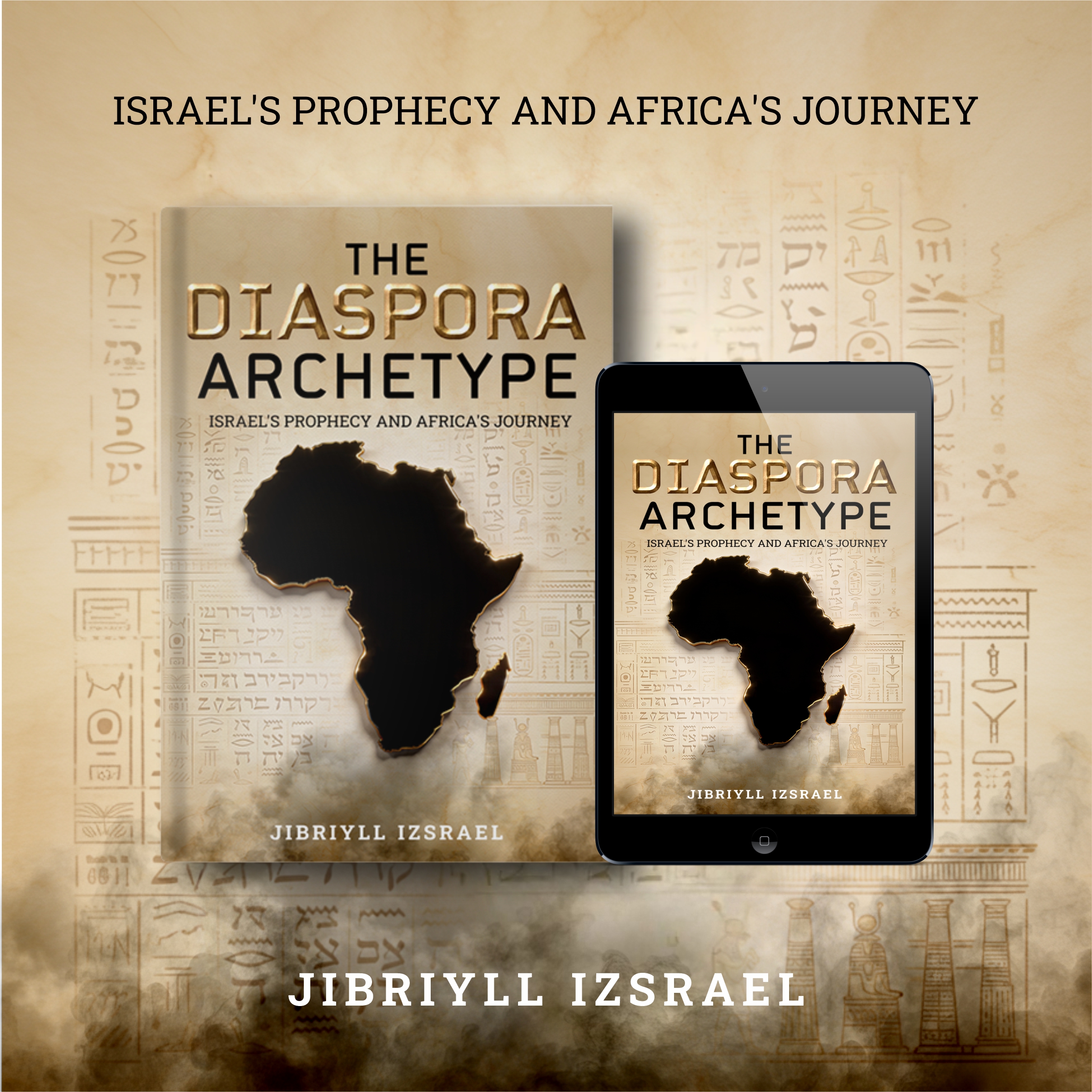
The Diaspora Archetype: Israel's Prophesy and Africa's Journey-Chapter 20
-
 By Jibriyll Izsrael
- 2026-03-20
The Diasporic Covenant — Exile as Formation, Return as Illumination
The Diaspora Archetype-Chapter 20
Diaspora as Covenant
Within sacred history,
displacement is not merely a tragedy to be endured.
It is a condition
through which a particular kind of consciousness
is forged.
This chapter names diaspora
not as accident,
punishment,
or deviation—
but as covenant.
When Abram is called into vision,
he is not promised immediate possession.
He is given a prophecy of delay:
Descendants who will become strangers,
enslaved and oppressed
in a land not their own—
before emerging with great substance.
This is not a marginal detail.
It is the structure of the promise itself.
The covenant is explicitly diasporic.
Exile as Formation, Not Failure
In the Abrahamic vision,
the descendants are described first
not as inheritors,
but as diasporans.
Before land—
comes formation.
Before sovereignty—
comes consciousness.
Peoplehood is refined outside territory—
under pressure,
without institutional protection,
sustained by memory, ethics, and covenant
rather than force.
This inversion is decisive.
Scripture overturns the assumption
that territory produces identity.
Instead,
identity is forged without territory—
so that when land is finally entrusted,
it is held responsibly
rather than possessed destructively.
This pattern repeats throughout sacred history.
Law is not given in the homeland,
but in the wilderness.
Freedom precedes possession.
Covenant precedes statehood.
Exile becomes the site
where memory is disciplined into structure.
Diaspora, then, is not merely endured.
It is instrumental.
Time as Moral Exposure
The covenant is precise
not only about suffering,
but also about duration.
Long spans of time
allow injustice to fully expose itself.
Oppression is granted room
to exhaust its own justifications
until its moral bankruptcy
becomes undeniable.
History does not rush judgment.
It allows systems to reveal
what they are.
This temporal logic reappears unmistakably
in the Atlantic world.
African enslavement was not brief
or chaotic.
It was:
Prolonged
Legalized
Theologized
Institutionalized
across centuries.
Its duration was not incidental.
It was necessary
for the system to indict itself
beyond defense.
As the African Diaspora approached
the four-hundred-year horizon
of its presence in the Americas,
the convergence with the ancient covenantal pattern
was not mystical.
It was structural.
A people formed under forced dispersion—
denied land, language, and law—
yet sustaining memory, faith, culture, and moral imagination—
reached a threshold
where history itself demanded response.
The question becomes unavoidable:
What is required
of a people formed this way?
Diaspora and the Burden of Illumination
The covenant’s horizon
is never inward alone.
It is universal.
The promise is not survival for its own sake—
but illumination for others.
Light does not dominate.
It orients.
Diasporic peoples are uniquely prepared for this role
because they are bilingual in history.
They know empire
from within and from without.
They understand:
Exclusion and aspiration
Survival and hope
They carry memory older than modern states
and insight forged inside their contradictions.
African Americans embody this condition
with singular clarity.
Formed at the violent crossroads of:
Africa
Europe
The Americas
their cultural production has reshaped:
Global music
Language
Protest
Ethics
Their spiritual traditions articulated hope
where hope was designed to die.
Their historical position forced freedom
to be interrogated
not as abstraction,
but as structure.
Diaspora does not dilute ministerial vocation.
It universalizes it.
From Suffering to Stewardship
The covenant carries
not only promise,
but warning.
The “great substance” promised after exile
is not merely material wealth.
It is capacity:
Organizational
Ethical
Intellectual
Spiritual
Capacity without structure dissipates.
Liberation without institutions invites repetition.
Consciousness without governance exhausts itself.
History confirms this repeatedly:
Freedom without law collapses into chaos.
Memory without organization risks assimilation.
Emancipation without infrastructure reproduces dependency.
The covenant does not culminate in escape.
It culminates in construction.
The Institutional Threshold
Here The Diaspora Archetype moves
from interpretation
to obligation.
If diaspora is formative rather than accidental,
then sovereignty is not optional—
it is required.
A people refined under exile
carries with them the responsibility
to translate memory into institution.
Covenant demands completion
through structure.
Thus,
institutional sovereignty becomes
the modern expression of ancient covenant:
Memory made law
Ethics embodied in economy
Culture stabilized through governance
Vision rendered durable
For African Americans,
this moment marks
the end of improvisation
and the beginning of authorship.
Survival, while heroic,
is no longer sufficient.
Recognition without organization
risks stagnation.
The covenantal threshold requires
a collective apparatus
capable of stewarding capacity
at scale.
This is the historical role
of the African American Union (AAU).
The AAU does not arise
as reaction,
grievance,
or imitation.
It emerges as institutional recall—
the deliberate reassembly
of political,
economic,
and cultural sovereignty
after centuries of enforced dispersion.
It is the mechanism
through which a diasporic people
assumes responsibility for its future—
and contributes to global rebalancing.
In covenantal terms,
the AAU marks the passage
from wilderness
to governance.
Not empire.
Not domination.
But order rooted in memory,
disciplined by structure,
and oriented toward justice.
Conclusion — Fulfillment Begins
The covenant has been remembered.
What follows
is no longer lamentation,
but architecture.
Now we explore
the design of institutions
capable of carrying
what exile has produced.
The light forged in dispersion
now demands vessels
strong enough to hold it.
Exile formed the people.
Their return illuminates
a dark, dying world.
What remains
is the work of fulfillment.
Support the Work
If this chapter resonated with you, consider supporting the African American Union.
Your support helps expand education, economic cooperation, and cultural development within our community.• Become a member
• Support the Union store
• Share this chapter
• Make a contribution
All net proceeds from the Sovereign Trilogy are dedicated to helping seed the African American Sovereign Wealth Fund, an initiative of the African American Union designed to strengthen economic cooperation and institution-building for future generations.
By supporting this work, readers help transform ideas into lasting infrastructure for our community.