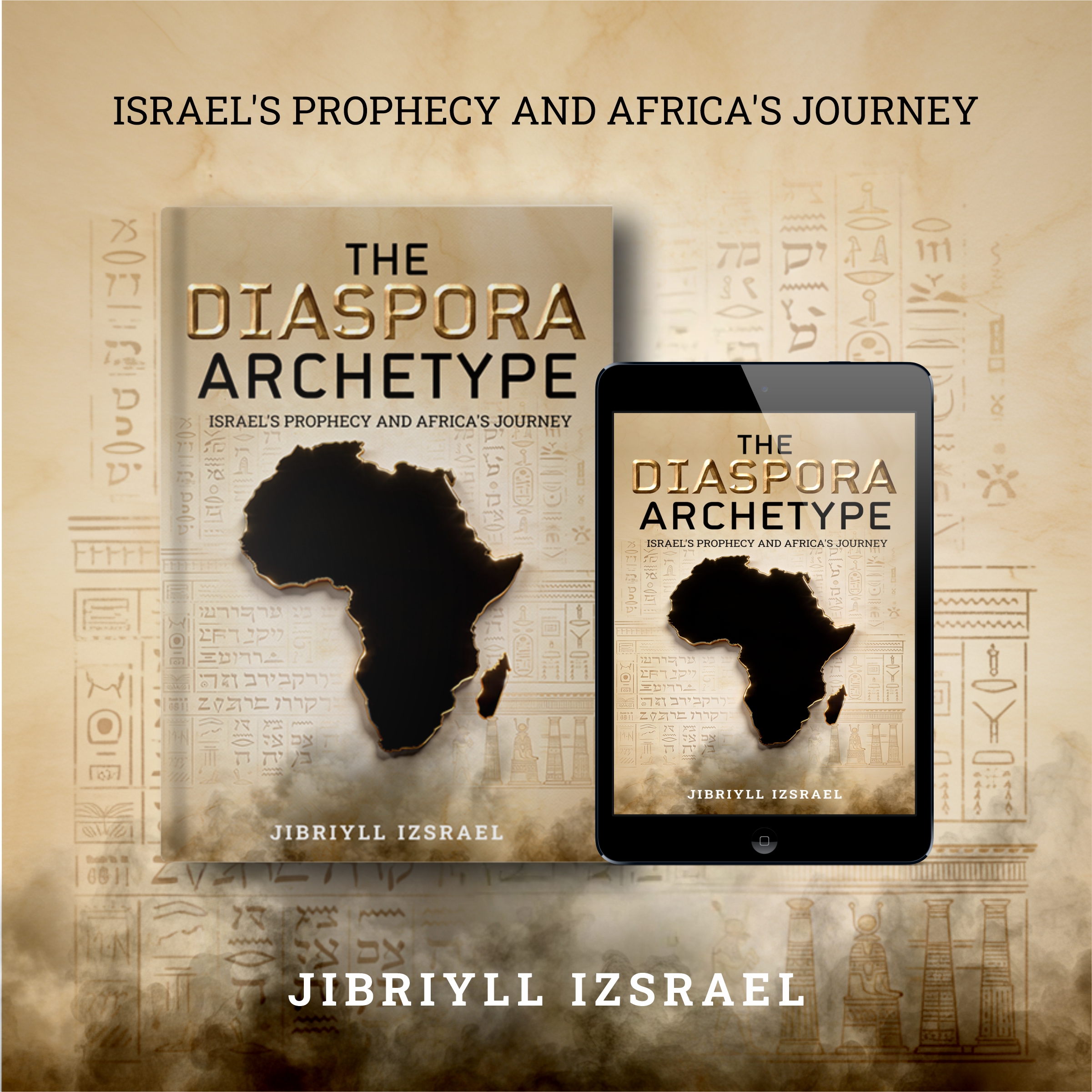
The Diaspora Archetype: Israel's Prophesy and Africa's Journey-Chapter 26
-
 By Jibriyll Izsrel
- 2026-03-20
Sovereignty as a Complete System
The Diaspora Archetype-Chapter 26
From Fragmented Power to Coherent Authority
Sovereignty does not emerge
from a single achievement.
It is not secured by culture alone,
nor by capital alone,
nor by law, land,
or belief in isolation.
Sovereignty exists only
when systems align.
For centuries,
African-descended peoples
have generated power in fragments—
Cultural brilliance without ownership
Political visibility without insulation
Economic activity without compounding structure
Spiritual depth without institutional protection
Each fragment carried force—
yet none endured long enough
to secure continuity.
This work has argued a single, unifying claim:
Power that is not systematized
is eventually captured.
Sovereignty, therefore,
is not an aspiration.
It is an architecture.
This chapter names how that architecture functions—
as a complete system—
not as theory,
but as operational logic
governing how freedom survives time.
The Failure of Single-Axis Liberation
Modern liberation movements
often collapse under their own success
because they pursue
one dimension of power at a time.
Economic gains without narrative control
invite misrepresentation.
Political wins without economic insulation
invite reversal.
Cultural influence without institutional ownership
invites extraction.
Spiritual awakening without governance
invites fragmentation.
History is filled with moments of ascent
that dissolved—
because power was never integrated.
Sovereignty requires more than momentum.
It requires coherence.
The Five Interlocking Domains of Sovereignty
What has emerged across this work
is not a list of initiatives—
but a closed-loop system
composed of five interdependent domains:
Economic Sovereignty
—control over production, circulation, storage, and deployment of wealth
Institutional Sovereignty
—durable governance structures that outlive individuals
Legal & Juridical Capacity
—the ability to defend rights, contracts, and continuity
Narrative Sovereignty
—authorship over meaning, memory, and future orientation
Theological & Ethical Grounding
—the moral logic that governs how power is used
None of these domains functions independently.
Each stabilizes the others.
Remove one—
and the system unravels.
Sovereignty as Feedback, Not Static Control
Sovereignty is often misunderstood
as domination or rigidity.
In reality,
it behaves more like feedback regulation—
the capacity to sense imbalance
and correct course
before collapse.
A sovereign system can:
Absorb shock without disintegration
Self-correct without external permission
Regenerate leadership without crisis
Adapt without surrendering identity
This is why sovereignty must be:
Institutional rather than personal
Systemic rather than charismatic
Charisma moves people.
Systems move generations.
Why Fragmentation Was Always the Strategy
The historical denial
of African-descended sovereignty
was never accidental.
Fragmentation was engineered.
Culture was permitted without ownership.
Religion was allowed without political agency.
Consumption was encouraged without capital control.
Representation was tolerated without governance power.
Each fragment created
the illusion of inclusion—
while preventing consolidation.
The Diaspora Archetype names this truth plainly:
Dispersed power is manageable for empire.
Integrated power—
is not.
Integration as the Point of No Return
Once economic, institutional, legal, narrative,
and ethical domains are aligned,
reversal becomes structurally difficult.
You can sanction a state.
You can co-opt a leader.
You can distort a story.
But you cannot easily dismantle
a coherent system
whose components reinforce one another.
This is why the work described here
is not framed as protest,
reform,
or demand.
It is framed as construction.
The AAU as a Systems Prototype
The African American Union
does not claim to be the final form of sovereignty.
It functions as a prototype—
a living demonstration
of how a diasporic people
can coordinate power
without waiting for:
Territorial secession
External recognition
Its significance lies
not only in what it builds—
but in how it builds:
Coordination over chaos
Continuity over spectacle
Covenant over consumption
System over symbol
The AAU is not presented as perfection.
It is presented as proof of concept.
From Survival Intelligence to Governance Intelligence
Exile produces survival intelligence:
Adaptability
Creativity
Resilience
Improvisation
These traits sustain life under pressure.
Sovereignty requires a shift:
From improvisation to design
From reaction to anticipation
From survival intelligence to governance intelligence
This transition is not automatic.
It must be trained,
structured,
and protected.
A people can survive almost anything.
But only a people that governs itself
can endure abundance.
The System Is Moral or It Collapses
Power without ethics
decays internally.
Ethics without power
collapses externally.
A complete sovereignty system
therefore requires a moral spine—
not performative righteousness,
but enforceable standards
that regulate:
How wealth is used
How authority is exercised
How the vulnerable are protected
The purpose of sovereignty
is not supremacy.
It is stewardship.
Any system that forgets this
eventually reproduces
the violence it sought to escape.
What This Chapter Prepares Us For
This chapter does not conclude the argument.
It stabilizes it.
What follows in the remaining chapters
is not abstraction—
but application:
How sovereignty scales
How it defends itself
How it avoids internal capture
How it transmits across generations
How it interfaces with a transforming world system
The system has now been named.
What remains is to show how it lives.
Coherence Is the Threshold
History does not ask
whether a people has suffered enough.
It asks:
Has a people organized its capacity?
The transition described here
is not from oppression to freedom—
but from fragmentation to coherence.
And coherence—
once achieved—
is difficult to undo.
Sovereignty,
when understood as a complete system,
ceases to be a demand.
It becomes a condition.
Support the Work
If this chapter resonated with you, consider supporting the African American Union.
Your support helps expand education, economic cooperation, and cultural development within our community.• Become a member
• Support the Union store
• Share this chapter
• Make a contribution
All net proceeds from the Sovereign Trilogy are dedicated to helping seed the African American Sovereign Wealth Fund, an initiative of the African American Union designed to strengthen economic cooperation and institution-building for future generations.
By supporting this work, readers help transform ideas into lasting infrastructure for our community.