
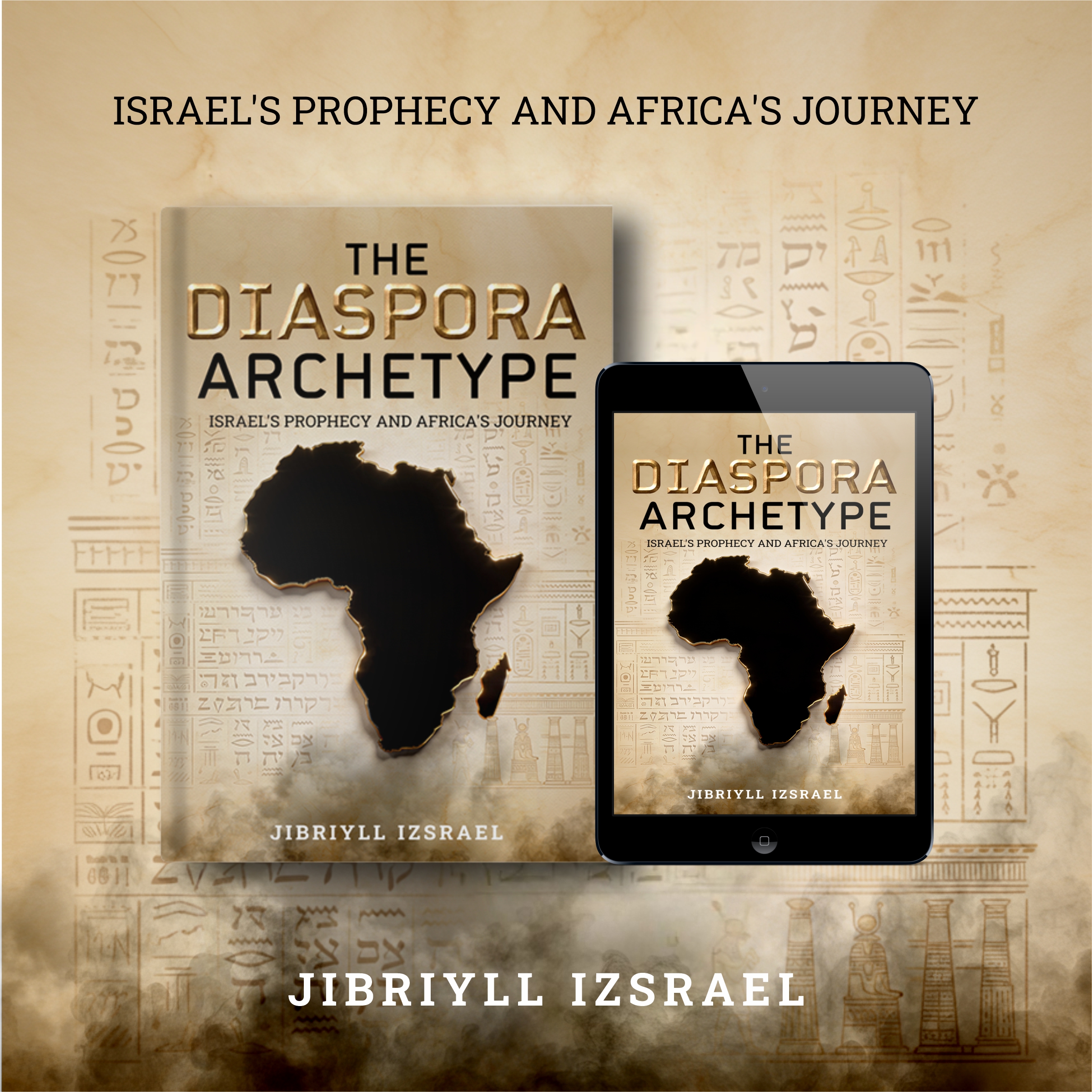
The Diaspora Archetype: Israel's Prophesy and Africa's Journey-Chapter 27
-
 By Jibriyll Izsrael
- 2026-03-20
The Moment of Recall
The Diaspora Archetype-Chapter 27
Why Now, and Why This Generation
There are moments in history
when remembering becomes an obligation—
not a choice.
Not remembering facts alone,
but remembering direction.
Remembering not simply where a people has been—
but what it was carrying
before interruption.
Remembering not as nostalgia—
but as orientation.
This—
is such a moment.
For centuries,
African peoples and their diasporas
have been narrated as aftermath—
Descendants of rupture
Survivors of catastrophe
Fragments of a once-whole past
Yet this framing
has always been incomplete.
What has been called disappearance
was more often a displacement of authorship.
What was labeled loss
was, in truth, interruption.
Civilizations rarely end in silence.
They are more often:
Paused
Diverted by conquest
Reorganized by force
Denied continuity
—by systems that benefit from their suspension.
Memory survives—
but without institutions.
Capacity persists—
but without coordination.
Identity remains—
but without power.
The Diaspora Archetype begins here:
This condition is no longer sustainable.
The Long Interruption
Africa’s fracture
and the dispersal of its peoples
were not random events.
They were structural acts—
Engineered to break economic circuits
Dismantle governance traditions
Sever narrative continuity
The Atlantic world
was built upon this severance:
Africa reduced to resource
The diaspora reduced to labor and consumption
Both denied authorship
—over the systems governing their fate.
Yet interruption
is not erasure.
Across centuries of exile,
African-descended peoples preserved
what could not be confiscated:
Moral imagination
Communal instinct
Spiritual depth
Creative force
An unyielding sense
that survival alone was not the final assignment
Diaspora became a crucible.
Formed without territory,
African Americans and other diasporic communities
learned to build:
Culture without state power
Ethics without law
Meaning without security
These were not signs of deficiency.
They were signs of preparation.
What was missing
was not intelligence or will.
What was missing
was institutional sovereignty.
The Hidden Preparation
Diaspora is often spoken of as curse.
This work insists—
it was also formation.
To exist across borders
is to learn translation.
To survive dispossession
is to learn endurance.
To navigate empire from below
is to understand power without illusion.
No people understands domination
more intimately
than those who have lived inside its machinery.
No people understands extraction
more clearly
than those whose labor and culture fueled it.
And no people is more prepared
to imagine alternatives
than those who were never fully allowed
to belong to the old order.
This is why the diaspora matters now—
not as a relic of suffering,
but as a repository
of earned insight.
History has reached a point
where survival intelligence
must become
governance intelligence.
Why Now
This moment did not arrive by chance.
Global systems built on extraction
are straining under their own weight.
Financial architectures reveal fragility.
Narratives that justified domination weaken.
Technology accelerates exposure.
Illusion is collapsing—
in real time.
Africa stands
at the threshold of transformation.
The diaspora holds:
Unprecedented capital
Technical expertise
Global reach
Never before
have the conditions for reconnection
been so present—
nor the consequences of delay
so severe.
To postpone sovereignty now
would not be caution.
It would be abdication.
The world no longer needs
African genius expressed only as culture.
What the world now requires—
is
African institutional authorship.
Why This Generation
Every generation inherits memory.
Only some
inherit responsibility.
This generation stands
between what was endured—
and what can be built.
It carries:
The full archive of injustice
The tools of coordination
The capacity for execution
You are the first generation with access to:
Global communication without intermediaries
Pooled capital at scale
Transnational networks of expertise
Historical clarity sufficient to see the pattern whole
With recognition
comes obligation.
To see the architecture of disenfranchisement
and do nothing—
is no longer ignorance.
It is choice.
This is why The Diaspora Archetype
does not ask for belief.
It asks for duty.
The Architecture of Return
Return does not mean
retreat into the past.
It means:
Resumption of authorship.
The work of return is institutional:
Building economic sovereignty
so wealth circulates with purpose
Creating financial systems
that fund futures rather than extract them
Reconstructing a Diaspora–Africa economic corridor
to reconnect what conquest severed
Reclaiming narrative sovereignty
so a people speaks itself clearly into the world
Together—
these are not aspirations.
They are infrastructure.
The African American Union emerges
in this moment
not as protest—
but as instrument.
Not as reaction—
but as continuity.
An architecture through which
a diasporic people transitions
from improvisation
to stewardship.
Sovereignty here
is not withdrawal.
It is participation
on authored terms.
The Responsibility of Recognition
Recognition is never neutral.
To recognize oneself in history
is to inherit its unfinished work.
To understand the system
is to be accountable
for what is built in its place.
Memory—
once awakened—
demands structure.
This work does not promise ease.
It promises clarity.
It does not offer heroes.
It offers institutions.
It does not conclude a struggle.
It opens responsibility—
that cannot be unlearned.
A Word to the Reader
If you have read this far—
you are no longer a spectator.
You are part of the recall.
What you do with this knowledge—
How you circulate it
How you embody it
How you fund it
How you teach it
How you protect it
—will determine whether this moment
becomes:
A footnote
or
a turning point.
History does not ask loudly.
It waits.
And when a people finally remembers itself—
not in fragments,
but in whole—
the future does not arrive as surprise.
It arrives as renewal.
This Is the Moment of Recall
And it belongs—
to this generation.
Support the Work
If this chapter resonated with you, consider supporting the African American Union.
Your support helps expand education, economic cooperation, and cultural development within our community.• Become a member
• Support the Union store
• Share this chapter
• Make a contribution
All net proceeds from the Sovereign Trilogy are dedicated to helping seed the African American Sovereign Wealth Fund, an initiative of the African American Union designed to strengthen economic cooperation and institution-building for future generations.
By supporting this work, readers help transform ideas into lasting infrastructure for our community.