
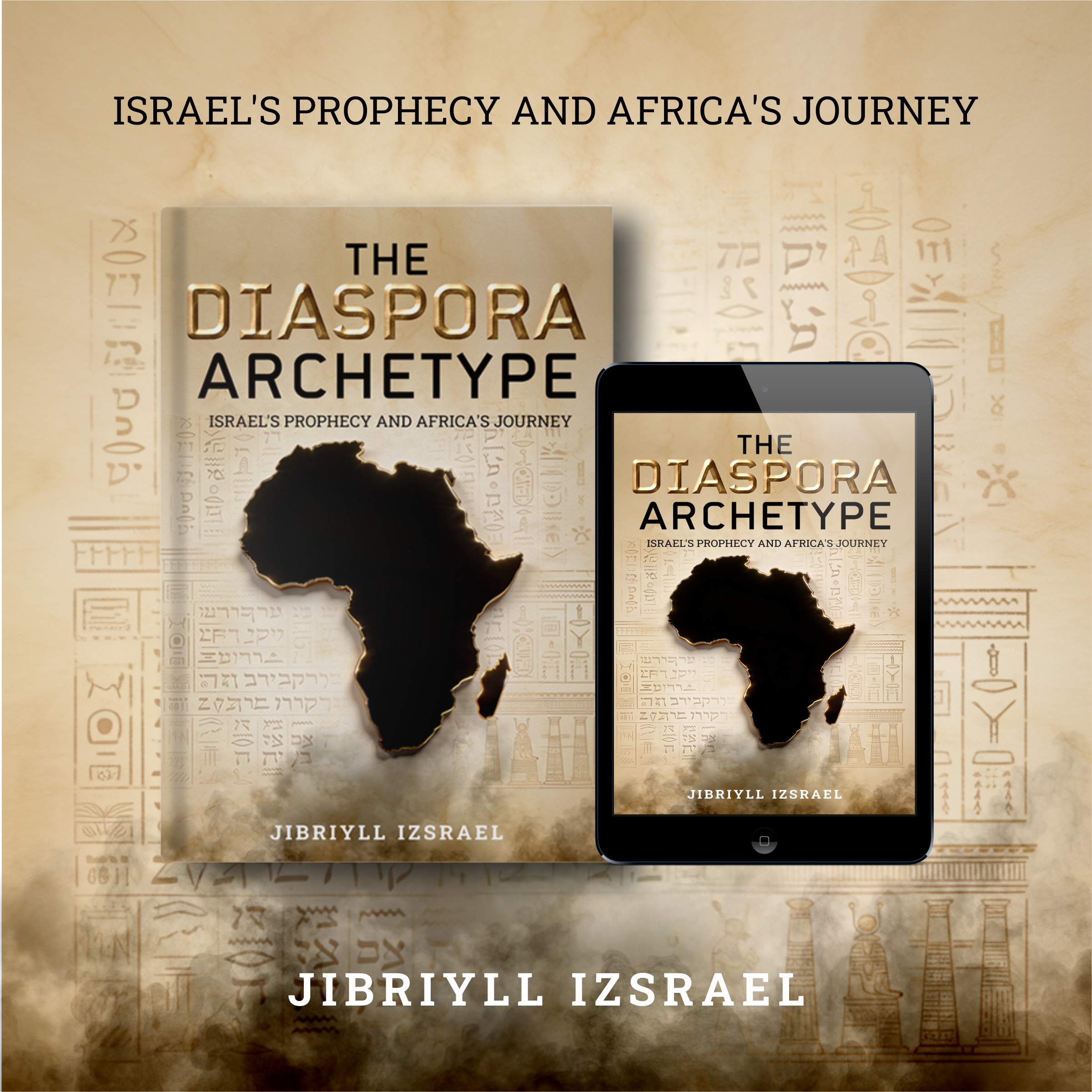
The Diaspora Archetype: Israel's Prophesy and Africa's Journey-Chapter 3
-
 By Jibriyll Izsrael
- 2026-03-17
The Covenant Pattern — Scattering and Return
The Diaspora Archetype: Israel's Prophesy and Africa's Journey-Chapter 3
“And the Lord shall scatter thee among all peoples, from the one end of the earth even unto the other.”
— Deuteronomy 28:64
The Archetype of Displacement
Within the Hebrew Bible, no motif appears with greater persistence—or greater explanatory power—than exile and return.
From Eden to Babylon, Scripture frames human history as a movement away from origin and toward restoration.
Displacement is not presented merely as tragedy, but as moral consequence.
Return is not accident, but intention.
Deuteronomy 28 articulates this logic with exceptional clarity, offering a theology of history in which ethical order and social stability are inseparable.
The covenant described in Deuteronomy is not simply a contract between a deity and a tribe.
It functions as a universal grammar of consequence.
Obedience to justice yields coherence.
Abandonment of equity produces desolation.
Blessing manifests as harmony within land, labor, and community, while injustice culminates in dispersion:
“Thou shalt be removed into all the kingdoms of the earth.”
Scattering, in this sense, is pedagogy—a teaching.
It externalizes internal disorder, transforming moral failure into historical motion.
This framework elevates exile from punishment to instruction.
Displacement is not random, but diagnostic—a mirror held up to collective conscience.
The archetype introduced here therefore transcends its ancient setting.
It becomes a pattern through which later histories of conquest, enslavement, and colonization may be interpreted without collapsing into fatalism or despair.
Exile as the Engine of Renewal
Historically, Deuteronomy’s warnings preceded the Assyrian and Babylonian captivities.
Yet the deeper significance of the text lies not in prediction, but in pattern.
Across civilizations, exile repeatedly appears as the crucible in which ethical consciousness is refined.
What is stripped away geographically is reconstituted inwardly.
What is lost politically is often recovered morally.
Read through this lens, the African diaspora occupies a symbolic position within a far older human rhythm.
A people violently removed from land, language, and institutional continuity nevertheless preserved coherence through memory, ritual, and faith.
Like ancient Israel, survival depended not on territory but on transmission—songs, stories, and moral codes capable of traveling where borders could not.
To identify this structural resemblance is not to claim biological descent or theological substitution.
It is to recognize a shared moral geography:
Exile as teacher.
Endurance as discipline.
Renewal as obligation.
In both cases, the scattered are compelled to ask not merely where they belong, but who they must become.
The Vision of Gathering — Isaiah’s Counterpoint
“And it shall come to pass in that day, that the Lord shall set His hand again the second time to recover the remnant of His people… and shall gather together the dispersed from the four corners of the earth.”
— Isaiah 11:11–12
If Deuteronomy names the fracture, Isaiah imagines its repair.
His vision of regathering does not erase diversity.
It harmonizes it.
The dispersed are assembled not through conquest but through justice.
Not by uniformity but by shared orientation toward righteousness.
For diasporic communities, Isaiah’s language has long functioned as moral cartography:
A map for meaning.
A way for scattered people to locate themselves ethically and spiritually in the world.
“The four corners of the earth” echoes the global reach of displacement, while the idea of a remnant—defined by endurance rather than privilege—mirrors the survival of African diasporic identity through centuries of fragmentation.
The prophecy thus operates less as eschatology than as ethic:
Reunion is conditional upon moral realignment.
Crucially, Isaiah reframes return as both spiritual and institutional.
Gathering does not require immediate geographic reversal.
It begins with the restoration of values:
Justice.
Equity.
Mutual care.
Nations are rebuilt not only by recovering land, but by recovering law.
Ezekiel’s Valley — Resurrection After Ruin
“Son of man, can these bones live? … Behold, I will cause breath to enter into you, and ye shall live.”
— Ezekiel 37:3–5
Where Isaiah offers vision, Ezekiel provides method.
His valley of dry bones depicts a people reduced to fragments—identity stripped of flesh, history reduced to remnants.
Yet the prophetic command is not to mourn the bones, but to address them.
Restoration begins with speech—with the re-articulation of meaning.
Throughout the African diaspora, Ezekiel’s imagery has been reimagined as lived experience.
Spirituals, sermons, and freedom songs echoed the prophet’s question:
Can these bones live?
And answered it through collective action.
Breath (ruach) became education, organization, and cultural renewal—the invisible forces that reanimate social bodies.
Ezekiel’s vision clarifies a central law of civilizational restoration:
Resurrection is never spontaneous.
It requires voice.
Structure.
Time.
Life returns when memory is organized and purpose is spoken aloud.
Covenant as Template
Together, Deuteronomy, Isaiah, and Ezekiel form a triadic structure that recurs wherever peoples confront historical rupture:
Scattering — Deuteronomy 28
Moral consequence; dispersion as discipline.
Gathering — Isaiah 11
Ethical realignment; unity through justice.
Revival — Ezekiel 37
Cultural resurrection; empowerment through vision and knowledge.
This covenantal sequence is not confined to Israel’s narrative.
It reappears wherever displacement produces conscience and suffering matures into structure.
The African diaspora’s passage from enslavement to emancipation to institution-building follows this rhythm with striking precision—not as imitation, but as recurrence.
Renewal in Modern Form
In contemporary movements for economic, cultural, and political sovereignty, the covenantal pattern persists in secular language.
Return is no longer ritualized solely through temple sacrifice.
It is enacted through:
Education.
Cooperative economics.
Governance reform.
Each school founded, each institution built, each alliance forged across the diaspora becomes an act of gathering.
Each revival of language, art, or philosophy breathes life into bones history once declared inert.
The lesson common to all three prophetic texts is ultimately moral:
Restoration follows remembrance.
And remembrance demands action.
History bends toward coherence when a people reclaims its ethical center and designs systems worthy of it.
Conclusion — The Labor of Return
Exile, at its deepest level, is the condition of forgetting.
Return is therefore not flight, but work—the disciplined labor of remembrance translated into structure.
Every generation must reenact the covenant in its own idiom, transforming scattering into solidarity and endurance into design.
The journey from Deuteronomy’s warning to Ezekiel’s resurrection frames more than ancient Israel or the African diaspora alone.
It describes a universal human drama:
How peoples learn, through loss, to rebuild the moral architecture of civilization.
Within that drama lies a perennial truth—
Every exile carries within it the seed of its own return,
waiting for a people courageous enough to remember who they are,
and deliberate enough to build accordingly.
Support the Work
If this chapter resonated with you, consider supporting the African American Union.
Your support helps expand education, economic cooperation, and cultural development within our community.• Become a member
• Support the Union store
• Share this chapter
• Make a contribution
All net proceeds from the Sovereign Trilogy are dedicated to helping seed the African American Sovereign Wealth Fund, an initiative of the African American Union designed to strengthen economic cooperation and institution-building for future generations.
By supporting this work, readers help transform ideas into lasting infrastructure for our community.