
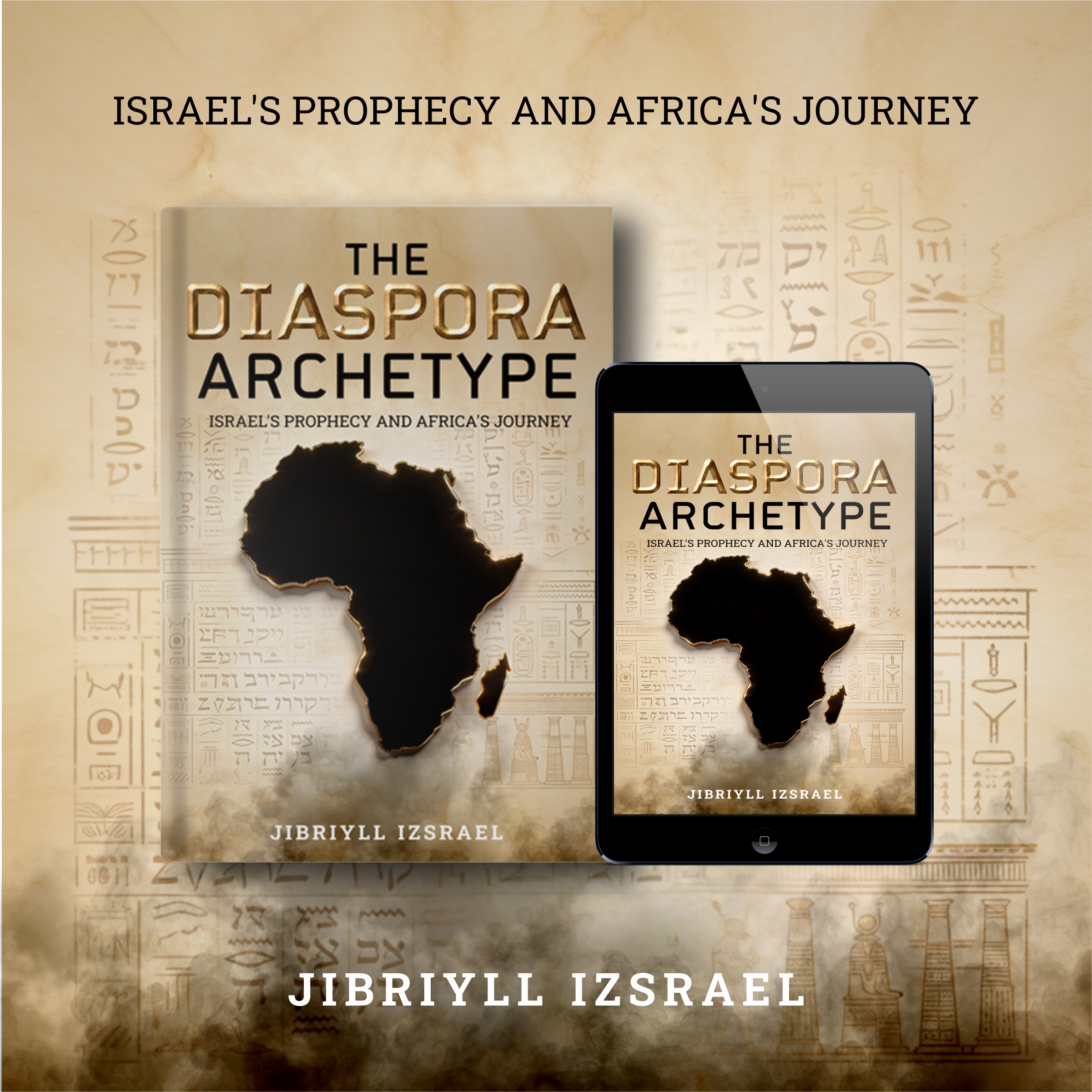
The Diaspora Archetype: Israel's Prophesy and Africa's Journey-Chapter 4
-
 By Jibriyll Izsrael
- 2026-03-17
Migrations of Memory — Israel in Africa
The Diaspora Archetype: Israel's Prophesy and Africa's Journey-Chapter 4
“Princes shall come out of Egypt; Ethiopia shall soon stretch out her hands unto God.”
— Psalm 68:31
Africa in the Biblical Imagination
From the earliest strata of the biblical record, Africa occupies a central—rather than peripheral—place in sacred geography.
Israel itself rests upon the African continental plate, and the lands that shape the biblical imagination—Egypt and Cush (Ethiopia)—appear not as distant worlds but as immediate neighbors and active participants in Israel’s unfolding story.
The patriarchs sought refuge in Egypt during famine.
Moses entered covenant history through marriage to a Cushite woman.
The prophet Jeremiah found sanctuary in Africa following the fall of Jerusalem.
Africa, in other words, does not merely border the biblical narrative—
It frames it.
For millennia, the Nile Valley functioned as a civilizational artery linking the Mediterranean world to inner Africa.
Along its routes moved caravans and fleets carrying more than commodities.
Ideas, symbols, ritual practices, and cosmologies traveled with them, forming a shared cultural vocabulary across regions later treated as separate by imperial and modern historiography.
Sustained Israelite contact with Egypt, Nubia, and Cush left traces preserved not only in written texts, but also in oral traditions that outlived the empires which once administered them.
This chapter traces those intertwined migrations—both physical and remembered—that bind the ancient Near East to Africa’s diverse civilizations.
By surveying historical evidence, linguistic correspondences, and living traditions, it argues that inner Africa was not the margin of Israel’s world—
but one of its enduring extensions.
Ancient Crossroads — Trade, War, and Intermarriage
Archaeological and textual records attest to continuous movement between the Levant and Africa.
Egyptian inscriptions from the New Kingdom period reference groups known as the Shasu and Habiru—nomadic or semi-settled peoples traversing Sinai and southern Canaan—figures many scholars associate with early Israelite populations.
These references situate Israel not as an isolated nation, but as part of a fluid regional ecology shaped by migration, conflict, and exchange.
During the monarchic era, political and commercial alliances further bound Israel to African powers.
The Queen of Sheba’s visit to Solomon symbolizes this diplomatic world, but it reflects a broader historical reality:
Sustained trade between Red Sea ports, the Horn of Africa, and the Levant was routine.
Gold, incense, textiles, and technologies circulated alongside marriage alliances, military cooperation, and shared administrative practices.
Intermarriage among elites, regional conflict, and climate-driven migrations blurred ethnic boundaries over generations.
By the time of the Babylonian exile, communities with Israelite ancestry or cultural influence existed throughout the Nile Delta and deep into Nubia.
Greek and Roman writers later observed established Judaean settlements in Upper Egypt and Cyrenaica (modern Libya).
These early dispersions form the historical substrate from which later African Jewish and proto-Israelite communities emerged.
Linguistic and Cultural Echoes
Language often preserves what political history obscures.
Comparative studies in Semitic and African linguistics reveal suggestive correspondences between Hebrew and several Afro-Asiatic languages spoken across the Horn of Africa and the Nile corridor.
Terms associated with divinity, ritual purity, covenant, and moral order frequently share phonetic structures or conceptual frameworks.
Equally compelling are parallels in social practice.
Circumcision on the eighth day, dietary distinctions between clean and unclean animals, and detailed family purity laws appear among multiple African societies independent of later Islamic or Christian transmission.
These resonances do not prove linear descent.
Rather, they point to shared cultural matrices formed through centuries of interaction between Northeast Africa and the ancient Near East.
Enduring Traditions — Lemba, Beta Israel, and Igbo
Among the many African peoples who preserve traditions of Israelite origin, three communities stand out for the depth of their continuity and the seriousness with which scholars have engaged them.
A. The Lemba of Southern Africa
Living primarily in Zimbabwe, South Africa, and Mozambique, the Lemba maintain an oral history tracing their ancestry to ancient Israel—specifically to Levitical priesthood lines.
They recount a migration from a northern place called Sena, often identified with a trading center along the southern Arabian (Yemeni) coast.
The Lemba observe dietary laws, practice male circumcision, honor the Sabbath, and preserve clan names with clear Semitic resonance.
Genetic studies have identified among Lemba men—particularly those of the Buba clan—a high frequency of a Y-chromosomal marker associated with Levitical priestly families.
They are therefore often described as parent stock of the Cohen Modal Haplotype.
These findings lend biological plausibility to the community’s oral traditions.
Living Black Jewish communities in Yemen further corroborate migratory narratives preserved by the Lemba across centuries.
B. Beta Israel of Ethiopia
Historically known as the Falasha, the Beta Israel preserved a distinct Mosaic tradition separate from both Rabbinic Judaism and Ethiopian Christianity.
Their scriptures, written in Ge?ez, closely parallel the Pentateuch and the Book of Jubilees, and their liturgy retains archaic elements absent from later Jewish practice.
Genetic evidence indicates a blended heritage—local Ethiopian and Near Eastern—suggesting a long process of cultural fusion rather than abrupt conversion.
Their continuity stands as one of the clearest examples of covenantal memory sustained on African soil.
C. The Igbo of Nigeria
Certain Igbo lineages maintain oral histories identifying descent from Eri, a figure tradition associates with the lineage of the biblical patriarch Gad (Genesis 46:16).
Igbo ritual life features ark-like shrines, priestly garments, and the name Chukwu (“the Great Spirit”) to describe supreme divinity.
Increasingly, scholars interpret these parallels as evidence of ancient Near Eastern religious patterns that migrated, localized, and endured within African cultural frameworks.
Genealogies of Spirit
Cultural memory moves like a river:
It may bend, divide, or deepen, yet it carries the same current.
Across Africa, oral traditions encode a sense of sacred origin that unites otherwise distant peoples within narratives of divine relationship.
Whether understood as historical transmission or mythic analogy, their persistence testifies to Africa’s role as both custodian and renewer of covenantal consciousness.
The festivals of the Beta Israel, the dietary disciplines of the Lemba, and the ancestral liturgies of the Igbo all express a shared conviction—
That identity can survive conquest,
and that covenant can outlive empire.
From Ancient Dispersion to the Atlantic Horizon
The ancient and medieval movements of Judaean and Israelite populations into Africa predate the Atlantic slave trade by millennia.
Yet they formed an imaginative bridge later crossed by enslaved Africans.
When Africans in the Americas encountered the Bible, they recognized themselves within its narratives of exile and endurance.
Identification with Israel—born amid suffering—offered psychological survival and moral coherence.
These older African Israelite traditions thus became seedbeds for a new liberation theology.
They provided language through which bondage could be interpreted as temporary exile rather than permanent negation—
and freedom as restoration rather than rupture.
Africa as Custodian of Sacred Memory
Rather than viewing Africa merely as a refuge for fragments of Israel, the perspective may be reversed.
Africa functioned as a crucible in which covenantal memory endured while empires elsewhere rose and fell.
From Egypt’s libraries to Ethiopia’s monasteries, from the scholars of Timbuktu to the griots of West Africa, the continent preserved vast reservoirs of moral and spiritual knowledge.
This endurance reveals a larger historical truth:
The ethical imagination associated with Israel—justice, communal obligation, and divine accountability—found one of its most durable homes in Africa.
That inheritance, however interpreted, continues to inform the diaspora’s vision of freedom and responsibility.
Conclusion — Remembering as Restoration
Migrations of Memory names more than movement across geography.
It describes the transmission of sacred consciousness through time.
Africa’s enduring claims to covenantal kinship reveal a profound intuition:
That history’s wounds are healed through remembrance.
By connecting biblical exile with Africa’s layered histories, we uncover a shared moral geography that transcends race and religion—
the geography of covenant itself.
Fidelity amid dispersal.
Endurance beyond loss.
Faith in renewal.
These form the map by which the modern diaspora has begun its return—
not solely to ancient territory,
but to a consciousness of dignity and destiny that no captivity can contain.
Support the Work
If this chapter resonated with you, consider supporting the African American Union.
Your support helps expand education, economic cooperation, and cultural development within our community.• Become a member
• Support the Union store
• Share this chapter
• Make a contribution
All net proceeds from the Sovereign Trilogy are dedicated to helping seed the African American Sovereign Wealth Fund, an initiative of the African American Union designed to strengthen economic cooperation and institution-building for future generations.
By supporting this work, readers help transform ideas into lasting infrastructure for our community.