
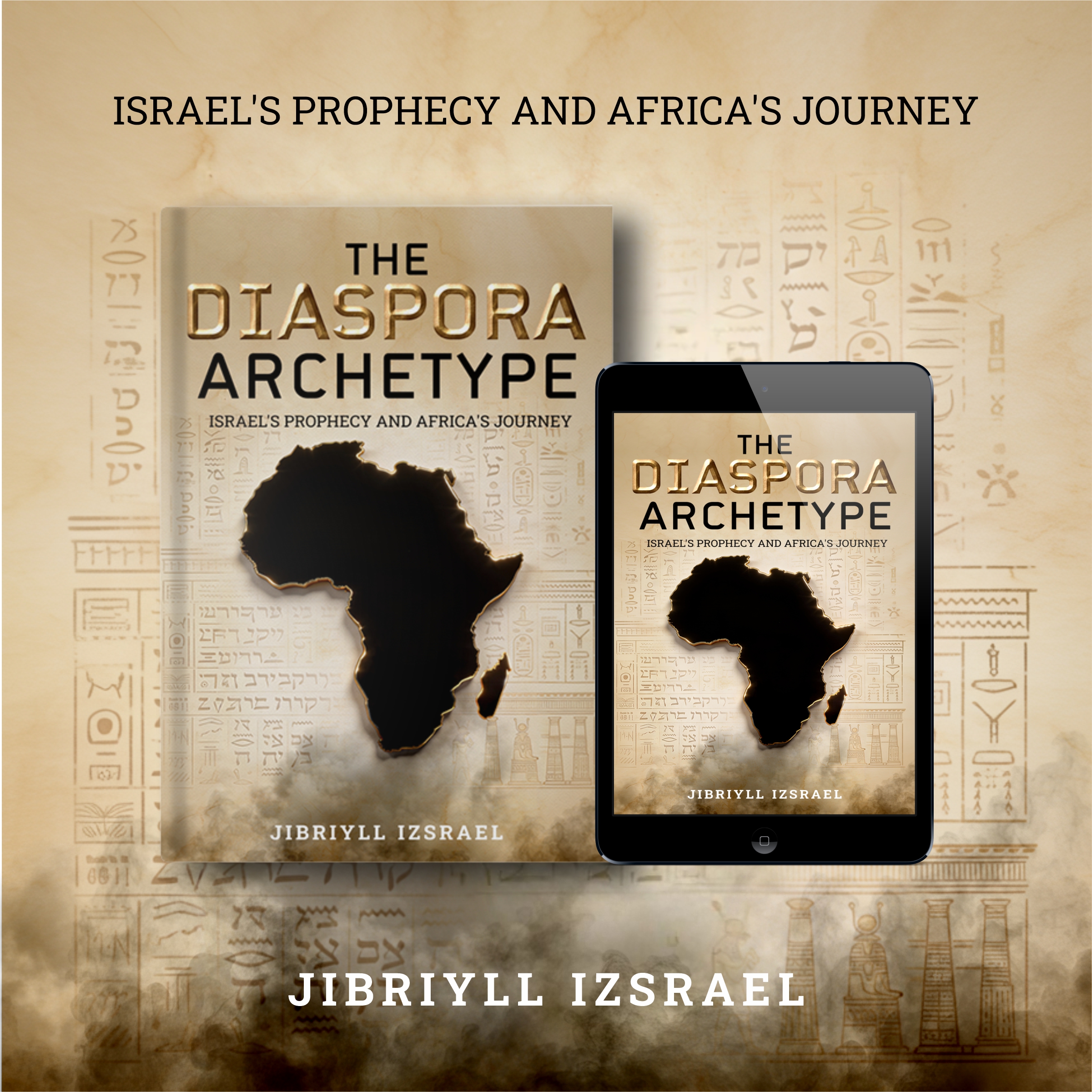
The Diaspora Archetype: Israel's Prophesy and Africa's Journey-Chapter 6
-
 By Jibriyll Izsrael
- 2026-03-17
Remembering the Law — From Garvey to the Global Renaissance
The Diaspora Archetype: Israel's Prophesy and Africa's Journey-Chapter 6
“Ethiopia shall again stretch forth her hands unto God.”
— Marcus Garvey, Philosophy and Opinions, 1923
When Memory Becomes Commandment
Every people that survives exile eventually confronts a decisive question:
What shall we do with what we remember?
Memory alone does not liberate.
It can inspire, but it can also stagnate.
The covenantal burden of a post-exilic people is therefore not merely to remember—
but to translate remembrance into law—
into structures capable of sustaining dignity across generations.
By the dawn of the twentieth century, the African world stood at this threshold.
Emancipation had loosened chains, but it had not dismantled systems.
The spiritual fire of Exodus still burned, yet the terrain ahead demanded architecture, discipline, and coherence.
Remembering the Law thus took on a new meaning:
Not a return to tablets of stone,
but the inscription of justice into economy, culture, and governance.
Marcus Garvey and the Reawakening of Command
Marcus Mosiah Garvey emerged as a voice crying not in wilderness, but in the industrial heart of empire.
Where the plantation had produced prophets of endurance, the modern city required prophets of organization.
Garvey’s genius lay in his refusal to separate vision from machinery.
He preached redemption—
but he also built institutions.
Through the Universal Negro Improvement Association, Garvey restored an ancient truth to modern consciousness:
A scattered people must think as a nation before it can act as one.
His language was unapologetically biblical—Zion, Ethiopia, redemption—
but his method was resolutely material.
Factories.
Newspapers.
Shipping lines.
Uniforms.
Ledgers.
These became sacramental objects.
Economics was no longer neutral—
it became covenant in motion.
Garvey’s insistence on mental emancipation articulated a law older than empire itself:
Captivity endures wherever imagination remains colonized.
His movement reminded the diaspora that sovereignty is not granted.
It is organized.
The Law of Self-Command
At the heart of Garveyism lay a recovered commandment:
Govern thyself.
Not as aspiration—
but as system.
Self-reliance was not isolation.
It was moral orientation.
It meant directing labor toward communal uplift, circulating wealth within the body of the people, and restoring dignity to work itself.
Though the Garvey movement was suppressed, ridiculed, and dismantled by imperial pressure, it planted a seed that could not be uprooted.
Across Africa and the diaspora, it awakened a durable understanding:
Freedom without infrastructure is illusion.
Memory without organization is vulnerability.
Du Bois and the Discipline of Knowledge
If Garvey spoke with prophetic thunder, W. E. B. Du Bois labored with legislative precision.
Where Garvey mobilized masses, Du Bois refined consciousness.
His insight was surgical:
The diaspora suffered not only from material deprivation, but from epistemic distortion—
seeing itself through the eyes of its captors.
Du Bois named this fracture:
Double consciousness.
An exile of the mind within citizenship itself.
His remedy was mastery.
Knowledge, he argued, is the first territory a people must reclaim.
Without truth, power degenerates into imitation.
Through the Pan-African Congresses, Du Bois extended covenant beyond race toward global justice.
He inscribed memory into scholarship, protest into policy, and identity into international law.
If Garvey awakened the will,
Du Bois disciplined it.
Pan-Africanism as Secular Covenant
Pan-Africanism transformed sacred memory into political grammar.
From London to Paris, from Harlem to Accra, the scattered convened to remember together—
and in remembering, to legislate.
Early congresses petitioned empire.
Later ones prepared to replace it.
The Manchester Congress of 1945 marked a turning point.
Pleas gave way to proclamation.
Figures such as Kwame Nkrumah and Jomo Kenyatta carried a revelation forged in diaspora:
Liberation must be continental—
or it would remain partial.
Borders imposed by conquest could not contain a people bound by covenantal memory.
Nkrumah’s rise in Ghana represented the translation of diaspora law into statecraft.
His declaration—
Seek ye first the political kingdom—
was not rhetoric, but strategy.
Power, once centralized in justice, could reorder economics, education, and culture.
Culture as Commandment
Alongside politics arose a renaissance of art that functioned as legislation of the soul.
The Harlem Renaissance, Negritude, and later Pan-African cultural movements restored beauty as moral necessity.
Poets, musicians, and artists did not merely describe freedom—
they rehearsed it.
Langston Hughes, Aimé Césaire, and Léopold Sédar Senghor understood that a people stripped of image cannot sustain law.
Rhythm became remembrance.
Language became liberation.
Culture, in this sense, was not ornament—
it was commandment made audible.
Economics Remembered
As colonialism receded, a deeper struggle emerged:
Who would control value itself?
Credit unions, cooperatives, and community banks arose as modern expressions of ancient ethics.
Mutual-aid societies echoed covenantal economies older than capitalism—
where wealth circulated to preserve the whole.
In the twenty-first century, this remembrance has entered digital form.
Diaspora finance, cooperative platforms, and transnational trade corridors recover the ancient principle that prosperity divorced from justice inevitably corrodes.
Technology becomes neutral only when conscience abdicates.
Economics, once weaponized against the diaspora, is reclaimed—
as an instrument of restoration.
From Law to Renaissance
Taken together—
Garvey’s organization,
Du Bois’s intellect,
Nkrumah’s statecraft,
and the cultural renaissance—
they reveal a single truth:
Remembrance matures into law,
and law matures into renaissance.
The diaspora does not awaken once.
It awakens in waves—
each deeper than the last.
The modern African renaissance is not nostalgia for pre-colonial pasts nor imitation of Western futures.
It is synthesis—
a civilization remembering itself forward.
Memory becomes design.
Prophecy becomes policy.
Conclusion — The Law Written in Motion
To remember the Law is not to retreat into scripture or slogan.
It is to move deliberately—
building institutions that refuse to forget why they exist.
The prophets of the twentieth century taught the diaspora how to do this:
How to make imagination actionable.
How to discipline hope.
How to convert suffering into structure.
The covenant has not expired.
It has changed form.
The chapters that follow no longer ask what must be remembered—
but what must now be built.
Support the Work
If this chapter resonated with you, consider supporting the African American Union.
Your support helps expand education, economic cooperation, and cultural development within our community.• Become a member
• Support the Union store
• Share this chapter
• Make a contribution
All net proceeds from the Sovereign Trilogy are dedicated to helping seed the African American Sovereign Wealth Fund, an initiative of the African American Union designed to strengthen economic cooperation and institution-building for future generations.
By supporting this work, readers help transform ideas into lasting infrastructure for our community.