
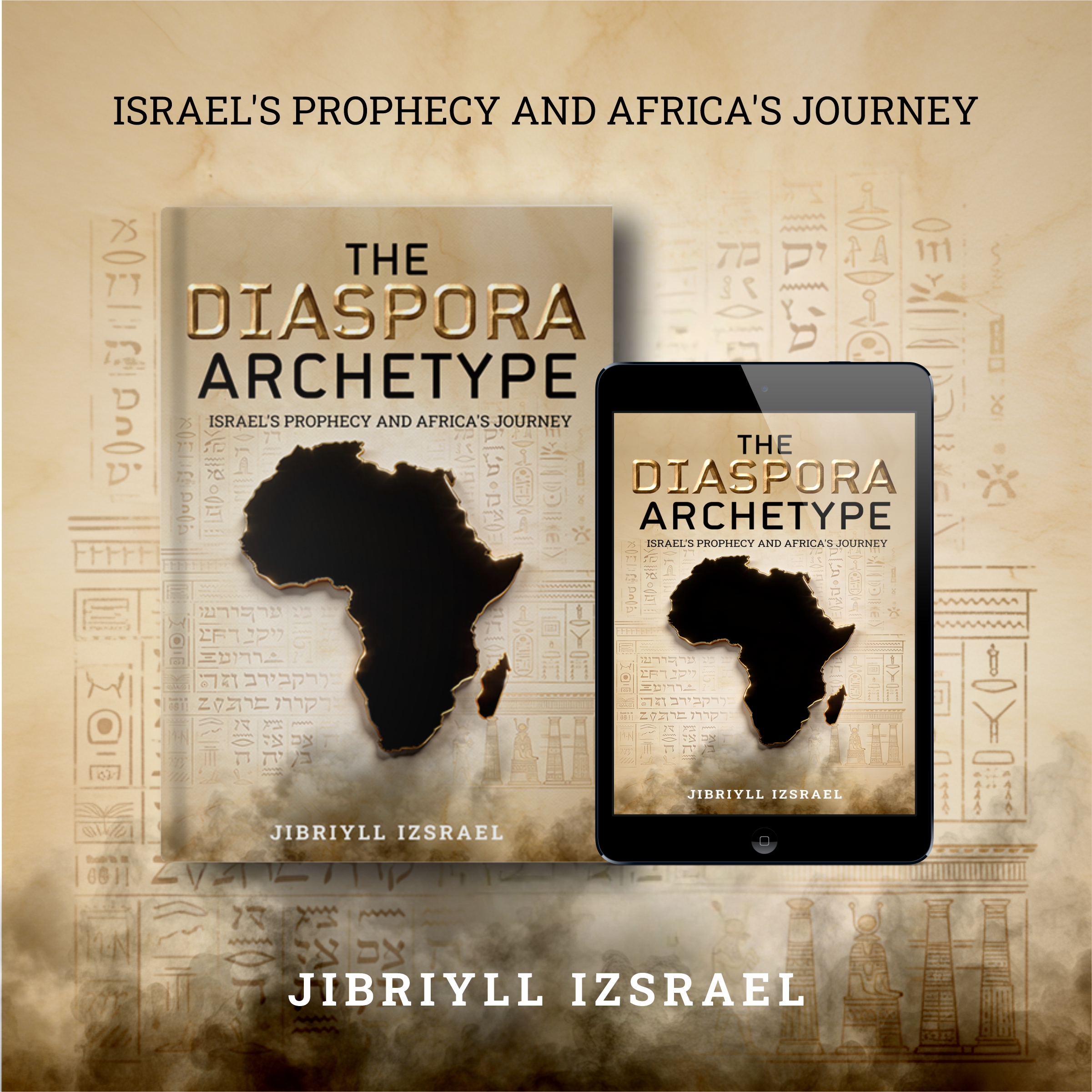
The Diaspora Archetype: Israel's Prophesy and Africa's Journey-Chapter 7
-
 By Jibriyll Izsrael
- 2026-03-17
The Diaspora Archetype Defined
The Diaspora Archetype: Israel's Prophesy and Africa's Journey-Chapter 7
“History is a pattern of timeless moments.”
— T. S. Eliot, Four Quartets
From Parallel to Principle
Across the preceding chapters, two historical experiences have unfolded in parallel:
The ancient Israelite journey through exile and restoration,
and the modern African diaspora’s passage through dispersion, survival, and renewal.
These narratives have not been presented as identical histories,
but as recurring structures—
manifestations of a deeper moral logic at work within human affairs.
The task of this chapter is to name that logic.
What has thus far appeared as analogy must now be clarified as concept.
The Diaspora Archetype is not a metaphor of resemblance,
but a pattern of recurrence—
a structural sequence through which peoples, when violently displaced yet ethically resilient,
transform suffering into civilization.
An archetype, in this sense, is not myth divorced from history.
It is history revealing its underlying grammar.
Defining the Diaspora Archetype
The Diaspora Archetype describes a fourfold movement observable wherever a people is scattered yet refuses dissolution:
Scattering
Violent displacement from land, institutions, and sovereignty.
Endurance
Survival through memory, adaptation, and communal discipline.
Remembrance
Reconstruction of a moral charter that explains loss and assigns purpose.
Reconstruction
Creation of institutions that translate memory into law, economy, and culture.
This sequence does not unfold mechanically or uniformly.
It matures across generations, often unevenly and under pressure.
Yet wherever the archetype completes its cycle,
a people emerges not merely restored, but refined—
capable of articulating ethical insight forged in exile
and applying it to the work of design.
Scattering as Historical Catalyst
Displacement initiates the archetype.
Whether by conquest, enslavement, or extraction, scattering strips a people of territorial coherence.
Yet it does not erase identity—
it externalizes it.
Culture, no longer anchored in place, is carried in bodies, rituals, and stories.
In both Israelite and African diasporic experiences, scattering functioned as a brutal teacher.
It exposed the fragility of power divorced from justice
and forced the displaced to confront enduring questions:
Who are we without land?
What survives when institutions collapse?
The diaspora begins where geography fails—
but memory endures.
Endurance Through Translation
Survival in exile requires adaptation.
Endurance is not stasis—
it is translation.
Language bends.
Ritual evolves.
Institutions are improvised.
Hebrew psalms became oral laments.
African cosmologies found refuge within Christian hymns and Islamic devotion.
Forms shifted—
but ethical substance persisted.
This capacity to translate without dissolving distinguishes diasporic endurance from mere survival.
Those who endure do not simply persist—
they preserve coherence under pressure.
Endurance thus becomes discipline:
The art of remaining oneself while becoming intelligible within hostile systems.
Remembrance as Moral Constitution
Exile compels remembrance.
Separated from territorial law, the scattered reconstruct a moral charter capable of traveling with them.
For ancient Israel, this charter was Torah.
For the African diaspora, it emerged through:
Spirituals.
Sermons.
Manifestos.
Movements.
Memory becomes constitution.
It defines boundaries of meaning where borders no longer exist.
Through ritual repetition and narrative transmission, trauma is transformed into testimony.
Loss is not denied—
it is given direction.
At this stage, remembrance ceases to be retrospective
and becomes directive.
It answers not only where we came from—
but what we are now obligated to build.
Reconstruction as Collective Project
The final movement of the archetype is reconstruction—
the translation of moral memory into structure.
Endurance matures into organization.
Ethics seek embodiment in:
Schools.
Cooperatives.
Churches.
States.
Cities.
Post-exilic Judaism rebuilt law and community without sovereignty.
The African diaspora built institutions within and against empire.
In both cases, survival ethics evolved into systems of governance, education, and economy.
Reconstruction reveals the archetype’s deepest truth:
Exile, when metabolized, produces architects.
The Archetype as Sociological Model
From a sociological perspective, the Diaspora Archetype can be understood as a cycle of identity reconstruction under duress:
Disruption
Violent rupture of cultural continuity.
Legitimization
Creation of narratives that preserve dignity and explain suffering.
Organization
Institutional embodiment of those narratives.
Projection
Transformation of survival ethics into universal principles.
Through this cycle, the suffering of one people becomes instruction for many.
The African diaspora’s struggle generated concepts—
civil rights,
nonviolent resistance,
cultural pluralism—
that reshaped global moral discourse.
Exile produced conscience.
Text, Voice, and the Architecture of Memory
Texts—written, sung, or spoken—function as the architecture of remembrance.
Torah scrolls, spirituals, pamphlets, newspapers, and digital platforms all serve the same purpose:
Stabilizing identity through language.
Literacy becomes sacrament.
To read and write is to claim authorship over destiny.
From Garvey’s Negro World to contemporary transnational media,
diasporic texts extend covenant into public space.
Memory ceases to be private—
and becomes shared law.
Ethical Universality
The Diaspora Archetype ultimately transcends ethnicity.
Its moral logic—that justice is clarified through displacement and empathy refined through suffering—
has shaped international human-rights discourse and postcolonial ethics.
Just as Hebrew prophets spoke beyond Israel,
the descendants of the Middle Passage articulated principles that challenged power everywhere.
Their historical wounds became moral instruments.
The archetype fulfills itself when survival becomes conscience for the world.
Contemporary Expressions
In the present era, the Diaspora Archetype manifests across three converging domains:
Cultural Renaissance
Global Black art and thought reassert aesthetic sovereignty.
Technological Solidarity
Digital networks reconnect dispersed intellect and capital.
Political Re-assembly
Continental and diasporic institutions echo ancient assemblies of law.
Each represents a modern iteration of covenant renewal—
memory disciplined into action.
Conclusion — The Law Written on the Heart
The Diaspora Archetype endures because it resolves history’s deepest paradox:
That loss can generate law,
and exile can produce vision.
In both the Israelite and African experiences, bondage refined conscience and remembrance prepared leadership.
When dispersed peoples recover their ethical grammar and inscribe it into institutions,
they become living texts—
walking covenants whose existence testifies that civilization advances not by conquest alone,
but by conscience carried across generations.
The chapters that follow move from definition to demand—
from archetype to application—
asking how gathering, sovereignty, and restoration can now be deliberately constructed.
Support the Work
If this chapter resonated with you, consider supporting the African American Union.
Your support helps expand education, economic cooperation, and cultural development within our community.• Become a member
• Support the Union store
• Share this chapter
• Make a contribution
All net proceeds from the Sovereign Trilogy are dedicated to helping seed the African American Sovereign Wealth Fund, an initiative of the African American Union designed to strengthen economic cooperation and institution-building for future generations.
By supporting this work, readers help transform ideas into lasting infrastructure for our community.