
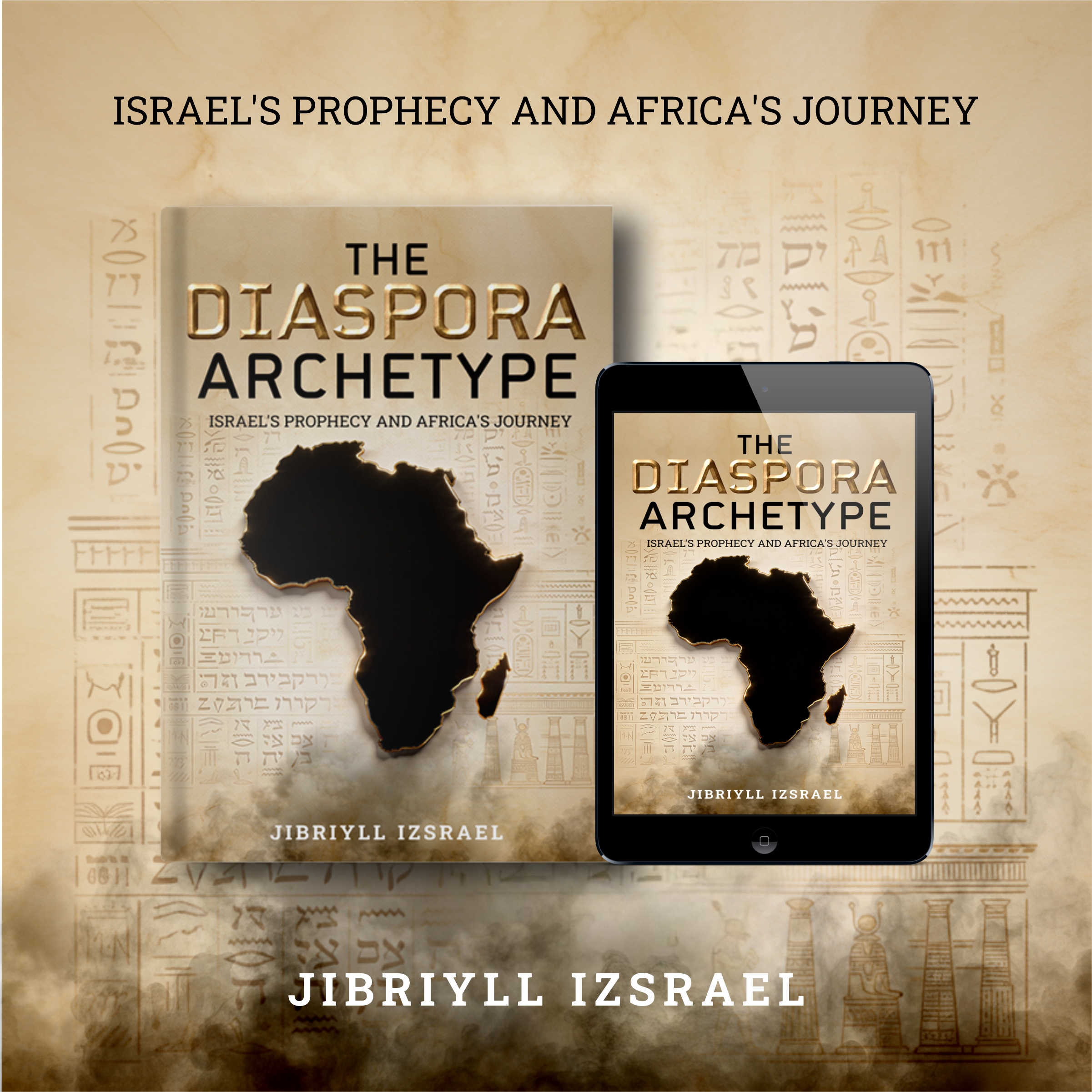
The Diaspora Archetype: Israel's Prophesy and Africa's Journey-Chapter 8
-
 By Jibriyll Izsrael
- 2026-03-17
The Age of Gathering — Networks, Movements, and the Reassembled World
The Diaspora Archetype: Israel's Prophesy and Africa's Journey-Chapter 8
“The scattered shall yet weave a single fabric of purpose.”
— Pan-African Congress Memorandum, Manchester, 1945
From Pattern to Momentum
Every archetype, once named, seeks completion.
Having passed through scattering, endurance, remembrance, and reconstruction, the diaspora enters a new historical register:
Gathering.
This is not a reversal of exile—
but its maturation.
What was once torn apart by force now learns how to assemble by choice—
through intention, design, and shared ethical orientation.
The twentieth and early twenty-first centuries mark the threshold of this phase.
Political independence, civil-rights victories, and cultural renaissance prepared the ground.
Technology, mobility, and transnational consciousness supplied the means.
Gathering emerges not as prophecy fulfilled—
but as process inaugurated.
Post-Colonial Convergences
The wave of African independence beginning with Ghana in 1957 signaled more than the lowering of colonial flags.
It marked Africa’s re-entry into history as author rather than subject.
Yet the borders inherited from empire fragmented the continent into administrative units ill-suited for collective power.
Visionaries such as Kwame Nkrumah and Julius Nyerere recognized the danger:
Sovereignty without federation risks reproducing division at scale.
Their call for continental unity reframed gathering as necessity rather than sentiment.
The Organization of African Unity—and later the African Union—emerged as imperfect but indispensable laboratories where memory encountered governance.
Here, the Diaspora Archetype advanced:
Law remembered now sought coordination.
Diaspora Movements Beyond the Continent
Beyond Africa’s shores, parallel awakenings unfolded.
The American civil-rights struggle, Caribbean labor uprisings, and the anti-apartheid movement formed a single moral theater.
Ideas crossed oceans faster than armies.
Solidarity traveled where bodies could not.
Martin Luther King Jr.’s disciplined nonviolence echoed Nkrumah’s doctrine of positive action.
Malcolm X’s Organization of Afro-American Unity mirrored continental ambitions in miniature.
The logic was unmistakable:
If oppression was global in scope,
liberation had to be global in organization.
Gathering thus began as alignment of struggles—
a recognition that dispersed fronts could act as one moral force.
Culture as the First Network
Before satellites and digital cables, culture stitched the diaspora together.
Jazz improvisation, reggae’s bassline, and hip-hop’s cipher formed a transoceanic grammar of resistance and affirmation.
These were not mere styles—
they were systems of meaning encoding memory, critique, and hope.
Festivals, films, and literary movements functioned as informal summits.
Artists became diplomats of conscience,
translating political aspiration into shared feeling.
Through culture, the scattered learned to recognize one another again.
At this stage, gathering was emotional—
before it was institutional.
The Technological Turn
The digital revolution accelerated what culture began.
Fiber-optic networks, social platforms, and collaborative tools collapsed distance, enabling coordination without centralization.
Diaspora entrepreneurs now link:
Accra to Atlanta.
Nairobi to New York.
Kingston to Johannesburg.
Technology converts dispersion into advantage.
Where distance once weakened capacity,
it now multiplies it.
Crowdfunding replaces tribute.
Platforms replace intermediaries.
Data circulates where extraction once prevailed.
Gathering becomes architectural.
Networks are no longer metaphor—
they are infrastructure.
Knowledge as Common Territory
Universities, research consortia, and open-access platforms constitute a new kind of homeland:
Intellectual territory.
African and diaspora studies programs, virtual classrooms, and transnational conferences weave scholarship into federation.
Knowledge is no longer hoarded—
but harmonized.
Curricula converge.
Archives open.
Students share syllabi across oceans.
The mind becomes the first fully liberated space—
a Zion without walls,
entered by discipline rather than passport.
Economic Solidarity Reassembled
Remittances, diaspora bonds, cooperative finance, and ethical trade corridors reveal gathering at work in capital flows.
What once drained outward now increasingly circulates inward.
Prosperity is reimagined as shared architecture—
rather than isolated accumulation.
This recalls the covenant economy explored earlier:
Wealth as stewardship.
Exchange as mutual preservation.
Modern finance, disciplined by memory, begins—unevenly but unmistakably—
to serve restoration rather than extraction.
The World Learns the Diaspora’s Lesson
The significance of the Age of Gathering extends beyond African peoples alone.
In a fractured world facing ecological crisis, mass migration, and technological disruption,
the diaspora’s hard-earned strategies—
cooperation across distance,
unity without uniformity—
offer templates for global survival.
What was once burden becomes instruction.
The archetype universalizes itself.
Conclusion — Toward a Reassembled World
The Age of Gathering does not promise final harmony.
It inaugurates responsibility.
Networks must be governed.
Movements must be disciplined.
Memory must be continually translated into design.
Yet the direction is unmistakable.
What was scattered is learning how to assemble.
What endured is learning how to coordinate.
The diaspora stands not at the end of history—
but at the threshold of authorship.
The chapters that follow will press this gathering toward its most demanding expression:
Sovereignty made visible.
Ethics rendered spatial.
Memory engineered into city, law, and future.
The world, long divided, begins to study how wholeness is built.
Support the Work
If this chapter resonated with you, consider supporting the African American Union.
Your support helps expand education, economic cooperation, and cultural development within our community.• Become a member
• Support the Union store
• Share this chapter
• Make a contribution
All net proceeds from the Sovereign Trilogy are dedicated to helping seed the African American Sovereign Wealth Fund, an initiative of the African American Union designed to strengthen economic cooperation and institution-building for future generations.
By supporting this work, readers help transform ideas into lasting infrastructure for our community.