The Crime of Caring
India.Arie, Yung Miami, and the War Against Cultural Responsibility
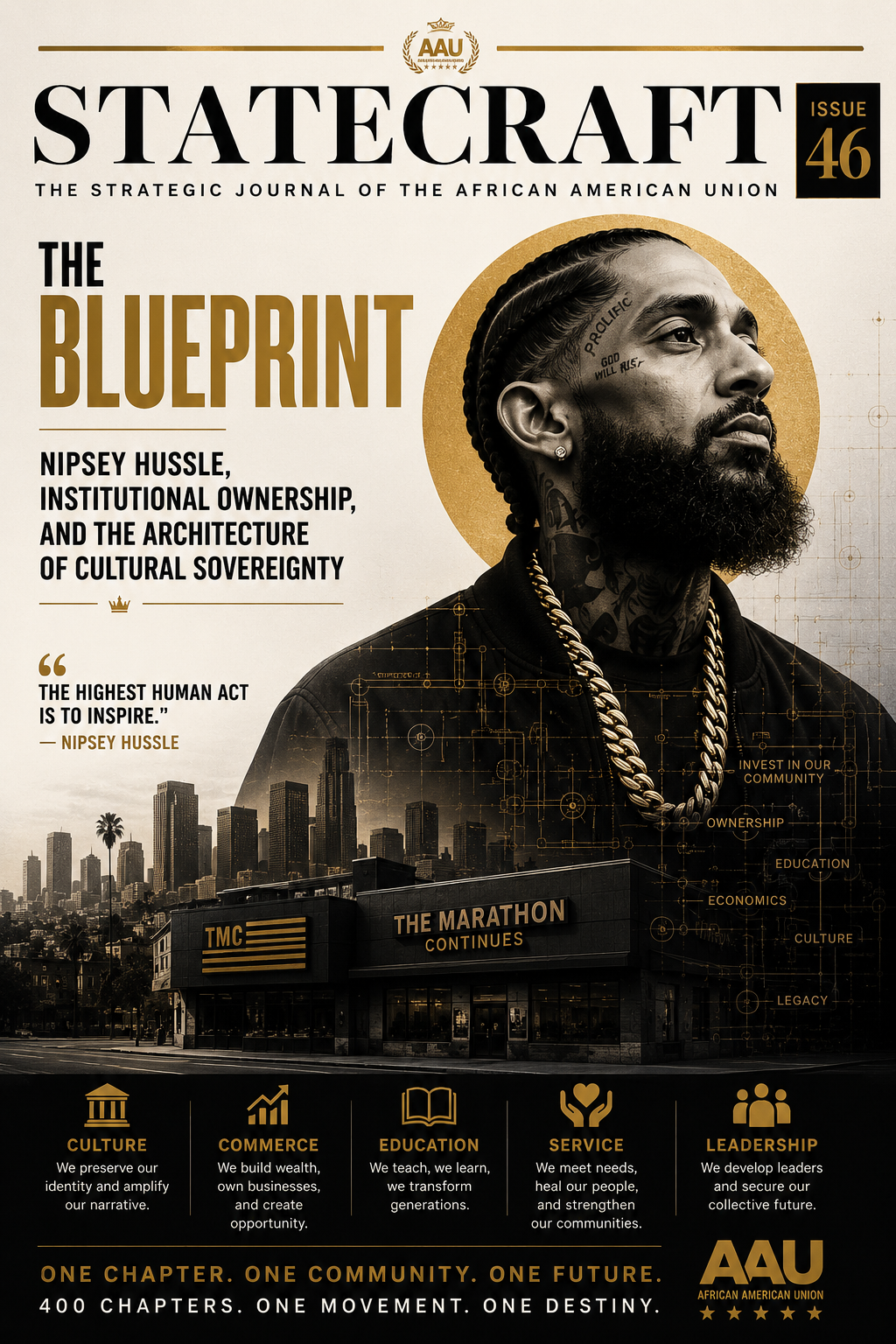
The Strategic Journal of the African American Union
Freedom is free. Liberation is not.
Opening Declaration
India.Arie did not expose a song.
She exposed a civilization struggling to remember that the artist is not merely a performer.
The artist is a steward of atmosphere.
And atmosphere is not harmless.
Every generation has songs.
Every generation has dances.
Every generation has scandal, laughter, provocation, contradiction, and release.
But every generation also has a moral environment.
A people do not only live beneath laws.
They live beneath sounds.
They live beneath images.
They live beneath repeated suggestions about who they are, what they should desire, what they should tolerate, and what they should become.
This is why culture matters.
Not because every lyric must be holy.
Not because every artist must be perfect.
Not because joy, sexuality, wealth, anger, or contradiction must be erased from expression.
Culture matters because it enters the nervous system before policy ever reaches the mind.
And when an artist dares to say so, the backlash reveals the crisis.
I. The Controversy Is Not the Controversy
India.Arie recently drew public criticism after expressing concern about the popularity and cultural message of Yung Miami’s song “Spend Dat.”
Arie objected not merely to the song itself, but to what its broad acceptance seemed to reveal about the deeper values being normalized through entertainment.
She later clarified that she was not calling for a boycott and that people are free to make their own choices.
Her central point was that what people listen to, see, and consume influences them.
That is the entire issue.
Not censorship.
Not elitism.
Not generational jealousy.
Not “old heads hating on the youth.”
Influence.
India.Arie said what elders, teachers, parents, mentors, and wounded children have known for generations:
Culture is not harmless.
That statement should not be controversial.
But in a civilization trained to confuse consumption with freedom, even the gentlest call for discernment can be treated like oppression.
That is why this moment matters.
The issue is not simply India.Arie versus Yung Miami.
The issue is not neo-soul versus rap.
The issue is not respectability versus ratchet culture.
The issue is not whether one song should exist.
The real issue is this:
Who is allowed to care about what culture is doing to the people?
That is the war.
II. The Crime of Caring
There is a strange punishment reserved for those who care too much.
They are told they are judgmental.
They are told they are outdated.
They are told they are bitter.
They are told they are policing joy.
They are told they do not understand the moment.
But often, what they actually understand is consequence.
To care about culture is to recognize that people are not machines.
We are impressionable.
We are rhythmic.
We are emotional.
We are mimetic.
We become what we repeatedly rehearse.
A song can comfort.
A song can awaken.
A song can sedate.
A song can normalize decay.
That does not mean every listener becomes a criminal because of a lyric.
That is too simplistic.
But it does mean repeated cultural exposure shapes appetite, tolerance, imagination, identity, and expectation.
Before a people accept a condition, they often hear it normalized.
Before a people defend a system, they often see it glamorized.
Before a people surrender to despair, they often sing it back to themselves.
Culture is rehearsal.
This is why caring has become dangerous.
Because the person who cares interrupts the trance.
III. India.Arie as Witness, Not Prosecutor
India.Arie should not be framed as the prosecutor of Yung Miami.
That framing is too small.
She is better understood as a witness.
A witness does not have to hate the accused.
A witness does not have to condemn the entire room.
A witness simply says:
I saw something.
I heard something.
I recognize what this means.
India.Arie’s career has long been associated with self-worth, healing, spiritual dignity, womanhood, and interior freedom.
Her critique did not emerge from nowhere.
It came from an artistic lineage that has always treated music as more than entertainment.
That lineage says the artist carries atmosphere.
The artist can create a room where a child feels beautiful.
The artist can create a room where a wounded person remembers breath.
The artist can create a room where grief becomes language.
The artist can create a room where survival becomes sacred.
But the artist can also create a room where self-destruction feels fashionable.
That is the burden of influence.
And influence is power.
IV. Yung Miami Is Not the Whole Problem
It would be a mistake to make Yung Miami the entire object of critique.
One artist did not create this condition.
She inherited an industry.
She inherited an algorithm.
She inherited a market.
She inherited a reward system.
She inherited an audience trained to confuse spectacle with liberation.
The system rewards what travels fast.
Shock travels fast.
Sex travels fast.
Violence travels fast.
Humiliation travels fast.
Luxury fantasies travel fast.
Degradation, when set to the right beat, travels very fast.
The question is not why one artist made one song.
The question is:
Why does the machine reward certain messages so efficiently?
Why does the culture amplify some expressions of Black womanhood and ignore others?
Why are healing, motherhood, discipline, spiritual beauty, and moral courage so often treated as boring, while chaos is treated as authenticity?
Why do we call destruction “real,” but construction “corny”?
That is the sickness.
Yung Miami is not the civilization.
She is a signal inside the civilization.
India.Arie heard the signal and named the atmosphere.
That is why the reaction was so intense.
V. The False Choice: Freedom or Responsibility
The public debate around culture often collapses into a false binary.
On one side, there are those who say:
“Artists should be free to say whatever they want.”
On the other side, there are those who say:
“Artists should be restricted, shamed, or silenced.”
ALI 400 rejects this binary.
Freedom is real.
Artists must be free to depict pain, pleasure, contradiction, rage, desire, poverty, trauma, humor, rebellion, and survival.
But responsibility is also real.
Freedom without responsibility decays.
The question is not whether artists should be allowed to create.
The question is whether artists are willing to understand what creation does.
The mature artist does not ask only:
Can I say this?
The mature artist also asks:
What atmosphere does this create?
What appetite does this feed?
What wound does this reopen?
What future does this train the listener to expect?
What kind of child is formed beneath this repetition?
That is not censorship.
That is stewardship.
VI. The Artist Is Not Merely a Performer
Modern entertainment has reduced the artist to a content producer.
The artist is told to generate.
Trend.
Convert.
Monetize.
Go viral.
Stay visible.
Stay controversial.
Stay clickable.
But the older understanding of the artist was much greater.
The artist was a keeper of memory.
A translator of pain.
A carrier of ancestral rhythm.
A custodian of language.
A builder of emotional worlds.
The artist did not merely entertain the village.
The artist helped the village feel.
And what a people are taught to feel determines what they become willing to build.
This is why the artist is dangerous.
Not because the artist holds office.
Not because the artist signs legislation.
Not because the artist commands an army.
The artist governs before government.
The artist governs at the level of desire.
VII. Why ALI 400 Requires an Oath
This is why ALI 400 Chapter 12: The Oath & Code of Alignment is not symbolic.
It is not decoration.
It is not branding.
It is a civilizational safeguard.
The ALI 400 Oath begins with a simple recognition:
Influence is power.
And power demands responsibility.
That recognition is the missing center of the current debate.
Without an oath, influence becomes appetite.
Without a code, talent becomes volatility.
Without alignment, culture becomes chaos.
ALI 400 does not demand that artists become saints.
It demands that artists become conscious of power.
It asks the artist to understand that the stage is not neutral.
The microphone is not neutral.
The camera is not neutral.
The hook is not neutral.
The algorithm is not neutral.
Everything trains.
Everything teaches.
Everything deposits something into the moral bloodstream of the people.
For this reason, ALI 400 requires an oath.
Because when culture moves faster than conscience, the oath slows the hand.
It asks:
Is this construction?
Is this clarity?
Is this healing?
Is this truth?
Is this discipline?
Is this necessary?
Is this aligned?
That is not artistic imprisonment.
That is artistic adulthood.
VIII. The Code of Alignment as Cultural Infrastructure
One artist’s conscience is not enough.
India.Arie can speak.
Lauryn Hill can warn.
KRS-One can teach.
Wise Intelligent can diagnose.
Reconcile can minister.
Chance can testify.
Tupac can haunt the conscience of the culture from beyond the grave.
But isolated voices cannot carry an entire civilization.
The culture does not merely need better opinions.
It needs infrastructure.
That is what the ALI 400 Code of Alignment provides.
It converts concern into standard.
It converts standard into discipline.
It converts discipline into training.
It converts training into institutions.
It converts institutions into continuity.
This is the difference between outrage and architecture.
Outrage says:
“This is wrong.”
Architecture says:
“Here is the system that prevents the wrong from governing the future.”
ALI 400 is not interested in temporary moral panic.
It is interested in permanent cultural construction.
IX. The Backlash Reveals the Crisis
The backlash against cultural responsibility reveals how deeply the crisis has matured.
Many people no longer reject only the standard.
They reject the right to name the need for a standard.
This is dangerous.
A people can survive disagreement.
A people can survive debate.
A people can survive generational tension.
But a people cannot survive the total collapse of discernment.
When the culture attacks every healer, mocks every elder, commodifies every wound, and sells every appetite back to the people as identity, then the crisis has moved beyond entertainment.
It has become governance.
And that governance is hostile.
It tells the wounded child:
Your wound is your brand.
It tells the young artist:
Your trauma is your market advantage.
It tells the community:
If it sells, it is valid.
It tells the people:
If the crowd repeats it, it must be culture.
No.
A crowd is not always a culture.
Sometimes a crowd is merely a market.
And markets do not raise children.
X. The Difference Between Depiction and Glorification
ALI 400 does not require artists to pretend suffering does not exist.
That would be dishonest.
The people have endured poverty, violence, abandonment, humiliation, predation, addiction, state neglect, industry exploitation, and spiritual exhaustion.
Art must tell the truth about these conditions.
But there is a difference between depicting the wound and decorating the wound.
There is a difference between telling the truth about destruction and making destruction aspirational.
There is a difference between testimony and seduction.
Depiction says:
“This is what happened.”
Glorification says:
“This is who we are.”
Depiction can lead to healing.
Glorification can freeze the people inside the injury.
That distinction is the battlefield.
XI. What We Must Refuse
We must refuse the idea that critique is hatred.
We must refuse the idea that standards are oppression.
We must refuse the idea that popularity equals legitimacy.
We must refuse the idea that Black pain must always be converted into entertainment.
We must refuse the idea that our daughters must choose between visibility and dignity.
We must refuse the idea that our sons must choose between authenticity and self-destruction.
We must refuse the idea that a beat can sanctify a message.
We must refuse the idea that because the market rewards something, the people must accept it as culture.
The market is not the ancestor.
The algorithm is not the elder.
The industry is not the village.
XII. What We Must Build
We must build a new cultural standard.
Not a standard of perfection.
A standard of alignment.
We need artists who can tell the truth without selling despair.
We need producers who can create beauty without manufacturing numbness.
We need platforms that elevate construction, not merely controversy.
We need youth programs that teach media literacy as survival training.
We need cultural councils that can critique without cruelty and correct without cowardice.
We need institutions capable of protecting artists from predatory markets and protecting communities from predatory messaging.
We need a culture where the artist understands:
My gift is not merely mine.
My influence enters others.
My freedom has consequences.
My voice creates atmosphere.
That is the standard.
That is the oath.
That is ALI 400.
XIII. India.Arie and the Burden of the Healer
There is a particular loneliness carried by healing artists.
They often see the wound before the crowd feels the infection.
They often name the danger before the danger becomes obvious.
They often endure mockery from the very people they are trying to protect.
That is the burden of the healer.
The healer is not always celebrated in the moment.
Sometimes the healer is accused of disturbing the party.
But if the house is filling with smoke, disturbing the party is mercy.
India.Arie’s comments should be received in that spirit.
Not as condemnation.
As alarm.
Not as superiority.
As grief.
Not as control.
As care.
And in a culture increasingly hostile to care, care itself becomes revolutionary.
That is why this issue is called:
The Crime of Caring
Because in an age of monetized numbness, to care is to interrupt the economy of decay.
XIV. The ALI 400 Response
ALI 400 does not respond to this moment by attacking artists.
It responds by organizing them.
It responds by teaching.
It responds by training.
It responds by building platforms, curricula, chapters, studios, youth programs, mentorship pipelines, and cultural standards.
It responds by saying:
The artist is not disposable.
The youth are not disposable.
The community is not disposable.
The wound is not a business model.
The culture is not a landfill.
The microphone is a trust.
The stage is a responsibility.
The song is a seed.
And seeds become worlds.
XV. Final Declaration
India.Arie did not expose a song.
She exposed a civilization struggling to remember that the artist is not merely a performer.
The artist is a steward of atmosphere.
This is why ALI 400 requires an oath.
This is why culture must be aligned.
This is why construction must become the standard.
ALI 400 does not belong to personalities.
It belongs to purpose.
And purpose requires boundaries.
Culture without alignment is chaos.
Alignment without discipline is illusion.
Discipline without construction is failure.
We choose construction.
Call to Action
The African American Union is building a cultural, civic, and economic infrastructure capable of transforming concern into construction.
Join the work.
Read the Sovereign Trilogy.
Enter the Reparations Registry.
Become a Founding Member.
Help build the Union.
africanamericanunion.com
Freedom is free. Liberation is not.
Support the Work
If this issue resonated with you, consider supporting the African American Union.
Your support helps expand education, economic cooperation, and cultural development within our community.• Become a member
• Support the Union store
• Share this issue
• Make a contribution
All net proceeds raised from the Statecraft newsletter are dedicated to helping seed the African American Sovereign Wealth Fund, an initiative of the African American Union designed to strengthen economic cooperation and institution-building for future generations.
By supporting this work, readers help transform ideas into lasting infrastructure for our community.

Jibriyll Izsrael
Contributor at African American Union.